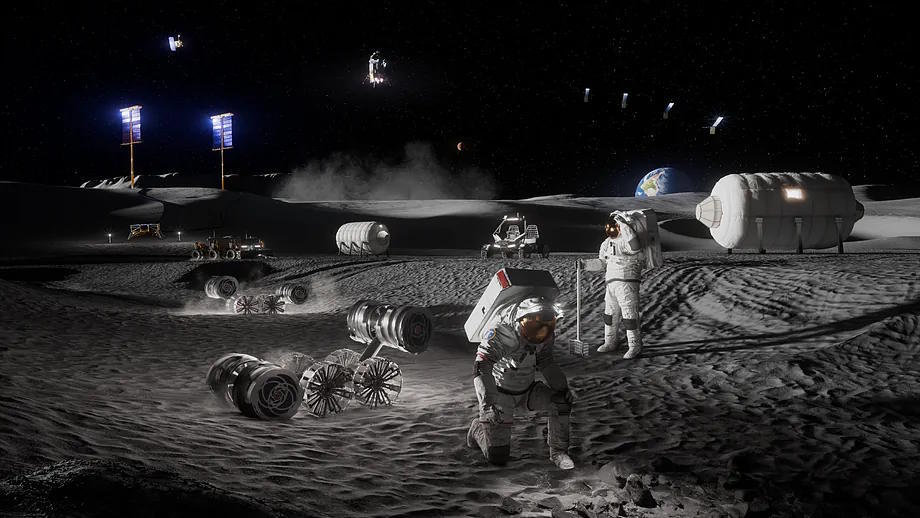
The construction of the first US lunar base, announced last March under the Artemis program, was set to begin next September with the launch of a moon landing module aboard the New Glenn rocket, Jeff Bezos' most powerful rocket. However, a spectacular explosion during an engine test on the ground at the Cape Canaveral launch pad on May 28 put on hold the ambitious schedule outlined by NASA to beat China in establishing the first settlement on our satellite.
Bezos' super rocket's destruction occurred the same week NASA had announced that his company, Blue Origin, would be a strategic partner in building the settlement planned near the south pole, where abundant ice - essential for water and fuel - and other resources like helium-3 are believed to be present.
This Tuesday, NASA Administrator Jared Isaacman and Lunar Base Program Director Carlos García-Galán detailed the next round of awards for new moon landing module missions scheduled for late 2028, granted to Astrobotic, Intuitive Machines, and Firefly, and reiterated their strong support for Bezos' company, Blue Origin, which they continue to rely on for the construction of their lunar base. The first launch would carry the Blue Moon Mark 1 Endurance lunar module, delivering payloads for NASA to the lunar surface.
Amid the World Cup celebrations, a highlight was NASA's director's promise to send a championship ball to the Moon if the US wins the title. The ball would be transported along with scientific instruments by a robotic vehicle as part of the lunar base program. "It's quite light, and I believe we can accommodate it without any issues, so it all depends on the men's team," joked García-Galán. The US has already sent a World Cup ball to the International Space Station (ISS).
Regarding the lunar base development, agency officials hope that the New Glenn rocket will be ready to launch again by the end of the year, as Bezos intends: "Blue Origin has responded to the anomaly [with their rocket] in an impressive manner," noted Isaacman, highlighting progress in investigating the cause of the explosion that damaged the company's sole launch pad.
"Plan A remains to launch [the lunar module Blue Moon Mark 1 Endurance] with the New Glenn rocket; they are very committed to achieving this by the end of the year," stated the agency director, reiterating what was said after the explosion: to realize the Artemis program and overcome any setbacks, NASA will play an active role alongside its partners, as was done in the 1960s during the Apollo era.
According to Carlos García-Galán, even if the New Glenn launch were delayed until mid-2027, it would not impact the lunar base. However, he mentioned that if the rocket were not ready or Blue Origin's launch pad not rebuilt within the expected timeframe, "they would explore other launch options" to send Bezos' moon landing module to the Moon.
During Tuesday's event, NASA revealed the three companies chosen to carry out the planned moon landing missions by late 2028. Astrobotic, Firefly Aerospace, and Intuitive Machines will receive a total of nearly $600 million to transport scientific payloads from the agency to the lunar surface.
As detailed by NASA, Astrobotic will receive $297.9 million for two deliveries, while Firefly Aerospace will get $144.2 million and Intuitive Machines $148.3 million for one delivery each.
These missions are part of the CLPS initiative (Commercial Lunar Payload Services), a cornerstone of the Lunar Program. Each company will use updated versions of landing module designs that have flown before, allowing for increased mission frequency.
Additionally, NASA officials mentioned that they are considering repurposing a Mars rover, nicknamed Promise, for use on the Moon.
The development of the US lunar base will proceed in three phases. The first phase involves 21 landings that will deliver 4,000 kilograms of components to test technologies on the lunar surface. The second phase, between 2029 and 2032, will include 24 landings transporting 60,000 kilograms of cargo to establish basic lunar infrastructure. Habitats for astronauts to live in will arrive in the third phase starting in 2033, with 28 planned landings and 150,000 kilograms of payload on the surface.
The initial launches, emphasized by the two NASA officials, will serve to test all technologies and learn to live on our satellite: "We have ideas and are conducting all the tests we can on Earth, but the Moon is a different playing field. That's why we want to launch as much as we can to experiment," stated Carlos García-Galán, describing the extreme environment the robots will have to survive, such as intense cold during the long lunar nights, and some of the numerous challenges ahead.
NASA estimates a total investment of $30 billion in its lunar base.