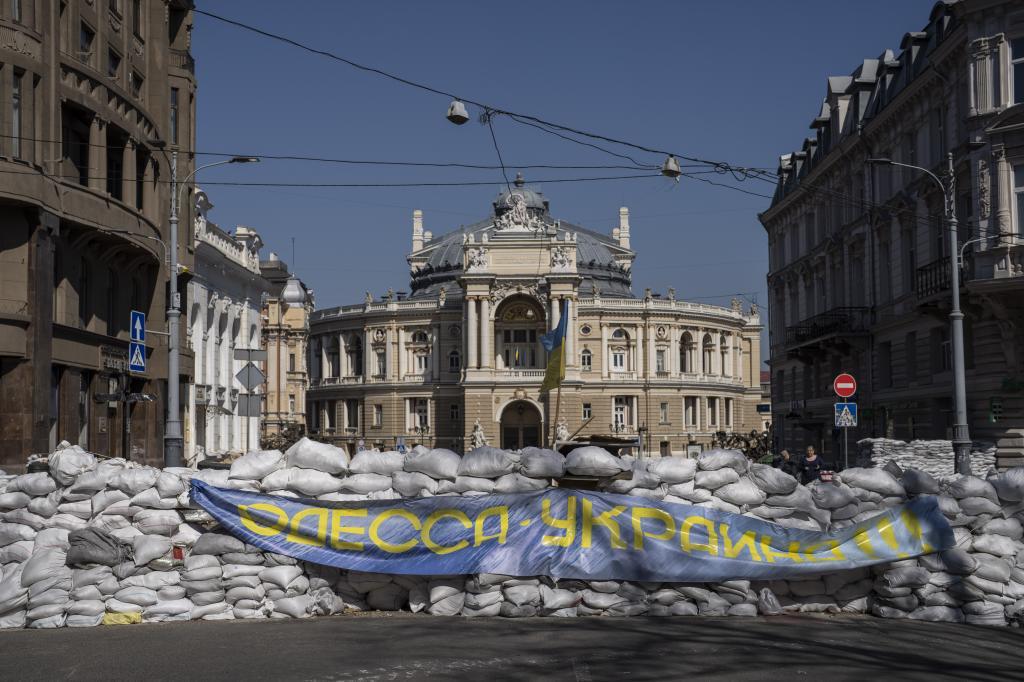
With Illia Razumeiko, it's never clear if he resorts to irony out of shyness or as an artistic resource. According to him, the fact that the artists of his company - including himself - frequently appear naked in their performances is simply a budgetary matter. "Imagine how much we save on costumes," he says. Last November, during the last performance of Gaia-24: Opera del Mondo in Kiev, the Ukrainian composer opted for something more discreet: a kind of fringed purple robe and a globe similar to those used in schools.
Razumeiko's aesthetic choices are always as unique as the performances he conceives. The opera combines Ukrainian musical tradition with a completely atypical staging, where performers completely naked walk among the audience seats, then come out in the same manner - without clothes - to play violins, cellos, harps, or drums, to continue with a mix of heavy metal or K-pop. As the composer and director explains in a meeting with a small group of reporters, Gaia-24 is the spearhead of one of his main objectives: "Deconstructing opera." The ultimate goal is to distance themselves from the omnipresent influence of Russian authors like Tchaikovsky, Rimsky-Korsakov, or Stravinsky, whose compositions were almost ubiquitous in the theaters of Soviet Ukraine. "Russia has always instrumentalized music and culture, in general, in favor of its interests. Every day Ukrainian compatriots keep dying, so right now we can't go back to Swan Lake. We have to move away from neocolonialism. I was educated in Russian, but as long as the Russians want to kill me, there will be no possibility of dialogue," he clarifies later in a conversation with La Lectura.
The effort of Razumeiko, his creative partner Roman Grygoriv, and the rest of the members of Opera Aperta is perhaps the most unique project in the Ukrainian musical scene to break ties with a school as significant as Russian opera, which reached its peak in the 19th century under figures like the aforementioned Pyotr Tchaikovsky or Nikolai Rimsky-Korsakov, his contemporary Modest Mussorgsky, or his 20th-century successors Sergei Rachmaninoff or Igor Stravinsky. While for some Ukrainian companies, such as the National Opera of Kiev or its counterparts in Lviv and Kharkiv, distancing themselves from Russian scores since 2022 has meant resorting to pieces from the classical legacy of Giuseppe Verdi or Georges Bizet, Opera Aperta's effort has taken them to remote places like the Aral Sea, Chernobyl, or the Cantabrian village of Silió, where Razumeiko traveled to document the mask festival celebrated in that village.
If Gaia-24 arose from the disaster caused by the Russian army's destruction of the Kajovka dam in June 2023 and its predecessor, Chornobyldorf (2020), from the Chernobyl nuclear catastrophe, the latest production of Opera Aperta, Modraniht, songs of the Winter War, premiered in May, is part of this trilogy dedicated to the gloomy legacy of "totalitarian regimes like the Soviet Union or Russia," in Razumeiko's words. "The Russian invasion made the post-apocalyptic utopia a reality. That's the spirit we want to reflect," explains the composer.
Acclaimed in recent years as one of the most innovative companies on the European stage, Opera Aperta became one of the awardees of the prestigious Music Theater Now last April, an institution dedicated to selecting the best novelties in this sector every three years. The jury of the award emphasized the iconoclastic nature of the Ukrainian group, which, according to their judgment, "expands the boundaries of musical theater." But Opera Aperta's creations are just part of the unique phenomenon that has forced Ukrainian opera to recreate its entire repertoire under the influence of a war that has ultimately given rise to an independent school from Moscow. "All our operas are connected to the environment, to the landscape, to history. Now, in times of war, reality changes rapidly. The earth breathes and suffers, pain intensifies, hearts harden," echoes one of the artists in the group, Marichka Shtyrbulova, to argue the almost ubiquitous presence of the conflict not only in new musical creations but in all contemporary culture of their country.
The influence of the conflict, indeed, is not limited to opera but has spread like an unstoppable trail through all sectors of Ukrainian culture. There is no week when their theaters do not host the premiere of a play performed by war veterans, or when their galleries and museums do not open exhibitions of painting, photography, or films based on war themes. The only Oscar that Ukrainian cinema has won in its entire history so far was in 2024 for the documentary "20 Days in Mariupol," by Mstyslav Chernov, which captured real images of the siege of that Ukrainian city. According to Kyiv Post columnist Miroslava Makarevich, the creative explosion witnessed in the country's effort to break ties with Russia does not mean that "Ukrainian culture is reborn, but it is reacting. Vitality is the result of trauma. It is an attempt to survive, to preserve identity, to resist oblivion."
However, the cultural divorce of two nations that have maintained an almost symbiotic relationship throughout their recent history is proving to be as complex as it is controversial. Renowned Ukrainian dancers Serhiy Kryvokon and Natalia Matsak - who were the principal soloists of the National Opera of Ukraine for 20 years - are now somewhat ostracized in their own country after participating earlier this year in a recreation of Swan Lake.
Although Matsak publicly apologized, the couple has decided to stay abroad due to the avalanche of criticism sparked by their performance. The dancer tried to explain in an opinion column and cited one of the challenges that, according to him, opera and ballet in their country face: "There is a lack of a competitive modern repertoire at an international level," he stated.
A few weeks ago, the Ukrainian capital hosted the premiere of "Mothers of Kherson," another piece inspired by the harrowing reality that this nation has had to face since the 2022 invasion. The president of Ukraine, Volodymyr Zelensky, and his wife Olena Zelenska attended the premiere of this artistic creation commissioned by the prestigious Metropolitan Opera in New York. In statements to local media, the head of the American institution, Peter Gelb, expressed satisfaction in "helping Ukraine show the world that Ukrainian art, whether in the form of music, theater, visual arts, or cinema, will not be undermined or crushed by Russian aggression."
Created by the Ukrainian composer Maksym Kolomiets and American playwright George Brant, "Mothers of Kherson" is based on the real story of two women from the southern city who embark on a journey of nearly 4,000 kilometers through various countries and territories controlled by Russia to rescue their daughters, who are held in Crimea. "This is the story of one of the deepest human traumas: the loss of children, violence against the defenseless, the destruction of families. Less than 500 children have returned to Ukraine out of the 20,000 kidnapped by the Russians," Kolomiets told Suspiline.
The Ukrainian author also supports the cancellation of works from Russia, although he admits that the Ukrainian alternative is still far from being able to overshadow the great names of the neighboring nation: "We should have dozens, even hundreds of operas competing with each other to completely forget about the Russians. But there aren't enough. It's a deep problem. It didn't start now, but it must be resolved immediately."