At 10:00 p.m., dozens of people are already gathered in the underground of the Heroes of Ukraine metro station. Lying on mats, foam rubber mats, tents, or inflatable beds.
Cristina Niluvova and her boyfriend Serhiy Chubirk explained that they had bought the whole set - a hammock and a mat - a year and a half ago. "At first, we brought sofa cushions, but it was very uncomfortable to sleep like that," said the 23-year-old woman.
The couple had chosen that shelter because of its proximity to their home. The girl showed an image of the first attack the capital had already suffered: a drone that hit a central hotel.
"It's next to our house!" exclaimed the girl.
The conversation - which took place on the street, at the entrance to the subway - was abruptly interrupted when the Ukrainian received an alert on her phone. The official app that informs about air threats had just announced that a Russian rocket was heading towards the metropolis.
"It's a ballistic missile, run, run!," shouted the Ukrainian heading towards the underground and dragging another half dozen residents who preferred to enjoy the fresh night air.
Cristina is a graphic designer by profession but, like a large contingent of Ukrainians, she has had to familiarize herself with military jargon and data completely unrelated to her specialty. "We know that with a ballistic missile coming from the north, we have only two minutes to seek shelter. Our house is six minutes away, so we have to sleep here," she pointed out.
"We have spent half the year sleeping at least a few hours in this same metro. We already form a community. We all know each other, because it's always the same people," she added.
The conversation was cut short again when the real wave of explosions began, around 2:00 in the morning. Driving through Kiev at that hour was like crossing a nearly deserted village, shaken by explosions and flashes of light and some bursts of machine gun fire, marking the action of the units trying to shoot down the drones.
The only vehicles circulating in the center were ambulances, police, or rescue teams. A contingent tried to contain the fire at the Residencia Cityhotel apartment building, an effort that was thwarted by the alarms and allowed the flames to devour a significant part of the multi-story building.
The war in Ukraine is one of the few conflicts where bombings can be anticipated. Long before the missiles started falling, local telegram channels were already warning about the next phase the population would face: "The drone attack, which has been going on for over an hour, is just the beginning. It's time to seek shelter. The Russians are depleting the air defenses, and barrages of ballistic and cruise missiles are expected," read one of the messages.
The President himself, Volodymyr Zelensky, who is currently in Ireland, had warned about the imminent attack during a press conference.
"We have very concerning information about the preparation of a massive Russian attack. I urge our people to take extreme precautions and take care of themselves and their children. Protect your families and use the shelters," he declared alongside the local government chief, Mikhol Martin.
Zelensky added that he was preparing to return to Ukraine "urgently" due to the impending emergency.
The massive Russian aerial offensive, which lasted for 11 hours, left at least 17 dead and nearly a hundred injured, according to the mayor of the city, Vitali Klitschko.
The Ukrainian Air Force specified that Moscow had launched almost 500 drones and 74 missiles against the country's main urban center.
The latest onslaught followed the pattern of the attacks organized by Moscow in June and marks a new tactic of its forces, which now concentrate the launch of most missiles in a single barrage and against a single city, in this case, Kiev. A dynamic that confirms the escalation of what is already being called the "War of the Cities."
During the attacks on June 2 and 15, the Russian Air Force used over 600 drones and nearly 70 missiles, according to the count by The Kyiv Independent.
Russia now more frequently resorts to hypersonic ballistic missiles, much more challenging to intercept.
"In 2022, cruise missiles accounted for approximately 70% to 80% of Russia's rocket attacks. This has changed. Russia is now betting everything on ballistic missiles. Cruise missiles have shifted from being a means to deplete air defenses," commented expert Kostiantyn Kryvolap to the same local media.
The increased use of the feared hypersonic missiles is also based on Ukraine's improved defensive capability against drones like Shahed or Gerbera, even when they are now jet-powered devices.
According to statistics from the Ukrainian Ministry of Defense, their forces usually destroy 90 percent of the drones launched by Russia, and that rate has even reached 95 percent on some days.
On the contrary, more than half of the missiles are capable of hitting their targets. In May, for example, only 53 percent were shot down.
After the attack, the Foreign Minister, Andriy Sybiha, once again urged Ukraine's allies to send more interceptor missiles, one of the main shortcomings of the Ukrainian air defense.
Of the thirty locations that suffered damage in the capital, the most chilling incident of the night occurred in the Darnytskyi district in the east of the city.
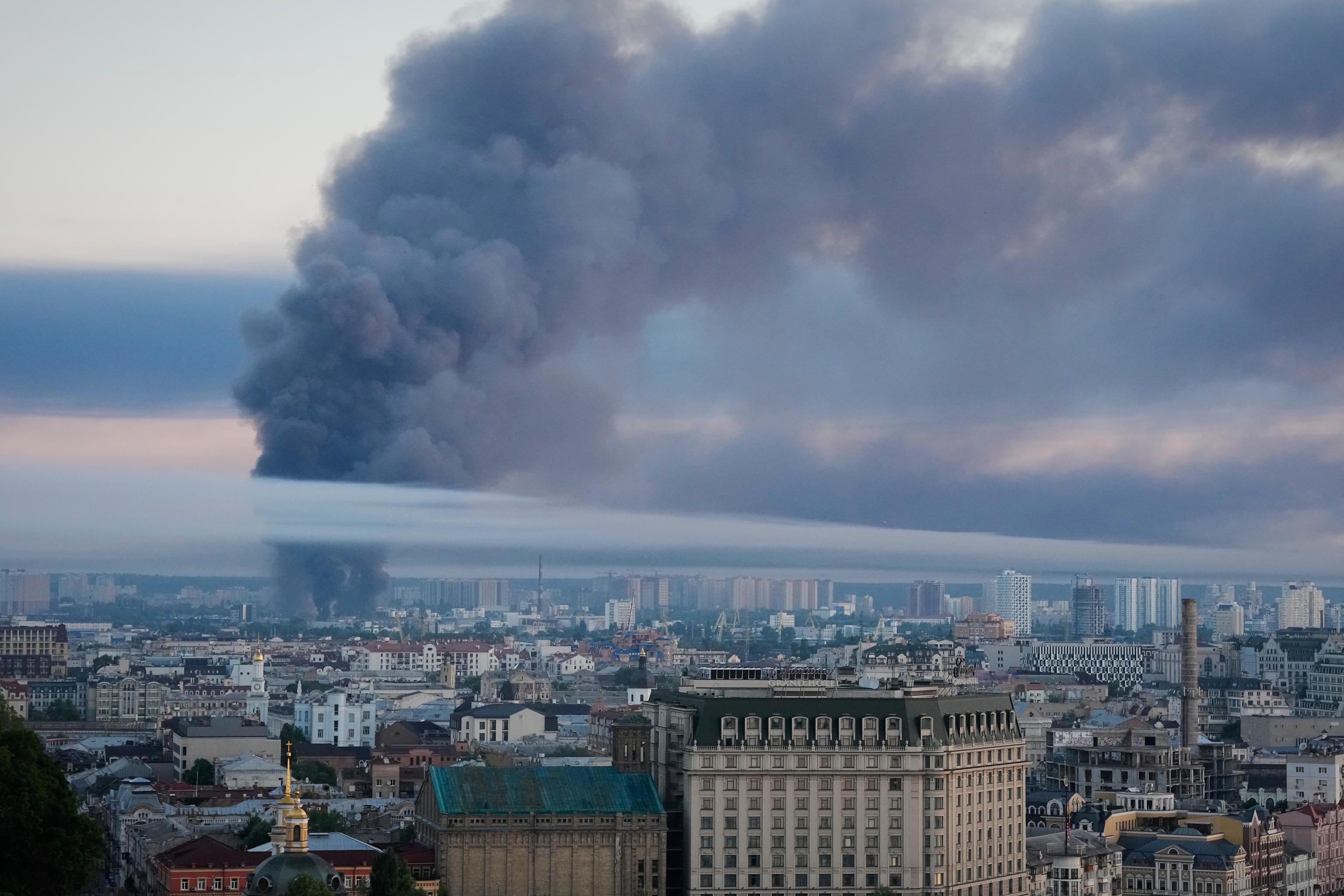
From the road leading to that district, a huge smoke cloud could be seen rising from the fire in a warehouse in the Obolon area, which covered part of the capital's sky.
In Darnytskyi, a section of a 9-story residential building was literally crushed by a missile. The mayor, Vitali Klitschko, arrived at the scene and said that rescue teams were still searching in the morning for several residents of the dwelling, including a 15-year-old girl and her family.
Excavators were trying to dig through the rubble pile while a robot removed the numerous cars that were destroyed.
Hundreds of residents wandered around trying to recover from hours of horror.
Vitaly Cherchuk, 47, had already lost his home in Konstantinivka - in Donbass - earlier this year under the brutal Russian offensive in that region of the country. Now he has been left homeless again. He lived just meters from the one that was razed by the missiles.
"We were in the shelter. We hid at 10:30. We know these things are no joke. We heard a first explosion at 3:45 that blew open the bunker door, but the second one was huge. All the walls shook," he said, sitting in a corner with his wife, two daughters, and the few belongings he managed to gather from his home in several bags and backpacks.
"I don't understand the Russians. They just want to destroy and kill people senselessly," he added.
In another nearby building, neighbors were busy cleaning the stairs and houses with shattered windows or stacking the doors torn off by the blast wave.
Mykola, 63, was still overwhelmed by emotion. His voice was about to break, and his eyes were watery. "We saw a huge ball of light next to the explosion," he said.
He couldn't hide his anger either. "I would love to tear Putin to pieces," he concluded.