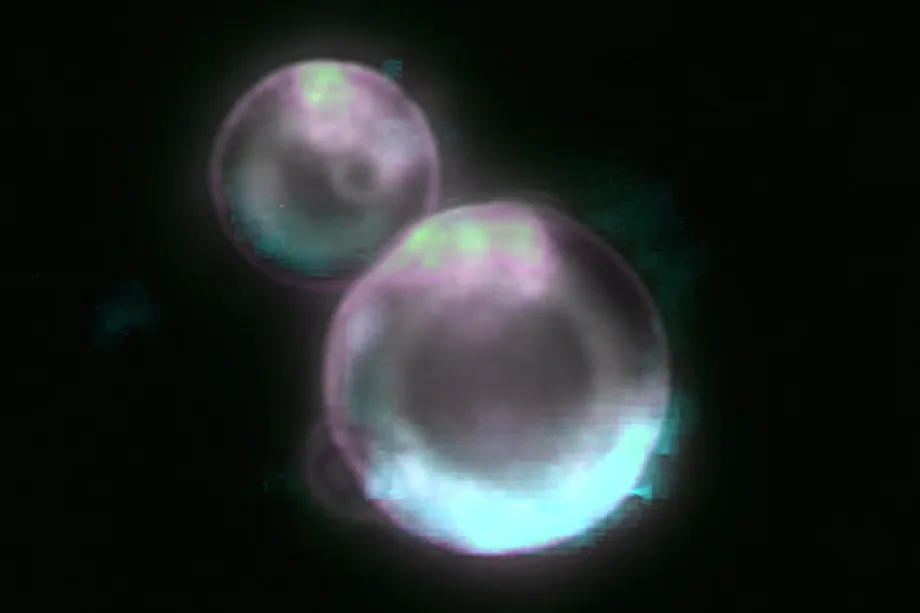
A team of American scientists has announced the creation of a synthetic cell capable of carrying out essential functions such as birth, feeding, growth, or replication. Instead of following the usual scientific channels, the discovery has not been published in any scientific journal but has been disseminated by its authors, scientists from the University of Minnesota (USA), through the team's website.
The work, as explained by Science News, was rejected by the journal Cell and is pending peer review, the usual procedure for publishing scientific novelties.
Named SpudCell, this synthetic cell incorporates an artificial genome of around 90,000 base pairs, a genome much smaller than that of a human cell. However, this material of chemical compounds allows for various functions, such as replication, as indicated by the authors.
Scientist Kate Adamala, one of the project's leaders, has stated that her group has managed to reproduce "what was previously only possible in biology: the complete set of behaviors of a cell."
"The most fundamental functions of life, such as growth and replication, do not require a mysterious magical spark," she added.
Nevertheless, the scientists acknowledge in the document that some of the described cellular functions are still imperfect. "It is not as robust, fast, or efficient in most of its functions as a natural cell, but it is a proof of concept that molecules can reconstitute behaviors that we have so far only associated with natural living cells," Adamala pointed out.
Several specialists in the field consider the announcement to be a significant advancement for synthetic biology, although they emphasize the need to interpret it with caution, as the work has not undergone the usual peer review process.
According to Víctor de Lorenzo, Research Professor at the CSIC at the National Center for Biotechnology, the work is "technically sound and an important technological advancement, but it is by no means the creation of life in the laboratory, a claim that is clearly exaggerated. Life de novo is not created at any point. What is demonstrated is the ability to manually assemble, using biochemical components and preexisting cellular parts, a system similar to a cell that reproduces some of its functions. In that sense, the study marks a milestone; but a milestone in biological engineering should not be confused with a milestone in the origin or creation of life," he stated in comments to SMC Spain.
Also, Manuel Porcar, leader of the Biotechnology and Synthetic Biology group at the University of Valencia (I2SysBio) and founder of the company DARWIN, pointed out that, although it is "a very spectacular advancement," it is not exactly an artificial cell, "but a cell-like system, with a very small genome and basic metabolic capabilities. However, the 'cell' requires an external supply of many components, including ribosomes, and does not yet have consistent reproduction. It will be very interesting to see if future versions of this development are more independent and can pass on their genome to offspring more effectively."
On the other hand, Juli Peretó, Professor of Biochemistry and Molecular Biology at the University of Valencia, first points out that Adamala, the main person in charge of the project, "is well-known in the field of synthetic biology and has many international initiatives; she is a person with a lot of drive. The work they are making public through this somewhat unorthodox way—not through a journal, but through a preprint platform and without peer review—is an achievement that, if confirmed to be correct, is important; it is a turning point in the field."
However, Peretó also recalls that this is not the first attempt at creating synthetic cells. "We have had several attempts already. Craig Venter has proposed several strategies for constructing artificial cells. The fundamental difference is that this one, instead of going from top to bottom, from known cells of the mycoplasma type, which are tiny, and reducing those cells, does it the other way around: construction from bottom to top, bottom up, with elements taken from other cells, enzymes, ribosomes, etc. It is a complementary strategy. The results they present seem quite spectacular because with a relatively small number of ingredients, they manage to make the cells divide. It does not have much continuity because the system is not able to sustain itself for long, but well, it is an important first step."
Also, Luis Serrano, leader of the Biological Systems Design group at the Center for Genomic Regulation (CRG), emphasizes that although it is an important advancement, "it should be noted that they use natural components, including a cocktail of 35 enzymes, and feed the cell by fusing with other liposomes carrying ribosomes and nutrients. The aspects related to cell division are more 'sexy.' But it is not really a cell designed or made of compounds not found in nature. It resembles more a minimal cell, like Craig Venter's, than a designed cell. In any case, 'it is very good work,' he concludes.