The Spanish Navy caused the biggest naval disaster for Great Britain in 1780: they captured 55 ships heading to the United States to supply British troops fighting against what would later become the Thirteen Colonies, the origin of the country. On this 4th of July, the United States celebrates 250 years of independence that would have been impossible without Spain's support. This is something remembered in the country, and especially on this significant anniversary, it has prompted Spanish sailors to join in the celebration, invited by the administration of Donald Trump as a great demonstration that beyond the political noise, at the military level, relations flow.
A relationship of reciprocity and fluidity also exists in Spain. As explained by a source to this newspaper, "since they have similar embarked technological systems, every time a US Navy ship arrives in Spanish waters, it can be easily assisted and supported." These relations materialize nationally at the Rota naval base, where this year the sixth destroyer will arrive. But also at the international level, as "next year, the maximum level of exchanges and joint operations between the two armies will be reached," as reported to this newspaper.
In the United States, the Navy's presence is evident on both coasts of the country, where national ships are deployed, and joint operations are reinforced. On the East Coast, five ships, through the Expeditionary Strike Group 26, have successfully completed their participation in the multinational exercise FLEETEX-250.
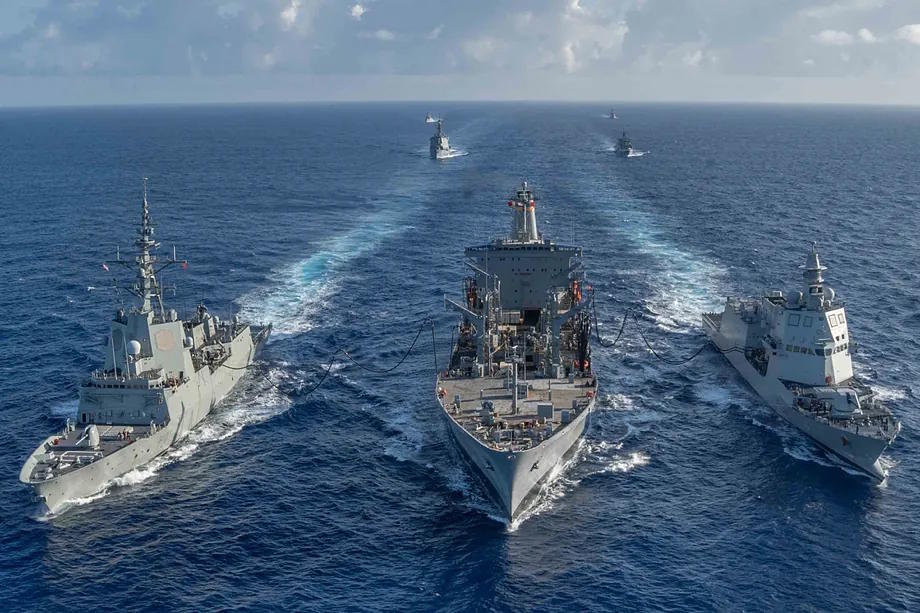
The Strike Group attended this event with its main assets: the strategic projection ship Juan Carlos I, the amphibious assault ship Castilla, the frigates Blas de Lezo and Reina Sofía, and the combat replenishment ship Patiño. The deployment was complemented by a Reinforced Landing Group from the Spanish Marine Corps, tactical vehicles, and amphibious vessels.
The training was led by the US Navy's Second Fleet, structuring the deployment into seven naval combat groups. Spain achieved a significant international milestone at the event by being the only allied country to assume direct command of one of these groups with the participation of over 3,000 military personnel from 14 different nations.
"Participation in FLEETEX reaffirms Spain's commitment to global maritime security and allied collective defense. Likewise, it consolidates the Navy's ability to generate, deploy, and maintain a first-rate expeditionary force, fully prepared to operate effectively and lead in any strategic scenario worldwide," explained the Defense Staff.
The presence of the expeditionary group at the event these days is not coincidental. Throughout this week, the ships are in New York to participate in the events of the 250th anniversary, joined by the Chief of Naval Staff, Admiral Antonio Piñeiro. While the main day will be tomorrow, July 4th, with a day where Spanish ships will participate in a naval review and the training ship of the Navy Juan Sebastián de Elcano, the celebrations will continue until the 9th.
"The celebration of the 250th anniversary of the US Navy has a strong international component under the motto For Navy and Nation! and focuses on highlighting the US Navy as a guarantor of freedom and prosperity for 250 years," sources explained to this newspaper.
While five Spanish Navy ships engage in diplomatic activities on the East Coast, on the other side of America, in the waters of Hawaii, the frigate Álvaro de Bazán will participate in the celebrations at Pearl Harbor, where for the first time, it will take part in key maneuvers, invited by the United States. These sustained military exchanges over time survive political noise and criticisms from the Trump administration, intensified with one week left for the NATO summit in Ankara.