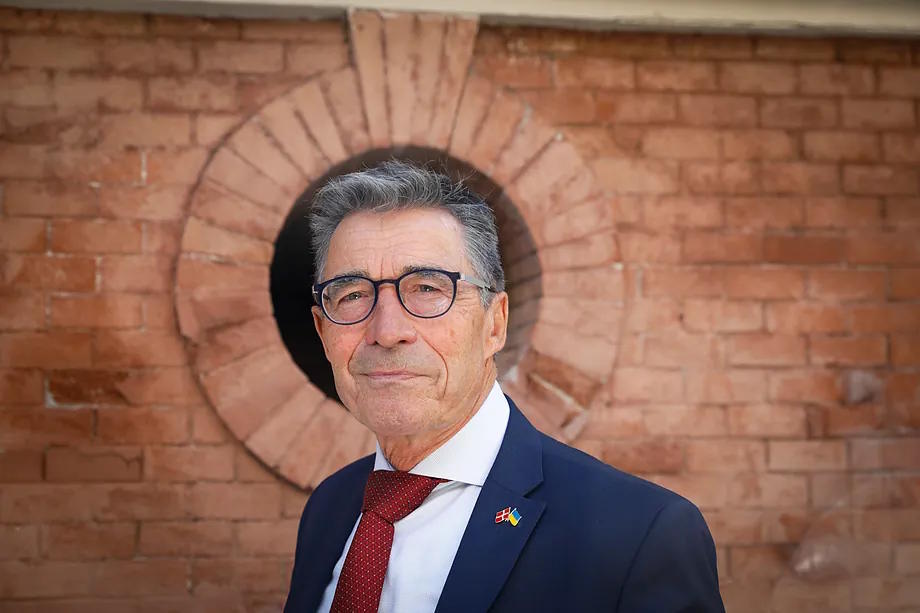
Anders Fogh Rasmussen (Ginnerup, Denmark, 1953) was the Secretary General of NATO from 2009 to 2014, as well as the Prime Minister of Denmark in the eight years immediately prior. He offers this interview to EL MUNDO just before the crucial summit that the Alliance will hold in Ankara, Turkey. "The differences on both sides of the Atlantic are real. The year started very badly with President Trump's threats regarding Greenland and the fact that he did not inform the allies before the attacks on Iran. But the Alliance has overcome discrepancies on many occasions throughout its history," he explains when asked about his expectations for the meeting.
"I believe President Trump has realized that Iran and Russia are increasingly becoming the same problem and not two separate ones. This should serve to unite us, not divide us. Here, I think Europeans must adopt a much more pragmatic approach. Tell Trump: 'We will help you with the issue of the Strait of Hormuz as long as you help us with Ukraine,'" he continues.
Trump has already hinted that he will arrive at the meeting "annoyed" with allies who did not assist him in the Iran campaign, and of course, the possibility, fear, and threat of the US leaving NATO will loom. "As a former Secretary General of NATO and a staunch advocate of the transatlantic bond throughout my life, I certainly hope not," Rasmussen remarks on this matter.
"But Europeans must stop planning based on what the United States may or may not do. The realistic perspective is not a US withdrawal at this moment, but a rebalancing towards China and its own hemisphere, accompanied by a gradual reduction of its forces in Europe. It is a natural evolution, and Europe must be prepared to stand on its own. NATO will remain the cornerstone of our security. Our task is to give it a more European face," he adds.
What the former Secretary General describes is what the United States has dubbed NATO 3.0, something that is "not a new debate." "We have been talking about it for decades. I remember that discussion vividly when I led the Alliance. If NATO 3.0 means an Alliance with a more European face, where Europe takes on a greater share of conventional defense burdens while the United States remains fully committed, then it points in the right direction. What we must avoid is a false choice between depending on the United States or isolating ourselves as Europeans."
At this point, the question arises about the current Secretary General, Mark Rutte, his leadership, and his relationship with Trump. Rasmussen is very clear on this point. Extremely clear and very European.
Spain's role in NATO, the Defense investment by the government of Pedro Sánchez, and its consequences are also part of the interview. "I want Spain to overcome its taboo regarding Defense. The Spanish contribution in this area, as a member of both NATO and the European Union, should be much greater," he states at the outset on this matter.
"The lack of investment by any major ally is a cause for concern for all others. And my concern is not limited to Spain, but also to the United Kingdom, another key ally that is also at risk of not meeting its commitments. We are not just talking about budget figures. We are talking about the cost in human lives that not strengthening our defense against Putin and new threats could entail. The world is not becoming safer," he emphasizes.
Regarding the problems of the European Defense industry, which is unable to supply countries at the speed they need, the former NATO Secretary General points out that Europe "does not spend enough or do so quickly enough." "Modern warfare is a war of attrition, similar in many ways to World War I, albeit with high-tech weaponry. And it is decided by the ability to produce more and do it faster," he adds.
He goes on to mention that "Ukraine is already producing millions of drones per year, while some of our major European programs remain fragmented and progress too slowly," and emphasizes that the Ukrainian country "is key." "We should invest directly in its defense industry, as Denmark is already doing. We should also integrate Ukraine into the European defense industrial base," he concludes.
And to conclude, the interview turns to the ultimate responsible for everything else: Vladimir Putin and Russia.