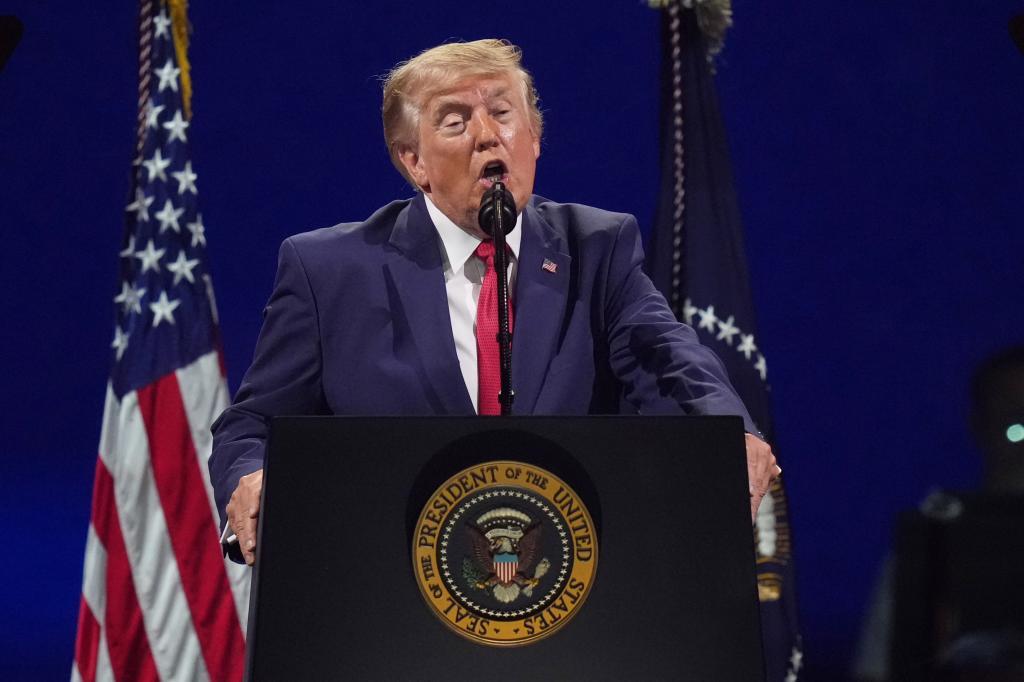
The 250th birthday celebration of the United States kicked off on Saturday morning in the capital with a Nazi parade in front of the Capitol and an extreme heatwave that forced the cancellation of events and festivities. It ended, 16 hours later, in the early hours of the morning, after a chaotic evacuation turned into an ideological clash due to a storm, with a polarizing and divisive rally by Donald Trump resurrecting the "Red Scare" and the most spectacular and delayed fireworks in the nation's history.
The commemoration since the proclamation of the Declaration of Independence was, in many ways, similar to that of past years or decades. A country dressed, fed, and dyed in red, white, and blue from coast to coast. Backyard parties, barbecues, hot dogs, and fireworks. A military display like no other, with dozens and dozens of state-of-the-art aircraft flying over the National Mall and the White House throughout the day. With school ships and helicopters from around the world honoring their ally in the Hudson Bay in New York. With concerts, parties, and parades in major cities and the smallest towns. Singing about "freedom" with an unmatched intensity for those who are sure they have never lost it.
But there were also many other unique and unprecedented things. Unexpected and improper things that tarnished the tribute and the national celebration. The first and most difficult to believe, five and a half years after the assault on the Capitol, is that Washington woke up with over 400 masked members of the Patriot Front, a neo-Nazi group, white supremacists carrying flags who marched through the main neighborhoods and left iconic images, especially in the metro, of their racial hatred and lack of democratic attachment. They came, they went, there were no fights or arrests, but they wanted it to be known that they are there, that they are still there, waiting for the moment.
It is not strange for it to be unbearably hot, humid, and sticky on July 4th in the capital that was once a swamp. Nor is it strange for school band parades in the morning to be canceled or for the public to be closed off, as it happened the day before, at the MAGA-inspired Great Fair that Trump placed on the Mall, where the country's main monuments and museums are located. But to have arguments, quarrels, and even skirmishes in that same place because the president's supporters do not believe in the weather or experts and believe that the evacuation that was forced for a couple of hours was the fault of "globalists," "communists," and the "radical left" will have its own paragraph in the history books.
The weather largely ruined the day despite the president repeatedly sending messages saying that he would speak and that there would be rockets and lights even in the middle of the night. "Storms bring good luck to any occasion. They also make events a bit more exciting! We will wait for it to pass, I don't care if it's 2:00 in the morning or in an hour. It seems like it will pass, they always do. I'll be there no matter what happens (...) Our great veterans, especially those from the old school, many of whom are there, went through hell, and that didn't stop them. It won't stop us either! I'm not going to let the rain stop our celebration of the 250th anniversary," he wrote on his social media. "Those veterans had to endure adverse weather on D-Day. I am also enduring adverse weather. Whatever happens, I will give this speech," he later told one of Fox's star presenters. "If they could land on the beaches on D-Day, I can give a speech", he repeated in a surreal analogy.
Normally, every July 4th the surroundings of the Obelisk and the African American Museum are filled with tens of thousands of people picnicking, dining, and waiting for the light and rocket show. This time, the meeting had turned more into a political event, a gathering with detours, the leader's favorite music, and full of messages for the MAGA world and the president's supporters, who once again turned his speech into an aggressive, vengeful rally. Trying to take center stage to link in the collective imagination the glory, the past, and the values of the nation with his ideology and his electoral program. Many had to leave due to the threat of a storm and the Secret Service's orders. Many others could not return or thought it was too late. But Trump, true to his style, appeared after 11:00 PM, behind bulletproof glass. "We will wait as long as necessary, I did not cross the country to now be scared by a few lightning strikes", shouted a supporter in front of the agents.
Trump brought out his usual arsenal, celebrating American exceptionalism and declaring that there is no equivalent nation in human history. But always with himself as the main actor. "Unlike many other countries in the world, in this one we have freedom of speech, freedom of religion, and equality under the law; although I wasn't treated very well, but we won't go into details," he said with a nod to his legal proceedings. "For 250 years, the United States has been the hope, the promise, the light, and the glory among all nations of the world. Because... no one can be like us," boasted the president.
On that special night, he brought out his favorite singers, those who opened and closed his campaign events: Christopher Macchio with God Bless America and Lee Greenwood with his iconic God Bless the USA. Like at conventions and in his State of the Union speeches, he put on a show bringing war veterans, decorated heroes, and even the Artemis astronauts who circled the moon a few weeks ago to the stage. Displaying a bunch of historical flags and appealing to the memory of Buffalo Bill and his partner Annie Oakley, or the explorers Lewis and Clark who ventured into the new territories of the country by order of Thomas Jefferson. Or to William Harvey Carney, a slave who escaped and served as a Union soldier in the Civil War, being the first black man to receive the Medal of Honor.
But after appealing to glory, exceptionalism, to the personalities that shaped the nation, something any other president would have done, something that Gerald Ford did in 1976 in Philadelphia or that Reagan, on a smaller scale, repeated in 1986 in New York, Trump returned to what his nature demands. He attacked judges and the opposition, spoke of election fraud, and lobbied for Congress to pass his Save America Act. He boasted about the attacks on Venezuela and the war in Iran. And he deployed his new strategy for the November elections: the "Red Scare."
As he had announced on Friday at the foot of Mount Rushmore, Trump focused his speech on communism, on the red threat, on the danger to American identity and freedoms. Why now? Because the mayor of New York is in the hands of socialist Zoran Mamdani (with whom, by the way, he gets along very well) and his party colleagues have recently won some local elections. The polls are not looking good for the Republicans for November, and Trump has put all his cards on the table: it's either us or the Reds.