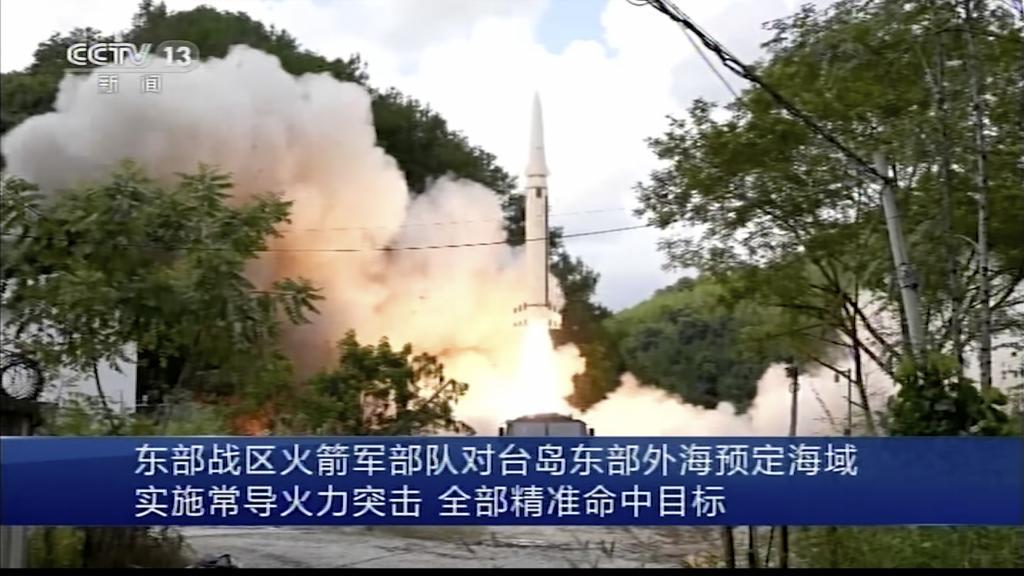
For decades, Chinese nuclear missiles remained shrouded in almost absolute secrecy. Beijing preferred its deterrence capability to exist more as a mystery than as a spectacle. But that strategy is changing. This Monday, a nuclear submarine from the People's Liberation Army (PLA) emerged at some point in the Pacific to launch a strategic long-range missile equipped with a simulated warhead.
China described it as a "routine exercise." Its neighbors, however, saw it as a new show of force by a military giant that is no longer content with defending its shores but wants to make it clear that it can project its power thousands of kilometers out to sea.
The launch marks a milestone for the Chinese Armed Forces. It is the first test of a missile fired from a submarine that the People's Liberation Army (PLA) has conducted since 1982 and also the first time Beijing publicly acknowledges a test of this nature carried out from a nuclear-powered submarine.
It was the official agency Xinhua that reported that a submarine fired a missile equipped with a simulated warhead that hit a pre-designated area in the Pacific "with precision." Chinese authorities emphasized in an official statement that the test complied with international law, that the affected countries were informed in advance, and that the launch "was not directed against any specific state or target."
However, Beijing avoided revealing the exact point where the projectile landed or the missile model used, a common silence when it comes to tests related to its nuclear deterrence force.
Although the Chinese government presents the test as a technical exercise, the symbolism is much greater. It is not common for the Asian superpower to conduct such launches in open seas. The vast majority of its ballistic tests are carried out within mainland territory, in areas very close to its coasts or in the Gobi Desert.
Sending a strategic submarine to the Pacific and demonstrating that it can successfully launch a long-range missile is part of the message that China has been sending for years: its nuclear response capability is no longer limited to coastal defense but aims to operate with global reach.
The test is reminiscent of the last such launch carried out in September 2024 when China fired an intercontinental ballistic missile towards the Pacific for the first time in decades with a test warhead. That move surprised many countries because it broke with Beijing's traditional discretion regarding its nuclear forces.
Since then, experts interpret these exercises as part of the accelerated modernization process of China's strategic arsenal, which includes the construction of hundreds of new missile silos, the addition of next-generation nuclear submarines, and the deployment of missiles capable of reaching virtually any point on the planet.
Monday's launch fits precisely into that transformation. China is developing a true nuclear triad (land-based missiles, strategic bombers, and nuclear submarines) similar to that of the United States. For Beijing, having a submarine force capable of patrolling the Pacific enhances the credibility of its retaliatory capability in the event of a conflict, especially in a scenario of growing tension over Taiwan and the disputed islands in the South China Sea.
Following the missile launch, Australia was the first country to react strongly. "We are very concerned about any measures that undermine the stability, peace, and security of the Pacific," said Deputy Prime Minister Richard Marles after confirming that Canberra had been notified a few hours before the launch.
Australian Foreign Minister Penny Wong was even more explicit in linking the test to China's rapid military buildup. According to her statement from Fiji, the issue is not only the launch itself but the lack of transparency surrounding China's military expansion. Just hours before the launch, Australia and Fiji had signed a new defense alliance aimed at strengthening military cooperation and regional security in response to Beijing's increasing influence among small island states.
The government of Xi Jinping has been expanding its diplomatic, economic, and policing influence in the South Pacific for over a decade through investments, loans, and significant security agreements, a strategy that worries both Canberra and Washington, traditionally the main guarantors of the region's security.
Japan criticized the Chinese missile launch. Tokyo says it received formal notification just 90 minutes before the test and urged Beijing to reconsider the test to avoid risks to navigation and regional security. Data from the New Zealand company Starboard Maritime Intelligence detected at least three Chinese space tracking vessels deployed at various points in the Pacific. These vessels, equipped with huge parabolic antennas capable of tracking ballistic launches and collecting telemetry data, had set sail from China weeks before, indicating that the operation had been planned for a long time.