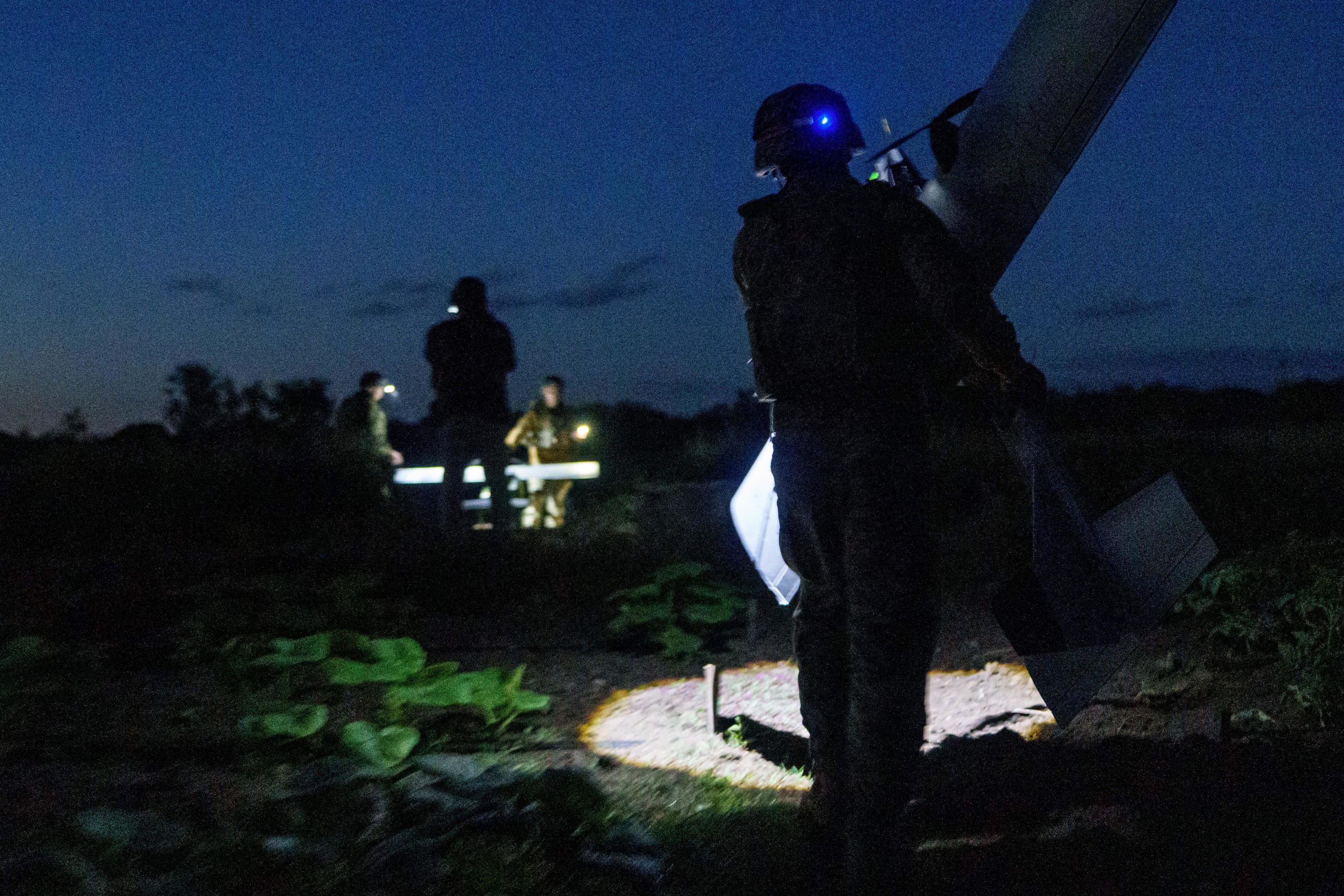
To reach the position of the Ukrainian cannon, one must move at 1:30 in the morning. Night vision drones (UAVs) are not yet swarming the Donbass region in broad daylight.
The soldiers travel in a vehicle protected by an electronic interference system (Rep) and attentive to the indications of their UAV detector. Despite all these measures, the driver prefers to cross himself before embarking on the kilometers that separate them from the artillery position.
On the side of the road, there is the shell of one of the military vehicles that did not manage to overcome the surveillance of the unmanned devices from Moscow. The artillery position, located in the Donetsk province, is hidden in a grove. The soldiers reside in an underground bunker that accommodates eight bunks. The seven members of the National Guard Artillery Brigade 3101 serve a huge 155mm Bohdana howitzer, installed on a truck, hidden among branches and camouflage tarps.
Their own statistics reflect the shift that has occurred in modern warfare. Until 2024, this same unit fought in the battle of Pokrovsk, also in Donetsk.
"We used to fire an average of 100 or 120 projectiles. Now we don't go beyond 30 or 40 per day. It's getting harder to fire each month", specifies Sobak, a young gunner who has chosen the name of that Egyptian deity as his military nickname.
While supporting operations in Konstantinivka, the group was the target of more than 10 attacks by Russian UAVs.
"Once, one of the drones fell a meter from the Bohdana. We had just enough time to hide it before they launched another 10 FPV (small drones)," recalls the 34-year-old.
For the members of this group, preserving the physical integrity of these devices is almost as basic as their own lives. They cost around three million dollars and could be destroyed by UAVs manufactured for just a few hundred dollars. In fact, they used to be five. They have added two more soldiers who are dedicated to monitoring the area with anti-drone shotguns and a personal drone detector.
"Now hiding is basic. We usually place tree branches everywhere because the FPVs crash into them and explode", adds Sobak.
The squad should have started firing hours ago, but the activity of enemy UAVs prevents it. "We have to wait for the skies to be clear," points out Tyson, the group's leader.
Finally, at 11:42, they receive the ok from the air defense. Then, all the soldiers spring into action. Sobak positions himself next to the artillery truck while his comrades start bringing the ammunition, loading it with a long metal rod.
The cannon rises among the undergrowth and begins to fire. It can only do so three times before hiding again. The entire operation has not lasted more than five minutes.
"We wanted to fire 5 times, but we were warned that the drones were coming", points out Sobak as they head back to the main bunker.
The visit to the 3101 site confirms the increasingly secondary role played by much of the 20th-century war armament in the conflict in Ukraine, which still forms the basic framework of NATO's strategy: cannons, tanks, or elite infantry units like snipers.
The mutation is not limited to the Ukrainian army. For the Soviet Union, artillery was "the God of war," as they coined in their propaganda slogans.
The use of artillery by its successors has also seen a significant reduction, as acknowledged days ago by Ukrainian General Yevhen Lasiychuk in an interview with a local media outlet.
"Between 70% and 80% of the damage caused by the enemy is due to drones. The rest, between 20% and 30%, is done with the help of artillery," he explains.
Moscow's forces only increase the use of these cannons when there is "a deterioration in weather conditions" that limits the number of active UAVs in the sky.
The senior military official added that offensives with armored vehicles - as was the case in the last century - are history, even the small advances where these armored transports were used to support infantry. "They are too easy a target", he points out. "The Russians use infiltration tactics where they use two or three soldiers," he adds.
As this journalist has been able to verify, tanks have disappeared from the front lines. "They are only used on stormy days when it rains heavily. They come out of hiding, fire a couple of times, and then hide again. This is a drone war," says Andrey Onistrat, a well-known Ukrainian public figure and former special forces member.
After studying the videos emerging from the battlefield, the specialized publication Defence24 recently estimated that the fleet of Ukrainian tanks from the West has suffered significant losses, with the more advanced Leopards "ceasing to exist" after the destruction of nine out of the 10 sent by Sweden.
Other models of the same armored vehicle have also suffered a significant blow, such as the type provided by Spain, where more than a third have been rendered inoperative or captured.
The damage to the Russian armored fleet is infinitely greater and is estimated in the thousands. However, according to Ukrainian statistics, if the Russians were losing dozens of tanks a day at the start of the general invasion in 2022, from 2025 onwards, they restricted the use of these tanks to reduce losses to single digits during the current year.
In fact, Russian tanks - which have implemented a regeneration program for old vehicles from the last century - now exceed the 3,000 they had in 2022, according to the estimate of Jompy, a well-known military analyst, based on satellite reconnaissance of these devices' warehouses.
"What they plan to do with all those tanks is a mystery. The same drones that have destroyed thousands of Russian tanks continue to fly overhead," adds the expert in a recent analysis.
In military chronicles, snipers have always been a particularly mythologized figure. Characters like the Soviet sniper Vasily Zaitsev, who eliminated over 200 German soldiers during the Battle of Stalingrad, acquired such a halo that they inspired movies like "Enemy at the Gates."
But as Rey, a former 43-year-old sniper, says, "drones are the new snipers." He was part of that select group of specialists until 2022. He fought during the early years of the war in 2014, on the Donbass front.
After the general invasion of 2022, Rey decided to switch sides and became a UAV pilot.
His logic is devastating. "A sniper can shoot a kilometer or a little more. A drone attacks from tens of kilometers away with the same precision. To be a good sniper, you need a minimum of a year of training. To be a pilot, you need three months," he states.
For Chak, a 36-year-old Ukrainian soldier who now serves as an instructor in the First Assault Regiment of the local infantry, being wounded precisely by one of those devices while heading to his sniper position "a year and a half ago" was decisive in abandoning that specialty.