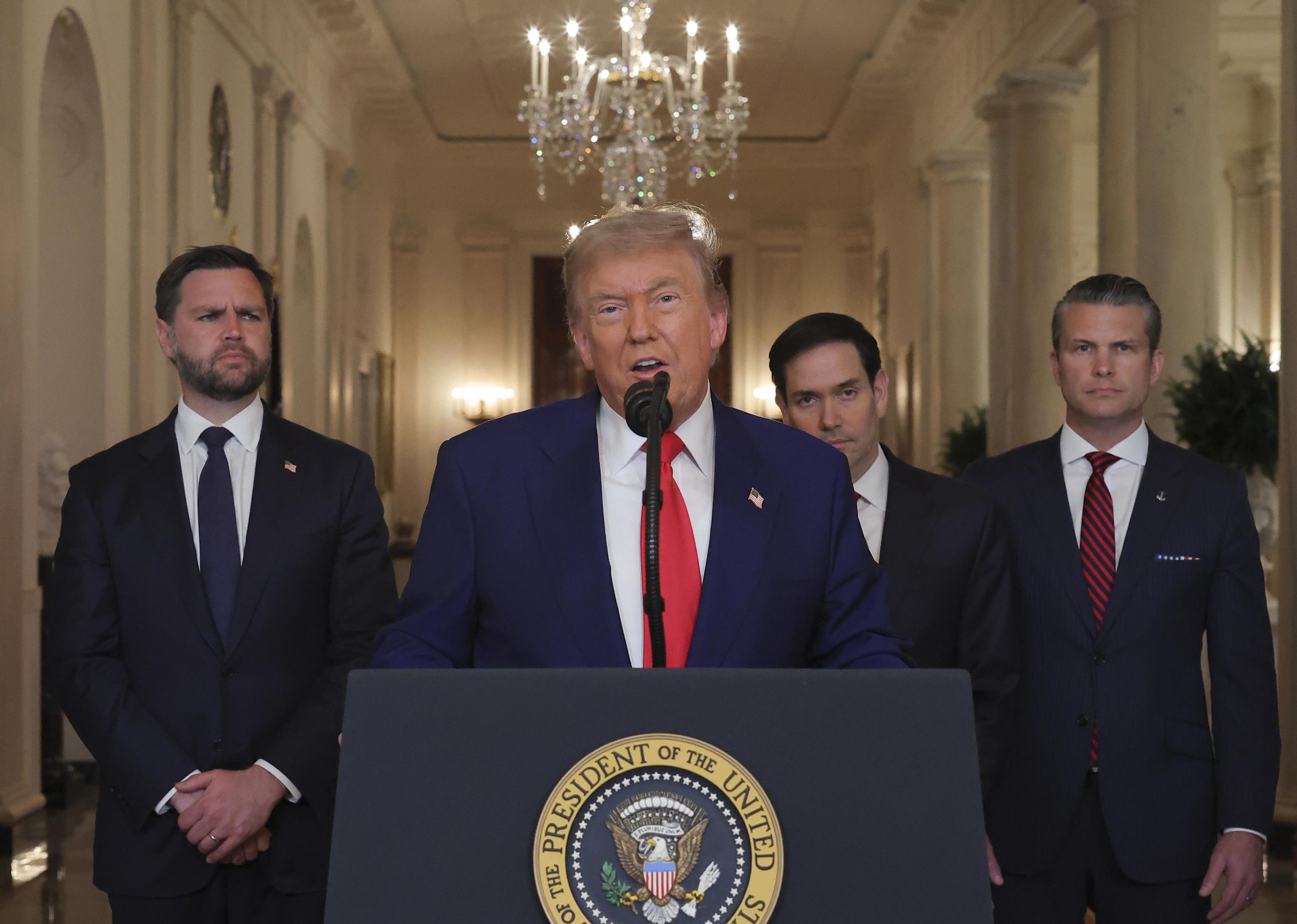
Exactly three weeks after the United States and Iran electronically signed a Memorandum of Understanding turned into a peace plan, the US military has resumed bombings. In the early hours of Tuesday to Wednesday, while the heads of state and government of the 32 NATO members, including Donald Trump, are meeting in Ankara, the Central Command reported that its forces "have begun to launch a series of powerful attacks against Iran to impose high costs for targeting and attacking commercial ship crews made up of innocent civilians on an international maritime route."
Iranian state media reported explosions in Bandar Abbas, Qeshm, and Sirik, towns in the province of Hormozgan, on the southern coast, near Ormuz. A key area from a military and communications perspective around the strait. The Pentagon states that the attacks are "in response to Iranian attacks on three commercial ships transiting the Strait of Hormuz. The aggression shown by Iran was unwarranted, dangerous, and a clear violation of the ceasefire," they explained in a statement certifying the fragility of the situation and the provisional nature of an agreement held together by a thread.
Meanwhile, the Revolutionary Guards (IRGC) of Iran claimed to have attacked dozens of US facilities in Bahrain and Kuwait in response to the bombings on their territory, according to a statement from the state television IRIB. "In an initial response to this aggression, the naval and aerospace forces of the IRGC carried out a joint operation of missiles and drones, hitting 85 US military installations" in Kuwait and Bahrain, and shot down an MQ-9 drone, the statement indicates.
Furthermore, they denounced that the attacks launched by the United States during the early morning, leaving several injured in the south of the country, constitute a "clear violation" of the permanent ceasefire agreement reached in June between Washington and Tehran.
The reopening of the Strait of Hormuz has always been the focus of peace negotiations, which, although seen as a significant step, left many issues unresolved, pending bilateral discussions over the coming months. Both parties had committed to lifting naval blockades, allowing toll-free and uncontrolled navigation, and facilitating the normalization of the oil market after months of deadlock. However, tensions remain high.
One of the oil tankers targeted by the Iranian navy was sailing off the coast of Oman when it was hit by a projectile and caught fire, according to the British agency Maritime Trade Operations. Iranian state television stated that the liquefied natural gas tanker was attacked after ignoring warnings, but the aggression was not directly attributed. The other two ships suffered some damage, but no one was injured, and both continued their journey, as reported by the British maritime agency, Efe.
With its president already in Turkey, the US had considered how to respond to the shots fired by the Iranian Revolutionary Guard at those vessels. The first step, approved by the Treasury Department, had been to revoke the suspension of sanctions on Iranian oil exports in the afternoon of Tuesday, Washington time, which had been one of the significant concessions of the negotiation. However, hours later, the White House gave the green light to much more forceful measures.
The Iranian Foreign Ministry condemned the decision to revoke the license last night, stating in a press release that the measure is a violation of the provisional agreement and that "the US government will bear responsibility for the consequences of this breach of commitment." Iranian Deputy Foreign Minister Kazem Gharibabadi also noted on the social network X that the new US attacks violated that agreement.
The license issued by the United States authorized the production, delivery, and sale of Iranian oil until August 21. Vice President JD Vance said at that time that lengthy discussions with senior Iranian officials in Switzerland laid a "good foundation for a successful final agreement" to end the war. US sanctions on the purchase of Iranian oil had been in place since the Iranian Revolution of 1979. After the United States and Israel started the war, Washington had authorized the temporary sale of Iranian oil at least twice as an incentive to reach an agreement.
As part of that provisional understanding, Iran and the United States had agreed to allow ships to pass toll-free for 60 days. However, Tehran insisted on controlling the routes of the vessels and being able to charge for passage, disrupting decades of practice in the maritime route. The United States and its Gulf allies say they will not accept that tax and have denounced the shots fired.
The data firm Kpler reported that, over the past weekend, at least 108 ships crossed the strait using various routes. The reaction in the markets has been immediate, with a 6% increase in oil prices to over $76 per barrel, the highest level in two weeks.
This week, Washington expects the visit of Benjamin Netanyahu, the Israeli Prime Minister and the main opponent of the agreement with Iran. His concerns towards Tehran, Lebanon (whose president will come to the White House at the end of the month), and Turkey will be the main topics. Just yesterday, Trump announced that the United States will lift sanctions imposed on the government of Recep Tayyip Erdogan for purchasing a Russian air defense system in 2019. "We are going to lift the sanctions. It's time. We don't want to sanction our friends," he said in his meeting with the Turkish leader. This would allow them to buy the F35s they desire once again.