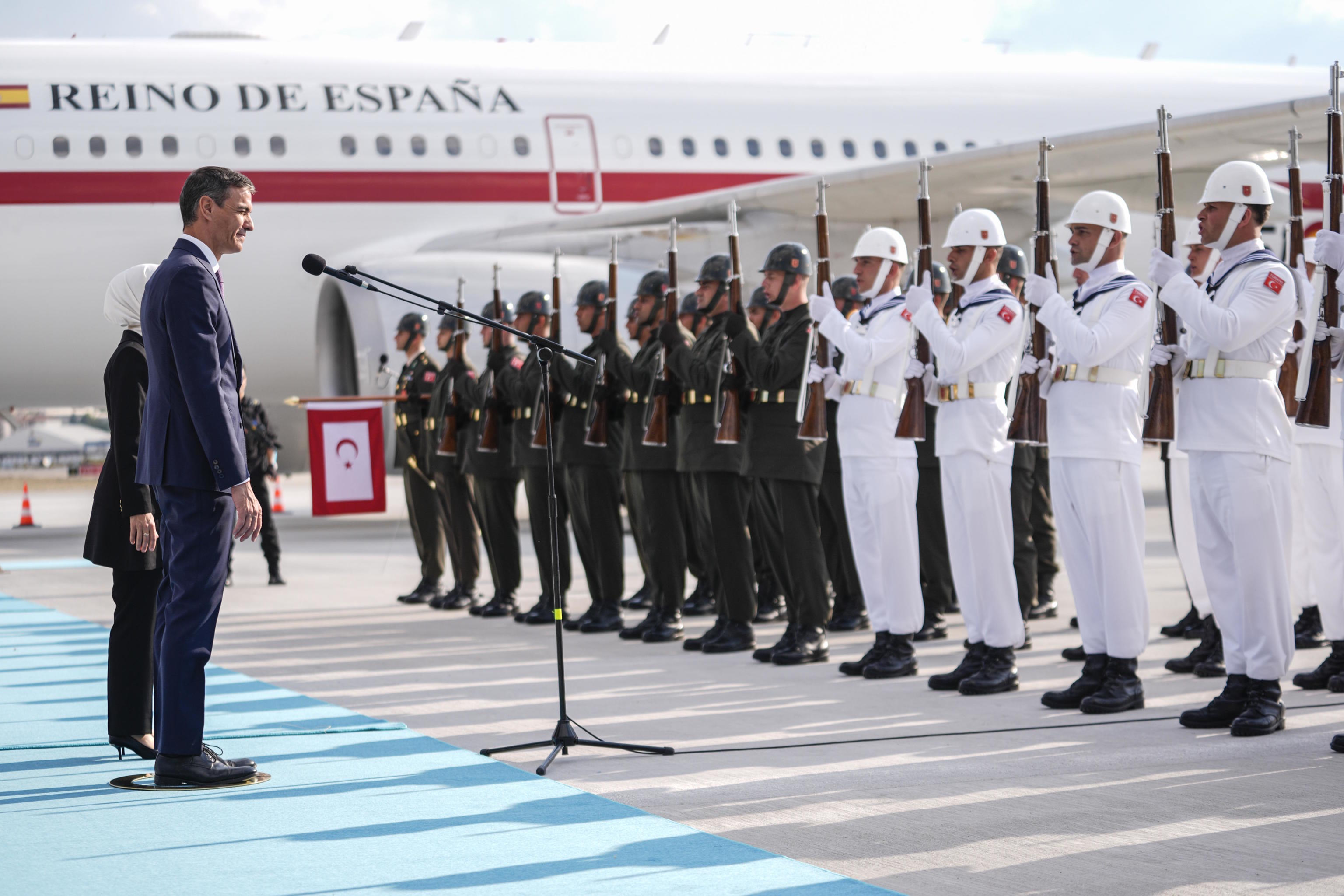
Turbulence and solid ground at the same time. Defense spending creates seemingly contradictory situations for Pedro Sánchez, but they complement each other. The Prime Minister is the political leader on the international stage who champions 'no to war', a role he combines with being the Spanish head of government who has allocated the most millions to military spending. These are the experiences forced by the international and national geopolitical context. The Spanish leader participates in the NATO summit in Ankara with the purpose of showcasing a multi-billion investment in military spending and presenting himself as a compliant partner, shifting the spotlight to other countries, while positioning himself as the main advocate for diplomacy and respect for international law.
These are two souls coexisting in a Sánchez compelled by geopolitical circumstances. The unilateral war decided by the US and Israel against Iran led him to reclaim the 'no to war' proclamation, a leftist banner, especially from parties to his left, which managed to mobilize his electorate at a difficult time for the PSOE, cornered by a cycle of poor electoral results and by corruption scandals. "We are a reference in the world," he said in a letter to socialist militants. This approach also allowed him to bridge gaps with his partners, who reject increasing military spending and demand a firm stance against Donald Trump and his demands.
"A reckless arms race," recently criticized the BNG. "No matter how much President Sánchez says 'no to war and peace,' in reality, what he is going to the NATO summit for is to do just the opposite," censured Podemos leader Ione Belarra on Tuesday. "This is not a whim or an invention of Pedro Sánchez. There is an international consensus on the need to invest more in security, and those who do not see it do not see the current world we are in," government sources rebuke this newspaper.
From 2019 - the first full year as the resident of La Moncloa - until 2026, Sánchez will have disbursed 159.983 billion euros on military spending. This is confirmed by NATO's official data, which on Tuesday released its report on Defense investment by allied countries. For 2026, it sets a forecast of 35.419 billion, with the aim of maintaining Spain's 2% of GDP.
The socialist leader has increased Defense investment by 24.138 billion annually, rising from 11.281 billion in 2019 to over 35,000 for the next year. Sánchez attends this summit armed with data to try to break the stigma that our country does not comply or invest enough. As they say in La Moncloa, he is not dragging his feet. The approach is to counterpose numbers against what they consider opinions without empirical basis.
So far, Trump upon arrival in Ankara criticized the position of countries like Italy, Germany, France, or the United Kingdom, but did not mention Spain, after months of reproaches and threats. The Spanish delegation downplayed this situation. "We do not give it importance or assess it," they said. "We go to the summit calmly, with our homework done and data in hand," they added, referring to having the approval of the Alliance.
The coexistence of 'no to war' and the highest historical investment in military spending does not worry or concern the government. "We believe it is a topic that benefits us, that focuses us, and also puts the PP in an impossible situation because they cannot be against the country's Defense policy," government sources point out. Because NATO, discussing security spending, provides a respite amid the judicial investigations for corruption. "It is a serious and important issue. This government has an image problem. In discussions, topics unrelated to management are brought up. Begoña, her brother David, Ábalos, Koldo, Jésica... It works in our favor."