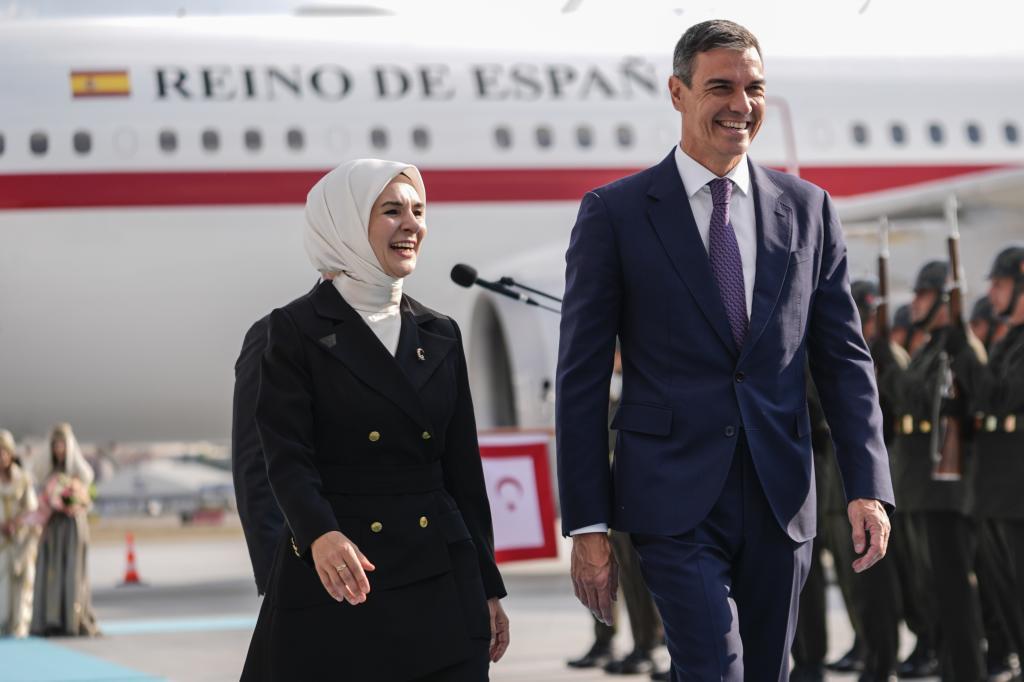
At La Moncloa, they were not entirely confident after Donald Trump ignored Spain on Tuesday in his reproaches to some European allies, right after landing in Ankara to participate in the NATO summit. The calm was momentary, as confirmed on Tuesday. He mentioned Germany, Italy, or United Kingdom, but not Spain. A year later, it seemed that our country was no longer the preferred focus. Everything was blown away. The unease returns. Once again, the Trump-Spain-Defense triangle. The government aims to convey "calm and normality" after these new threats.
The US President has directly and strongly threatened Spain for its refusal to increase Defense spending to 5% of GDP and also for refusing to allow the United States to use the Rota and Morón bases in the context of the war in the Middle East. "It's a terrible ally," stated the President of the United States, adding that the country is "a lost case," and ordered during a press conference to immediately cut off all commercial business with the country. These words were said in the presence of Mark Rutte, NATO Secretary General.
This challenge is not new at La Moncloa. In Pedro Sánchez's team, they are accustomed to Trump's rhetoric. They try to downplay the harsh threats and their potential consequences, especially economically. "Our country maintains a magnificent social, cultural, and economic relationship with the US, and it is not our intention for that to change," they insist, despite it being one of the harshest attacks on our country.
"The bilateral relationship between the US and Spain is beneficial for both countries, both in the commercial and defense fields," is the message they convey as if trying to light a candle in the middle of a storm.
The Government explains that with Trump, daily life is constant uncertainty, as his opinions can change within days or even hours. Nothing can be predicted or planned. However, they avoid escalating tension and try to minimize the clash: "Our country maintains a magnificent social, cultural, and economic relationship with the US, and it is not our intention for that to change."
This is not the first time Trump has threatened to cut off commercial relations with Spain. He did so last year with a similar threat to the current one: "Spain is terrible. They want to stay at 2%. I think it's terrible. And, as you know, they are doing very well. The economy is doing very well. And that economy could completely collapse if something bad happens."
Government sources explain that throughout this year, they have not detected any impact on the Spanish economy or the level of foreign investment despite these threats from Trump. However, they remind the US administration that economic ties "are woven by private companies, not governments," and that trade policy in the European Union is led by the European Commission, it is a community economic policy, and that it is not possible to "single out" or retaliate against a specific Member State.
So far during the summit, there has been no public contact between Sánchez and Trump. Not even during the official photo, despite both being in the front row, separated only by British Prime Minister Keir Starmer and the Prime Minister of Sweden, Ulf Kristersson. During the dinner hosted on Tuesday by Turkish President Recep Tayyip Erdogan, the Spanish Prime Minister sat at a table with Canada, Poland, Finland, and Korea. Government sources indicate that there was a "good atmosphere" and that the conversation focused on international issues. Sánchez also spoke with Volodymyr Zelensky.