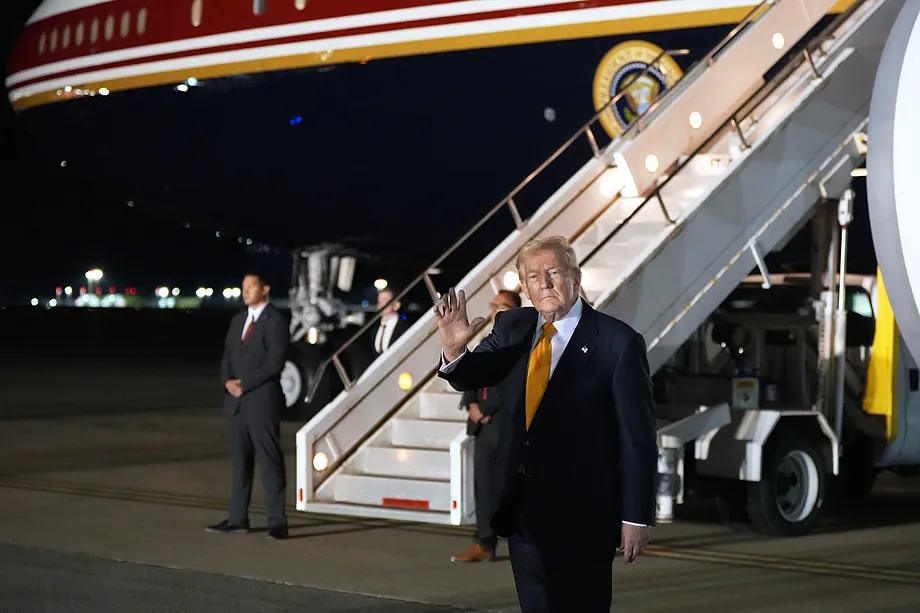
This Wednesday, in Ankara, the President of the United States once again lashed out against Spain and once again raised the possibility of commercial retaliation as punishment for our country's reluctance to increase defense spending to 5% or the decision of Pedro Sánchez's government not to allow the use of the Rota and Morón bases for military operations against Iran.
"Spain is a lost cause. We no longer want to do any commercial business with Spain. By the way, I would like you to draft it, Scott [referring to Treasury Secretary Bessent]," said Donald Trump. "Spain is a terrible ally in NATO. They don't participate, they don't pay. I don't want anything to do with Spain. Cut off all trade with Spain, please, including visits. We don't want anything to do with them," he continued. "Do it immediately. Don't even talk to them. They are hopeless. They are bad people. Because, as you know, everyone else is paying and working, and Spain, especially Spain... There are a couple of other countries, but especially Spain. They openly say it, they are hostile. And we'll see if they remain so hostile when they call saying: 'Please, please, we want to trade with you, sir. We want to trade with you, sir'. They make a lot of money with us, and we will make them earn much less. I don't want to do any business with them," Trump concluded.
This is not the first time, nor the second or the third. Since the NATO summit in The Hague last year, Trump has criticized more than half a dozen times, suggesting or hinting at the idea of "expelling" our country from the Atlantic Alliance, stating that it was "probably deserving of economic and tariff retaliation." But in March, he went even further, threatening to "break all deals" or "relationships", depending on how his expression was interpreted. "We don't want anything to do with Spain," suggesting a possible "embargo" on a "terrible" and "hostile" ally.
Nothing has happened since then, and it is not clear if it will happen now. In fact, President Sánchez has stated that despite the public outbursts, when he spoke with Trump in person yesterday, everything was "cordial," a conversation "about the World Cup and golf."
And Trump himself, in an unexpected but in line with his style, completely changed his speech on the plane back to Washington. In response to journalists' questions, the American praised our country's attitude at the summit. "I will say that I had problems with Spain, and I still do, but today Spain completely reversed course. Spain was very generous today.... They responded to a very important payment request, and if they hadn't, we wouldn't even be talking to them," he pointed out. His attacks on the government were in the morning, before exchanging words with the president and the meeting. Apparently, his attitude was different at the end. "They had behaved very badly in my opinion, but today there was great unity in the meeting, tremendous unity. Very nice," he concluded.
The umpteenth change in tone raises questions about what will happen. Before Trump's words on the plane, U.S. officials had taken a step forward, clearly marking for the first time what the path could be for punitive trade measures, indicating that they will start moving the gears. But if the leader believes that there has been a change in attitude and that Spain has been "generous," perhaps he no longer deems it necessary.
"The Department of the Treasury will work with the U.S. Trade Representative and the Department of Commerce to provide Trump with a list of Spanish products that could be embargoed in the coming days," a source said in an email response to various media outlets. Something that was considered in the past, and that high-ranking political officials brandished as a threat in front of the cameras, but that was never executed because it is very complicated and legally risky.
Any punitive trade measure must take into account that it is the European Commission that has the negotiating competencies in trade within the EU. In his first term, the U.S. took tariff or punitive measures against products that were particularly harmful to the Spanish economy. But a direct embargo is a very big step, legally difficult to justify and entirely unacceptable for the EU. The U.S. has approved ad hoc embargoes in the past, but in very extreme situations relying on the Emergency Powers Act (the same one that the Supreme Court overturned as a tool to impose global tariffs). But for something like this, it would be necessary to invoke other laws that regulate relations with enemy countries or define national emergency situations much more precisely.
"The process of imposing tariffs on Spanish products is not so complicated," Chad P. Bown, former chief economist at the State Department during Joe Biden's presidency, told Politico. "But the implications this would have for the Turnberry Agreement are another thing. I think it would be devastating... it would probably mean the end of said agreement," he added in reference to what was signed last year by Trump and Ursula von der Leyen in Scotland.
"This issue was worked on last October. I think they are going to pick up that idea again," a second source familiar with the Trump administration's internal deliberations on trade matters told the same American media outlet, pointing to something that Trump celebrated when the Supreme Court overturned the global tariffs. "I can't impose tariffs, but I can impose an embargo," the president said then, as troubled as he was interested in the possibility of applying that mechanism.
Another option could be to invoke Section 232 of the 1962 Trade Expansion Act, which allows imposing tariffs or restrictions on imports to protect certain sectors considered important for national security. To invoke the IEEPA, that law of extraordinary powers, Trump must declare a national emergency in the face of an "unusual or extraordinary threat" to national security, foreign policy, or the U.S. economy. This law has been repeatedly used to restrict trade with Iran, Russia, and North Korea, or to block transactions in dollars from thousands of companies and entities linked to terrorism.
But it is difficult to think that a court will consider Spain, a NATO ally with which it has a trade surplus, as an "unusual or extraordinary threat" for not increasing spending or not allowing the use of its bases, even though some senators and congressmen have pointed precisely in that line of thinking, saying that limiting the Operation Epic Fury against Iran endangered soldiers' lives.
The administration could try it, knowing that at least it would send a very powerful message. And unlike the case of tariffs, which ended up before the Supreme Court due to complaints from several affected U.S. companies and some states, a possible lawsuit would likely have to be filed only by Spain. Or by the EU on its behalf while a political damage control is carried out.
Total trade in goods between the two countries exceeded $47.9 billion in 2025, according to data from the U.S. Census Bureau collected by Reuters. If services, such as tourism, are included, the total amounts to $74.5 billion, according to data from the Department of Commerce's Bureau of Economic Analysis, making Spain the 23rd most important trading partner of the U.S.
In fact, the U.S. sells more goods to Spain than it buys, exporting $26.6 billion in goods to the country in 2025 and importing $21.35 billion, resulting in a trade surplus of $5.25 billion. The United States imports mainly pharmaceutical products from Spain, electrical transformers and converters, personal care products, petroleum derivatives, glazed ceramics, and olive oil, the heavily affected product in 2017. The main U.S. exports to Spain are pharmaceutical products, crude oil, civilian aircraft, and corn.