In 1890, the same year in which the American admiral Alfred Thayer Mahan revolutionized the world of emerging geopolitics with The Influence of Sea Power upon History, Arthur Conan Doyle put in Sherlock Holmes' mouth one of the most useful phrases to understand life in general and international relations in particular: "When you have eliminated the impossible, whatever remains, however improbable, must be the truth."
Today, with the closure of Ormuz, it is no longer enough to control land or sea, not even the air as specialists tirelessly point out, considering what happened in Iran. It is necessary to dominate logistical chains, submarine cables, satellites, digital networks, energy, rare earth materials, semiconductors. There is a geopolitics of critical infrastructures and drones, as demonstrated by Ukraine, in record time and precarious conditions.
For decades, NATO was considered one of the few constants in international politics. It survived the Cold War and its abrupt end, endured the Balkan wars, reinvented itself after the 9/11 attacks with the intervention in Afghanistan, and pivoted towards China for the first time in 2019, at the London summit. The Alliance withstood De Gaulle's ego and the deep divisions caused by the invasion of Iraq. It also persisted, despite serious doubts, during Trump's first term and the "brain death" era declared by Macron.
In strategic circles, the prevailing idea was that, despite internal tensions, external challenges, and the end of bipolarity, the Alliance was a virtually indispensable institution, immune to political changes. That paradigm has begun to crack. The growing rivalry between the United States and China has shifted the center of gravity towards the Indo-Pacific, while the rise of nationalist and populist movements on both sides of the Atlantic has weakened the consensus prevailing since 1945.
The return of Trump, unleashed, has reopened all catastrophic scenarios. European diplomats said eight years ago that the situation was very serious but not grave. Or grave but not serious. Now they would not bet their salary on continuity, despite Mark Rutte's desperate contortions. For the first time since its creation in 1949, scenarios that would have seemed unthinkable just a decade ago are openly discussed in chancelleries, international summits, and the main Security and Defense forums: a drastic reduction in U.S. commitment, an alliance at different speeds, or even a gradual disintegration. NATO remains the most powerful military organization in the world, but its permanence is no longer considered inevitable, but a political challenge that must be renewed summit after summit.
The Alliance is entering its third major stage. NATO 1.0 was conceived to contain the USSR. NATO 2.0 tried to manage the post-Cold War order, from the Balkans to the post-9/11 world. NATO 3.0, the one that is now taking shape, has to coexist with three simultaneous threats: Russia, China, and, unexpectedly, the United States that has disrupted the international order established in 1945.
In 1973, when he published 'The Imperial Republic', Raymond Aron noted that U.S. foreign policy seemed to be entering a new phase. "The rapprochement of the United States with its enemies (the Soviet Union and Communist China), the commercial and monetary disputes with its European and Japanese allies, the narrowing of the wealth gap between the United States and its rival-partners, the growing public opposition to imperial weight, and the accusation against those responsible for the Vietnam War," he said with Nixon in mind.
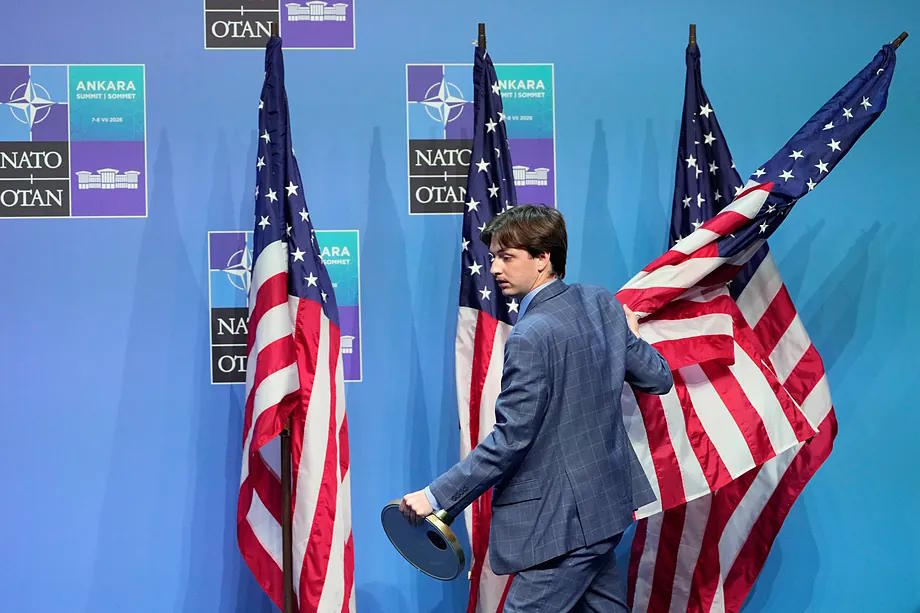
Change Vietnam for Iran and you will see the similarities. The poly-crisis, the hand extended to enemies and sticks to friends, the "imperial weight." From Ankara, Trump literally did that, praising Russia, China, and his host while badmouthing the others. The Summit, which he himself defined as a success and a show of "unity," was saved without major incidents. The declaration was approved, there were no quarrels inside the room, and the page is turned until the next one, which should be in Albania, but it is not even clear when.
But the problem is not a disagreement over military spending, not even that Washington is accelerating its pivot to the Pacific and wants to reduce its involvement. Or that Europeans, as in 2003, do not want to get involved in the Middle East. The challenge is fundamental and goes beyond Trump. The White House, reflecting a broad impulse in the country, presents it in civilizational terms. The strategic priorities are different, the worldview is different, the priorities are opposite. Perhaps irreconcilable.
Therefore, various scenarios are opening up. The first, that nothing happens. That the Trump Presidency ends without major mishaps, normality (sic) returns to Washington, and NATO evolves as it has done over these decades. A "revitalized organization," in the words of Rachel Ellehuus from the Center for Strategic & International Studies in Washington. The second, "a transition towards a more European Alliance," according to Camille Grand from the Brookings Institution. The third, more radical, involves a disenchantment that inevitably leads to a reduction in U.S. commitments. "In practice, and in a matter of months or years, the United States would multiply signals of disengagement: abandonment of Ukraine; rapid, massive, and uncoordinated troop withdrawals; closure of U.S. bases in Europe; disinterest in NATO's command functions; and a possibly irreversible weakening of the U.S. guarantee to allies and adversaries," says Grand, completely unknown waters that would push some members to seek security guarantees on their own. With Washington, Moscow, or perhaps other actors.
The last scenario, the worst, would involve a dissolution of NATO prompted by trade and technological clashes, the abandonment of Kiev, or the ambitions of the Imperial Republic in Greenland. With open hostility between both sides. The first Secretary-General, Lord Ismay, famously said that the Alliance existed to "keep the Russians out, the Americans in, and the Germans at bay." The breakup is a proposition that seems ridiculous, absurd, detrimental to all. But as Jonathan Burchell from CSIS emphasizes, "that world no longer exists". And when you eliminate the impossible, among what remains, however improbable it may seem, must be the answer. What Moscow always dreamed of, and today Tehran, Beijing, or Pyongyang yearn for, is improbable, but it is no longer impossible. Nor unthinkable.