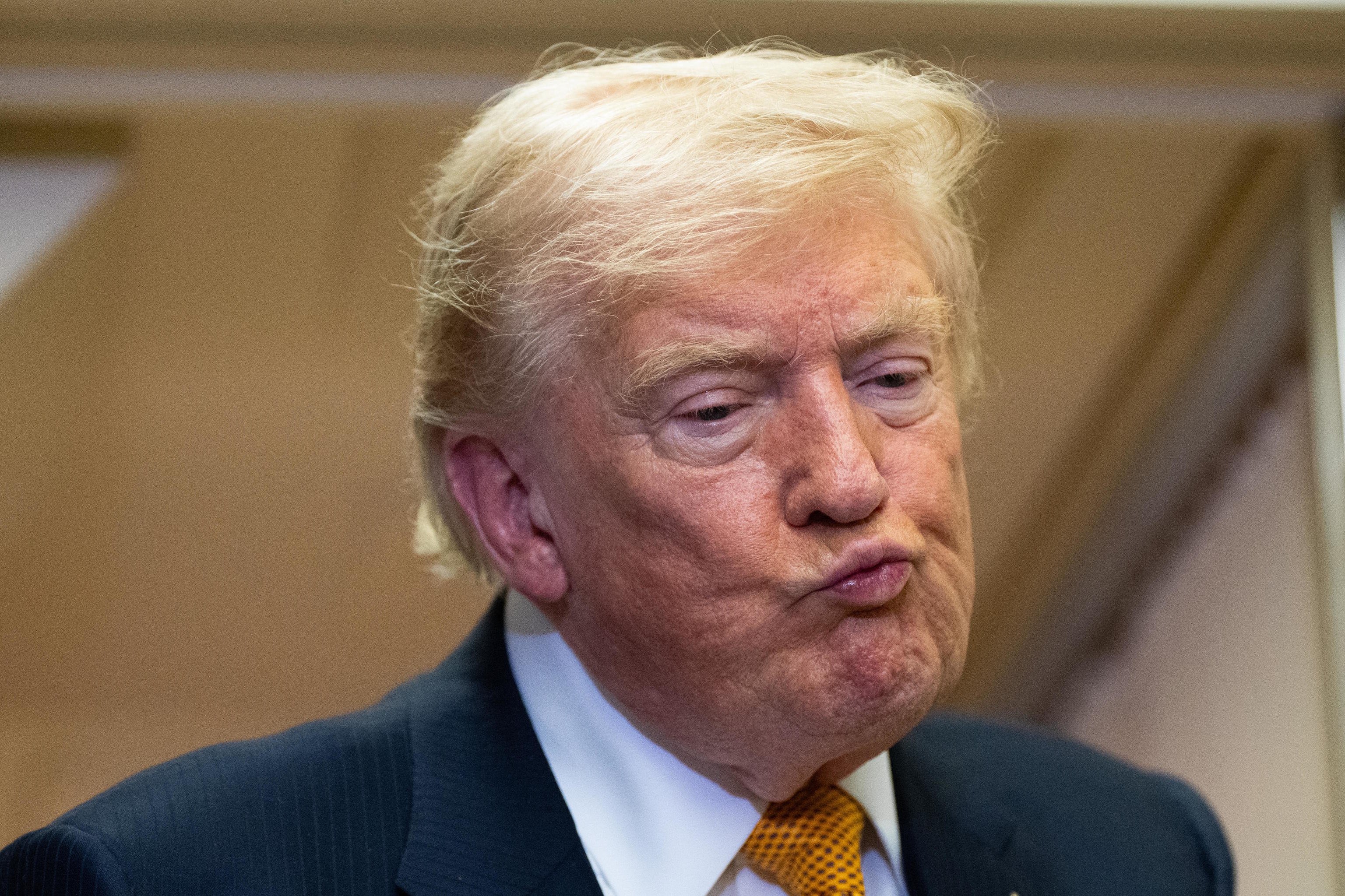
Shortly before 6:00 p.m. on Wednesday in Washington (midnight in Spain), while flying back to the United States from Turkey on his old Air Force One, President Donald Trump posted a series of messages on his social media accounts boasting of alleged images of the devastation caused by his bombings in Iran. "This is in retaliation for the attacks on ships carried out by Iran yesterday. If it happens again, the situation will be much worse!" he wrote in one post, sharing a strange image of burning buildings on the outskirts of what could be the city of Chabahar. Half a dozen more posts, with short videos of unidentified alarms and explosions, completed the message.
Hours earlier, Trump, in a press conference alongside NATO Secretary-General Mark Rutte, who fully supported the bombings as retaliation on Tuesday, had called the Iranian leaders "crazy," "scum," and "a bunch of sick people," stating that talking to them "is a waste of time" and therefore declared the ceasefire over. "For me, it's over. I don't want to negotiate with them because they are garbage. They are sick people, led by sick, bad, violent people. If they had a nuclear weapon, they would use it," he emphasized.
Following his orders, the US Central Command forces, responsible for the war in the Middle East, resumed attacks for the second consecutive day, seeking to destroy military installations in various locations. "By order of the commander in chief, we have begun to carry out additional attacks against Iran to further degrade their ability to threaten freedom of navigation in the Strait of Hormuz. The United States holds Iran accountable for the recent unjustified aggression against commercial shipping and civilian crews freely navigating a vital international waterway," the Pentagon explained in a brief message on social media. The US Central Command (CENTCOM) had previously reported on a new offensive against the Islamic Republic, targeting around 90 Iranian military sites.
Iranian state media, like the night before, reported numerous explosions in the south of the country, in the coastal area near the Strait of Hormuz. In places like Abu Musa, an island in the Persian Gulf claimed by the United Arab Emirates, or in the port of Sirik. According to public television, the attacks also reached Jask, a strategic port east of the Strait of Hormuz; Bushehr, where Iran's only operational nuclear power plant is located, and Chabahar, the port city mentioned in the photos distributed by Trump on his social media. Iranian authorities reported that three people died early Thursday in western Iran due to the latest US attacks.
Meanwhile, Kuwait, Bahrain, and Qatar activated their anti-aircraft defenses on Thursday after Iranian missiles entered their airspace. The Iranian Revolutionary Guard claimed to have targeted "important infrastructure and facilities of US bases in Kuwait and Bahrain" following Washington's "failure to fulfill promises and recent aggressions," according to a statement released by the state broadcaster IRIB, which did not mention Qatar. The military body stated that the attacks hit the bases of Arifjan and Ali al-Salem in Kuwait, and Juffair and Sheikh Isa in Bahrain.
The president was unable to return home directly on his new Air Force One, the plane gifted by Qatar, because despite the recent upgrades, it lacks the necessary technology and defensive capabilities to fly over risky areas, such as Turkey at the moment. Therefore, he had to travel on the old aircraft, which Trump detests because it lacks the luxury and colors he deems fitting for the position, to the UK, where they made a stopover and the new plane awaited him.
Nevertheless, the messages from the White House remain contradictory. The two days of the summit have been a festival of back and forth in all aspects. In his public appearances, he has defended Russia and China, praised Turkey, and criticized NATO members, especially Spain, for what he considers betrayals, selfishness, and lack of solidarity. However, according to all sources consulted and statements from heads of state and government, there were no complaints, reproaches, insults, or threats inside the room this time. For every scene in front of the cameras, there is a testimony of relative cordiality inside, something that did not happen in previous meetings. Including with Spain, according to President Sanchez.
A similar situation occurs with Iran. Harsh words, insults, threats, and even selective bombings, but extending a hand in a way. "Perhaps I will let my excellent negotiators continue talking," he hinted regarding the ongoing negotiations since the signing of the Memorandum of Understanding three weeks ago, as that partial peace agreement does not resolve all issues. The nuclear issue, Iranian missile stocks, the situation in Lebanon were still pending. Despite public denials, the United States has no choice but to keep talking. Even if there are exchanges of gunfire, missiles, and attacks in between. It has happened in the last 48 hours as it did repeatedly in the weeks leading up to the ceasefire. Even afterwards.
"I don't think it's going to start again. I think it will end very quickly," Trump told reporters from Ankara regarding the possibility of resuming open warfare. Just as he has spent the past week, in numerous speeches around the 250th anniversary of the US, saying that "for the first time in 3,000 years, we will have peace in the Middle East."
The ambiguity, the limited nature of the bombings, and the reluctance to escalate have not prevented the price of oil from rising to the highest level in recent weeks, surpassing $80 per barrel during the day. This year, Tehran has discovered that a few boats, drones, missiles, or mines can close one of the vital points for global trade in oil or fertilizers. Up to 20% of global traffic passes through the Strait of Hormuz, and with few resources and in a matter of minutes, the Revolutionary Guard can completely shut down transit.
"God does not love traitors," Iranian Foreign Minister Esmaeil Baghaei said on Wednesday, quoting the Quran. "The Memorandum of Understanding between Iran and the United States, from the outset, was not based on trust but on the clear mechanism of 'commitment for commitment,' as there was no sign of good faith in the behavior of the other party. Now, the United States, despite the clarification in the fifth paragraph of this memorandum —emphasizing the responsibility of the Islamic Republic of Iran in determining arrangements for the safe passage of ships through the Strait of Hormuz— has violated the structure of the agreement with its unilateral actions and aggressive attacks. The Islamic Republic of Iran will firmly pursue the safeguarding of its national interests and the exercise of its sovereignty."
In a statement, Pakistan, which has been mediating between the two parties since March, has urged both governments to "refrain" from actions that could undermine peace. "There is no alternative to continuing dialogue, engagement, and diplomacy to achieve the common goal of peace in the region," the Ministry of Foreign Affairs said.