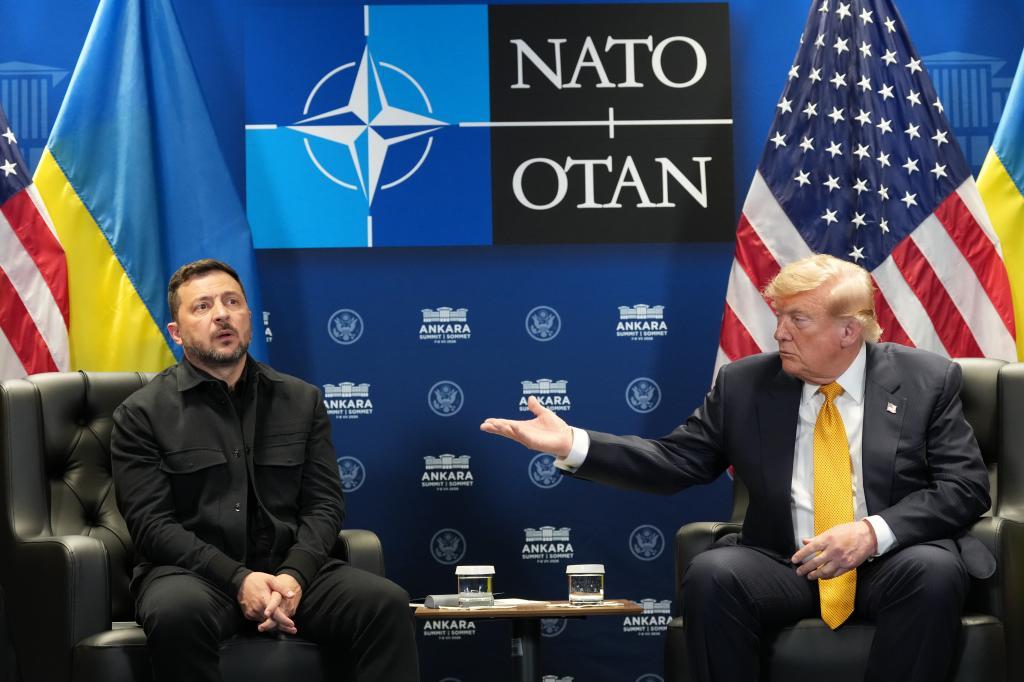
The NATO summit in Ankara was seen, for the Alliance itself and even for the European Union, as a very challenging survival exercise given the tough confrontations many of the most important allies had experienced in recent weeks. US President Donald Trump has only fueled those fears since arriving in Turkey. First, by reiterating his expansionist threats over Greenland. "I have always thought it should be controlled by the US, not by Denmark," he stated on Tuesday.
And then, directly attacking Spain, stating that he will cut all trade relations with the country for its refusal to increase military spending beyond 2% and not granting him the Rota and Morón bases during the Iran campaign. "It is a terrible ally in NATO. They do not participate, they do not pay. I do not want anything to do with Spain. Cut all trade with Spain, please, including visits. We do not want anything to do with them," he asserted at the start of the second day of the summit.
Therefore, the final outcome can be considered satisfactory. Europe, indeed, buys time and appeases Trump with increased military spending. Much more. "Europe and Canada will spend a total of 258,000 million dollars [about 225,000 million euros] between 2025 and 2026," announced NATO Secretary General Mark Rutte, who also announced over 40,000 million euros in new acquisitions. This does not mean that the US President will not continue to strain the Alliance. In fact, it is very likely to happen again, and the threat will remain. However, the final interventions of the leaders have been positive, and European allies have even managed to involve the US President to some extent in the fight against Vladimir Putin.
The final joint declaration clearly states that Russia is "a long-term threat to Euro-Atlantic security and stability". "Ukraine contributes to transatlantic security, and the Allies remain united in their unwavering support for Ukraine to defend its freedom, sovereignty, and territorial integrity," the document continues, in which "the Allies commit to providing 70,000 million euros in military equipment, assistance, and training" for the country. Trump himself has announced that he will grant the country led by Volodimir Zelenski the "right to manufacture" Patriot defense missiles. "Not bad, right? So they can't complain that we don't give them enough," the tycoon said to the Ukrainian president.
"It was a great meeting, there was a lot of love in that room, a lot of unity," he summarized in his final press conference, thus completing the total turnaround he made in his position throughout the summit that ended on Wednesday in the Turkish capital. French President Emmanuel Macron described any possible conflict between allies as "political fiction" and also highlighted the "great unity" that was observed inside the room. Spanish Prime Minister Pedro Sánchez also expressed great satisfaction with the meeting and the final document, even though the goal of investing 5% of the Gross Domestic Product (GDP) is emphasized. Secretary General Rutte made every effort to make it clear that everything is in order. "There was an enormous sense of unity. I had not seen anything like this in the recent history of the Alliance, and that is what I have always believed NATO represents."
The aforementioned final declaration also emphasizes "reaffirming the unwavering commitment to collective defense under Article 5 of the Washington Treaty and to the transatlantic bond." Also, of course, the more prominent role that Europe is obliged to take in its own defense, and a final reference to Iran. "The Alliance continues to respond and adapt to strategic competition, widespread instability, hybrid threats, and recurring disruptions that characterize our broader security environment. The Allies reiterate that Iran must never possess a nuclear weapon and call on Iran to fully respect freedom of navigation in the Strait of Hormuz," the document points out. It is probably insufficient for Trump, but for now, as mentioned, it seems to have served to make progress.
The next meeting will be in Albania next year, something that was not clear to materialize because there was speculation that the meetings would no longer be annual. But the summit has been confirmed by Rutte, who has also passed a very difficult exam. Perhaps in Spain, and certainly in Denmark, they do not think the same. He has avoided condemning Trump's expansionist plans that were so unpopular with Danish Prime Minister Mette Frederiksen; he has barely defended Sánchez from the tycoon's attacks; and many have confirmed their belief that he is too flattering to the US President. But he has successfully completed another summit.