For a supposed financial guru like Amadeo Llados to claim that a university degree is 'a piece of paper that doesn't guarantee a damn thing' - after all, he says, 'it doesn't prepare you to make money' - might sound like a joke. But for Palantir to offer a meritocracy scholarship to attract personnel in high schools without setting foot on a campus is a direct challenge to traditional universities. Because the U.S. company that provides surveillance software based on artificial intelligence to armies and spy agencies has its own proposal for young people: "Avoid debt. Avoid indoctrination. Get a Palantir degree." In essence, the company behind the controversial manifesto to make the U.S. a technological republic, seen by many as a spearhead of the techno-fascist revolution in the West, advises forgetting about the gown and mortarboard.
"The University is facing a very serious crossroads," warns Ricard Martínez, a Constitutional Law professor at the University of Valencia. "Palantir is a paradigmatic example of multinational companies displacing university degrees by stating that the training they provide is what matters," insists this privacy and AI expert. And indeed, he warns that the University is risking "in terms of credibility, costs, and competitiveness" if it turns its back on AI and fails to ride the upcoming wave. "Rejecting AI solely due to our concerns about dishonest students using it to cheat means giving up on their education. It means leaving our students behind," he comments regarding a challenge much greater than the talent recruitment by Apple, Google, or IBM outside the classic academic circuit almost a decade ago.
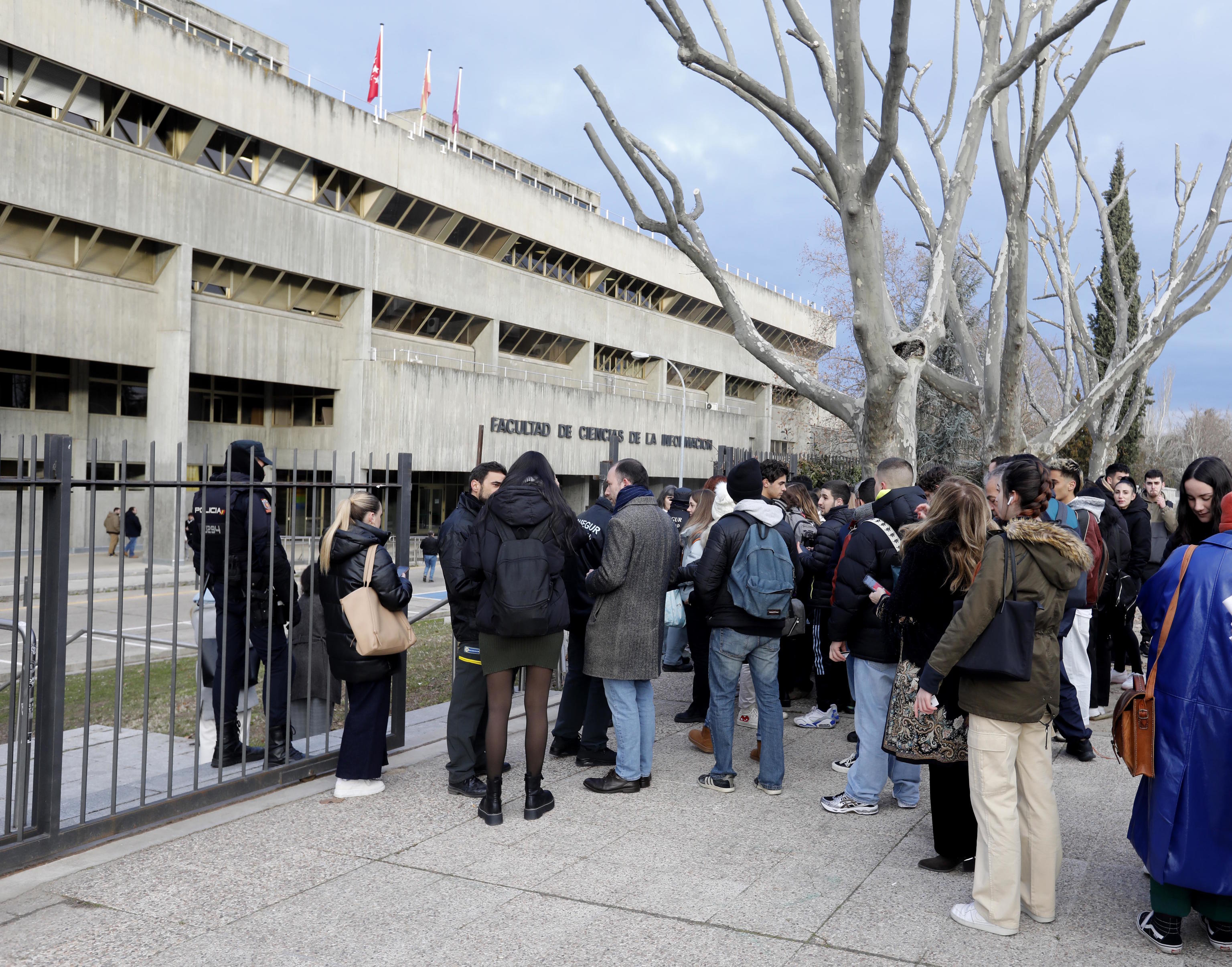
The recent university entrance exams have left a disturbing image: the first exams monitored with radiofrequency detectors to prevent teenagers from cheating using their phones through ChatGPT or wireless nano earpieces. What will these same students encounter in the next academic year at the next educational level? What are Spanish campuses doing besides trying to detect assignments rewritten by conversational agents? Is the University prepared to survive the impact of AI? With its emergence, educators foresee a complete break from the teaching model that has prevailed in classrooms for centuries.
"No one is prepared," confesses Senén Barro, a Computer Science and AI professor and scientific director of the Research Center in Intelligent Technologies at the University of Santiago de Compostela. "No one at this moment can say they are at ease because everything is being done in an orderly and planned manner with AI. No one."
To start with, Martínez warns: "There may be personnel implementing open-source AI models or models from third countries in highly sensitive research projects, which are at risk of being hacked from outside." "It's sad to have to say it," he adds, "but there is a significant lack of privacy culture, security, and regulatory compliance."
"Even I don't know what should be done," Barro summarises one of the major issues: the frantic pace of changes. "Advancements are so rapid and dizzying that there is no time to assimilate them. We are being overwhelmed by the speed at which these technologies are being deployed, universalized, and used." For example, any guide on using generative AI - which creates content based on our instructions - will become outdated in a few months. "People are moving at a pace that machines are not keeping up with." Let alone university timelines.
Despite that, he believes that the University is one of the areas where AI penetration has been "explosive." Precisely because the latest advancements directly impact cognitive work. That is, everything related to the daily lives of teachers, researchers, and students. "We are an institution of knowledge, where AI is currently developing all its capabilities. In the University, like in no other field, misuse can have disastrous consequences," adds Barro.
Here comes the second major problem threatening campuses: "The worrying aspect is that we are unable to anticipate the type of work that young people will have to carry out in different sectors of activity."
José Capilla, who is also the rector of the Polytechnic University of Valencia, questions, "Are universities prepared for AI because if not, who would be?" However, the concern running through campuses is not hidden: "We are worried because there is still no answer to what and how we should teach from now on."
Nuria Oliver delves even deeper. The AI Ph.D. from the Massachusetts Institute of Technology (MIT) and director of the ELLIS Foundation believes that "artificial intelligence has brought to the surface a reality that has been latent for decades: the educational model still follows that of a society from the Second Industrial Revolution, when we are already in the fourth."
Amidst the confusion, we find a practical case of adaptation to the context. The Polytechnic University of Valencia has just launched a chatbot capable of advising and guiding students and their families directly. Of course, this is not the only example of AI utilization. Other Spanish institutions have started working with tools that predict early student dropout and allow for preventive action. Not to mention the use of online teaching avatars available for 24/7 tutoring.
The emergence of AI has questioned a model that was already under scrutiny, as it "has accelerated and amplified the need for modernizing the system." According to Oliver, this technology "forces an update on what is taught, how it is taught, and how it is evaluated."
Ricard Gómez, vice-manager of Talent, Transformation, and Organization at the UOC, emphasizes this existential crisis that the university was already experiencing. "Before the printing press, knowledge was held by a few monks. With the printing press, knowledge became widespread. Now the change is deeper because knowledge is in the hands of anyone with a mobile phone, even if they can't write," he reasons.
"A 75-minute monologue has the same competitive advantage as a fax"
Knowledge is no longer the exclusive domain of the University. Put differently: if in the past, students enrolled in a university to acquire knowledge, now students enter the classroom with an electronic device in their hands that gives them instant access to that knowledge. Before the professor even starts speaking. This "alteration of the rules of the game," in the words of the head of the Catalan online university, has a not-so-distant precedent that explains where we are today: "People stopped going to class due to the pandemic, but they kept learning."
So, where does the role of the University stand when many point to YouTube as the world's largest training platform? Gómez is clear: the university institution still retains 'the accreditation of learning' against tutorials. The value of the degree, in turn, explains the campaigns to discredit it from different sectors.
What cannot be overlooked is that "the university lecture is in a terminal crisis," acknowledge educators. The professor of Applied Economics Andrés Pedreño, former rector of the University of Alicante and founder of 1MillionBot, recently wrote in an article titled The University Facing Agentive AI: Wake Up or Perish Forever. To put it simply: "A 75-minute monologue has the same competitive advantage as a fax."