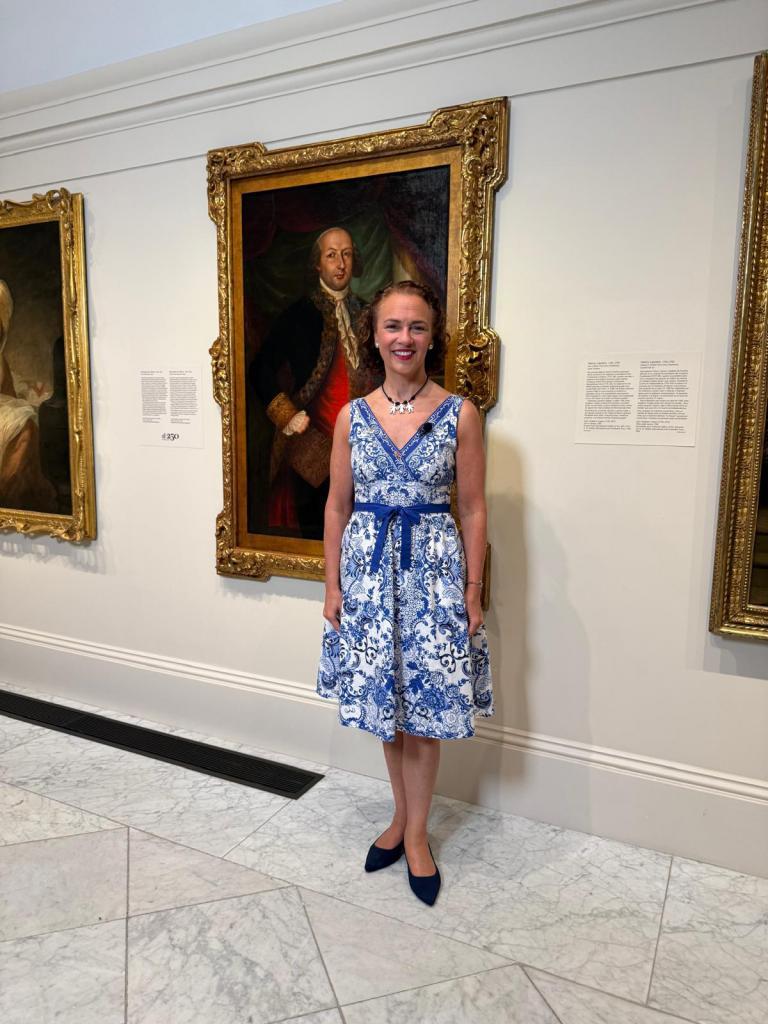
On October 31, 2014, under the vaulted ceilings that cover the Washington DC metro stations, Teresa Valcarce took her usual train to work. Sitting in the car, she saw a passenger sit in front of her and open a newspaper. When she focused her gaze, she was perplexed, almost to the point of trembling. "Could you give me the newspaper you are reading, please?" she asked. The surprised passenger looked at her, and she continued. "...The one on the cover is me...".
Teresa had achieved something unimaginable.
In the previous months, this woman from Ferrol called the editorial office of The Washington Post, the newspaper of the Watergate case and a media sentinel of the country's political capital, every week to pitch them "a story." She had spoken with a bunch of journalists who either brushed her off or simply didn't return her calls. Until one day, seeing her persistence, one said, "I'll give you 10 minutes, and I can't guarantee I'll write anything." The 10 minutes of courtesy turned into an hour and a half of conversation and then into the extensive report she found that day on the metro.
This is the story of how a courageous Spanish woman, without any institutional position and with an anonymous profile, managed to get the United States to fulfill a promise pending for 231 years to compensate a forgotten Spaniard who had been crucial in the birth of the nation.
Teresa Valcarce's adventure, which deserves to be remembered during the celebration of the 250th anniversary of the U.S., began with another article, this time from the Spanish press. "My mother had sent me a news article from the Sur newspaper in Malaga about the research by historian Manuel Olmedo Checay and the discovery of a letter from 1783," explains Valcarce. That letter written by Elias Boudinot, president of the Continental Congress of the U.S., to Oliver Pollock, a banker crucial in the American Revolution, communicated the acceptance of a gift: a portrait of Bernardo de Gálvez (1746-1786). The letter also included a resolution: the painting should be "placed in the room where Congress meets."
However, the painting was never hung in its intended location.
The portrayed protagonist, Bernardo de Gálvez, had been the Spanish governor of Louisiana during the war and a key figure in the final victory of the colonists, as he freed the Mississippi and the Gulf of Mexico from English presence. Just in the capture of Pensacola, in Florida, this military leader captured 14,000 prisoners and 153 artillery pieces. His role was so significant that George Washington even stated that, without his help, the independence venture would have been a failure.
Carlos III granted Gálvez the title of count and allowed him to include in his coat of arms the motto: "Yo solo," in recognition of the military feat of Pensacola that made him famous.
However, two centuries later, Spain was not doing justice to one of its greatest military heroes, while the U.S. was failing to fulfill a promise from its ancestors to pay tribute to him in the most important place of its political sovereignty.
Until Teresa Valcarce appeared, of course, a kind of fusion between Erin Brockovich and Don Quixote of historical memory, who, being a simple administrative employee in an educational institution, was going to shake up the power dynamics in Washington with the goal of having Bernardo de Gálvez pose where he deserved. "There is no university in the world that could have taught me what I learned about legal matters, diplomacy, and history," acknowledges Valcarce.
The first thing she did was obvious: call the Spanish embassy in Washington. "They told me that they couldn't demand that, that only a U.S. citizen on a personal basis could do that," Valcarce recounts. "Since I had been a U.S. citizen since 2007, I decided to take the step: I wanted my adopted country to fulfill the promise to the country of origin." It was a step that the Bernardo de Gálvez Cultural Association of Malaga had also unsuccessfully attempted.
Valcarce consulted the archivists and historians of the Capitol for information, who, due to her persistence, dubbed her with the nickname The lady of the portrait. She also contacted jurists to study legal precedents. She gathered all the information she could and moved on to the next phase: convincing politicians.
"In the U.S., there is a great democratic culture that allows you to speak with the congressman representing you," explains this activist. She spoke with him, and despite his interest, she realized she needed much more support and to learn how to handle Washington's machinery of interests. Who would be interested in campaigning for a Spanish military man who died two centuries ago? "You have to push this in the press," advised a politician. So Teresa began her barrage in search of publicity for her cause in the Post and other local media, in addition to contacting the Spanish press. However, her efforts were in vain. The U.S. Congress dismissed her request.
-Did this mission cost you money out of your pocket?
-Yes. I stopped keeping track when I saw on my Excel sheet that it exceeded $8,000 in expenses.
Valcarce did not give up. She discovered she had another card to play: the Senate. She met with a senator who years earlier had tried to present the candidacy of Bernardo de Gálvez for the title of honorary citizen of the nation. It was dismissed in the first vote. She met with him. Gálvez's ambassador in America in a way became a lobbyist, learning all the tricks of politics, a kind of Iberian House of Cards. "I felt like a goldfish in a tank of sharks," she says.
She spoke with the secretaries and employees of senators in the Senate hallways, attended all kinds of events, wrote emails tirelessly. The rejections did not matter to her.
A testament to her devotion to her cause was the time she came across a sign announcing that Ted Cruz, a powerful senator from Texas who would shortly after unsuccessfully attempt to secure the Republican nomination against Donald Trump, was hosting a breakfast for the influencers of his state. Valcarce saw an opportunity.
"While waiting for my turn to pass the screening, I thought about the Sons of the American Revolution, a patriotic non-profit association that brings together descendants of those who fought for independence and who supported me from the beginning. So I said that I had the support of 10,000 Texan Sons of the Revolution and the Granaderos de Gálvez. They let me in. I greeted Cruz, had only 30 seconds with him while they took a photo of us, I told him about the case, and mentioned that the city of Galveston in Texas was named in honor of Bernardo de Gálvez. Cruz said yes and asked me to speak with his staff to study the issue."
She had stormed Texas. She did the same with Dakota. Florida... This is how she managed to speak with dozens of senators to explain the historical importance of Gálvez.
-Why did you get involved in this mess?
-Out of love for Spain. I am a mother and I see my two nationalities as two children. One biological, which is Spain, and the other adopted, which is the U.S. I love them equally, with their virtues and defects. Spain gave me everything, and you remember the absent child a lot when you are far away. As María de Villota said, I achieved it because I had no idea it was impossible.
-Did you ever consider giving up?
-Once. One person really made things difficult for me. I won't reveal who it was, but they made me cry on more than one occasion by creating unimaginable obstacles for me.
The demands for support to get Gálvez into the Senate were enormous. But Teresa found influential allies, such as New Jersey Senator Robert "Bob" Menéndez—of Cuban origin and of Spanish descent—whom she approached at an event held at the Spanish ambassador's residence. "This is important," Valcarce told him.
Despite the progress, politicians were calling for more public pressure. To keep her dream alive, Valcarce was required to secure an extremely high number of endorsements, both in Spain and in the U.S. She contacted more associations, received letters of support, secured testimonials from long-forgotten clubs in remote towns across the southern U.S. that backed the Gálvez project, and even gained the endorsement of a genealogical society in Bexar, Texas—all armed with nothing more than a phone and an email address. In Spain, with the help of historian Olmedo, she garnered support from provincial councils, libraries, and universities. In the end, just like in the movies, at the eleventh hour, Valcarce submitted 31 letters in her official claim representing "four and a half million people." A month later, she was able to add a letter that thrilled her immensely: one from the Spanish government.
But not all the challenges were administrative and legal: for the time being, there was no painting by Gálvez to hang. The 1783 letter gave no clues as to its whereabouts. Valcarce searched for it in New York, Philadelphia, and New Jersey, speaking with museums and collectors. Nothing. So he turned, once again, to the expert Olmedo, who knew of another portrait of Gálvez, one that belonged to a private collection in Málaga.
It was a work by Mariano Salvador Maella, a painter at the court of Charles III, painted in 1784 and likely a gift from the king to Gálvez. The artist Carlos Monserrate offered to make a copy, which would be the one to travel to the U.S.
This faithful replica, depicting Gálvez at the height of his reputation, measures 90 x 120 centimeters. There was already support, there was already political will, and, most importantly, there was already a painting.
In 2014, the U.S. finally fulfilled its promise, and the portrait of Gálvez was hung on the west wall of Senate Room S-116—a place where the Senate Foreign Relations Committee debates legislative proposals and holds meetings with heads of state.
"The ceremony was very moving," recalls Valcarce. "Just as they were about to cut the ribbon, the Spanish ambassador—who was a true gentleman—called me over in front of the senators and said, 'Teresa, you have to do this.'"
The debt was paid in full.
But the story of Bernardo de Gálvez, victorious at Pensacola, does not end there. Shortly before Christmas 2014, President Barack Obama signed the resolution granting him honorary U.S. citizenship. This honor has been bestowed on only seven other foreigners in all of history and is awarded for extraordinary contributions to the country.
This legal status as an American has also allowed Gálvez to be featured at the Smithsonian. A portrait of him painted in 1781 by José Nicolás de Escalera—acquired and restored thanks to the Iberdrola Collection as part of its "Unveiling Memories" project—is on display at the National Portrait Gallery in Washington.
This unofficial ambassador has received her honors. In 2017, she was awarded the Commendation of the Order of Civil Merit, and her hometown, Ferrol, has honored her. During their first official visit to Washington, the King and Queen thanked her in person for her work.
-Has Spain been generous to you?
-I am very grateful to the Spanish people. For me, what matters is that credit be given to civilians who do things for their country. I remember years ago a young man who wrote to me to tell me that he had seen the forgotten grave of the first governor of California—who was Spanish—and that he wanted to fight to ensure he had a decent headstone. These examples are moving and very important.