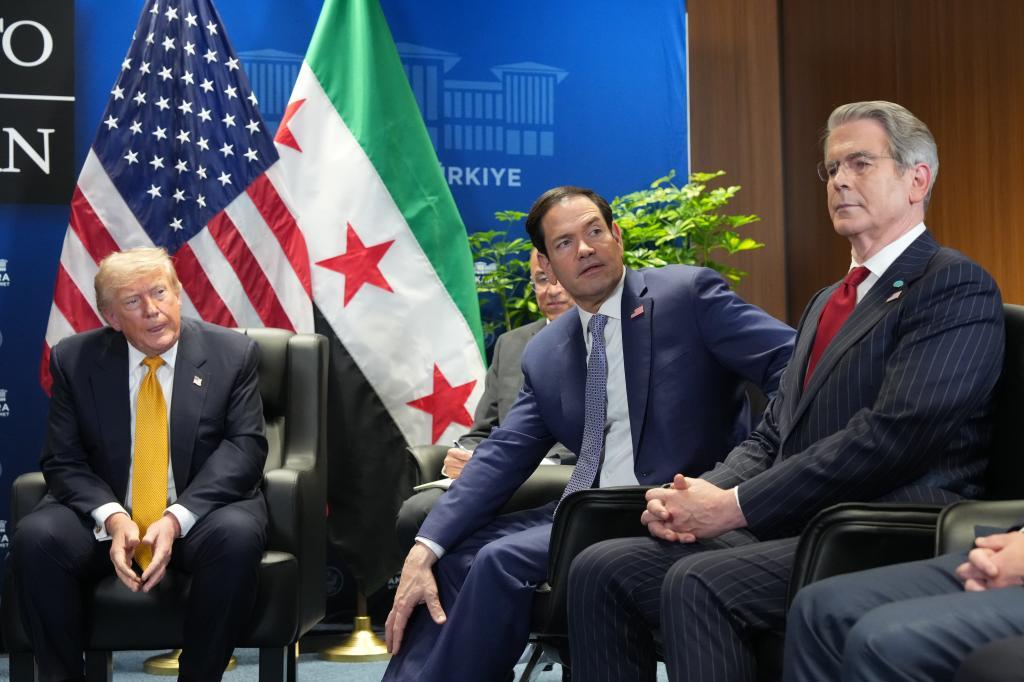
It was the German Chancellor, Friedrich Merz, who revealed that the Prime Minister, Pedro Sánchez, had extensively explained behind closed doors the effort made by his government to increase military spending and that Donald Trump reacted positively. Merz was particularly interested in having Sánchez help appease Trump at the important NATO summit in Ankara, and the Spanish socialist did not add fuel to the fire.
The US President later made public statements about Spain that were inconsistent with his earlier ones, but it was clear in Ankara that his pressure on Sánchez would continue, despite his coalition government with Sumar having increased defense spending from 12.828 billion in 2020 to 35.670 billion last year, according to the latest official NATO data.
Meanwhile, Trump left his worst attack on Spain in recent history in Ankara. The most concerning aspect is not that the United States will implement an unfeasible order from Trump to cut off imports and exports with a European Union member state, as Brussels has exclusive competence in trade matters. The most negative aspect for now is how Trump's comments about Spain and the "yes, sir" response he received when he ordered even "visits" by senior Spanish officials to Washington to be cut off have spread worldwide.
This "yes, sir" was uttered by his powerful Treasury Secretary, Scott Bessent. This financier, former manager of George Soros' funds, is Trump's reference on Wall Street and can put into practice more of the President's bravado than it seems. Not only does he have the power to impose harsh sanctions invoking "national security" or competition distortion, which are extreme measures. His power goes beyond that. The presidents of the world's largest multinational corporations pass through his office, and if he wants to portray Spain as a bad partner currently, it is more dangerous than one might think.
An indication of the challenging climate perceived by investors is this dispatch from Reuters: "Spanish markets, hit by Trump's renewed threat." It reported how the Ibex 35 was the worst performer among the major European indices with a 2.73% drop.
And what about trade relations? They have deteriorated with Spain, according to the latest official US data collected up to May of this year. US imports of Spanish products have fallen by 14%, while sales to Spain have remained at similar levels. This has resulted in a 54% improvement in the US trade balance in the first five months of 2026 compared to the same period last year.
Experts consulted find it very difficult to establish a cause-effect relationship between Trump's attacks on the Spanish government to explain this decline, which has been influenced by tariff policies and other multiple factors. However, when comparing how the trade balance has evolved with Germany, France, and Italy in the same period, there hasn't been as much proportional change in favor of the US.
As for investments in Spain, their evolution has been very negative in the first months of the year. As reported by this newspaper on June 23, net investment from the US in Spain plummeted by 719.48% in the first quarter of 2026. The reason is not that the flow of investment has been interrupted, but rather that disinvestments have surged. According to official Ministry data, US companies reorganized in a way that they withdrew 3.335 billion in one quarter. This represents a 533.8% increase compared to the same period in 2025, making the gross 1.359 million that entered from the US in the first quarter imply, in net terms, a real decrease of 1.976 million. If this trend were to continue, it would be serious, as the US is the top foreign investor.
There are counterpoints. The world's largest fund, BlackRock, continues to bet on the Spanish stock market, given the country's differential economic growth confirmed by the IMF this Wednesday. "Spain remains our preferred country for equity exposure. Although valuations seem less attractive compared to other countries, its internal growth remains the strongest in the region," said the fund chaired by Larry Fink this week.
Spanish investments in the US also help maintain relations. Banco Santander, which fell 5% on the stock market on Wednesday, is processing the acquisition of the US bank Webster, and its president, Ana Botín, expects to complete the deal this year despite Trump's statements. On the other hand, Iberdrola announced yesterday that it is starting the installation of a solar plant in Oregon, which "strengthens its commitment to the United States," said the company chaired by Ignacio Sánchez Galán in a statement.
The issue is that any Spanish entrepreneur interested in doing business in the world's leading economic power faces a climate of tension summarized in headlines by major international economic media. "Trump renews his call to cut off trade with the 'terrible partner' that is Spain," said Bloomberg. "Spain is a lost cause, says Trump, while threatening to cut off trade," titled Financial Times. "Spanish stock market falls after Trump's threats," reported The Wall Street Journal. As the President of the American Chamber of Commerce in Spain, Jaime Malet, told this newspaper, the US has more to lose in this bilateral tension: "Spain has no real alternative to a strong alliance with the US."
Meanwhile, Sánchez's rhetoric at rallies is not the same as in Moncloa. The Council of Ministers, before flying to Ankara, agreed to increase military spending by another 6.200 million through credit transfers. The Sumar ministers also. Everyone knows that Trump cannot eliminate trade, but they also know that his threats are not harmless.