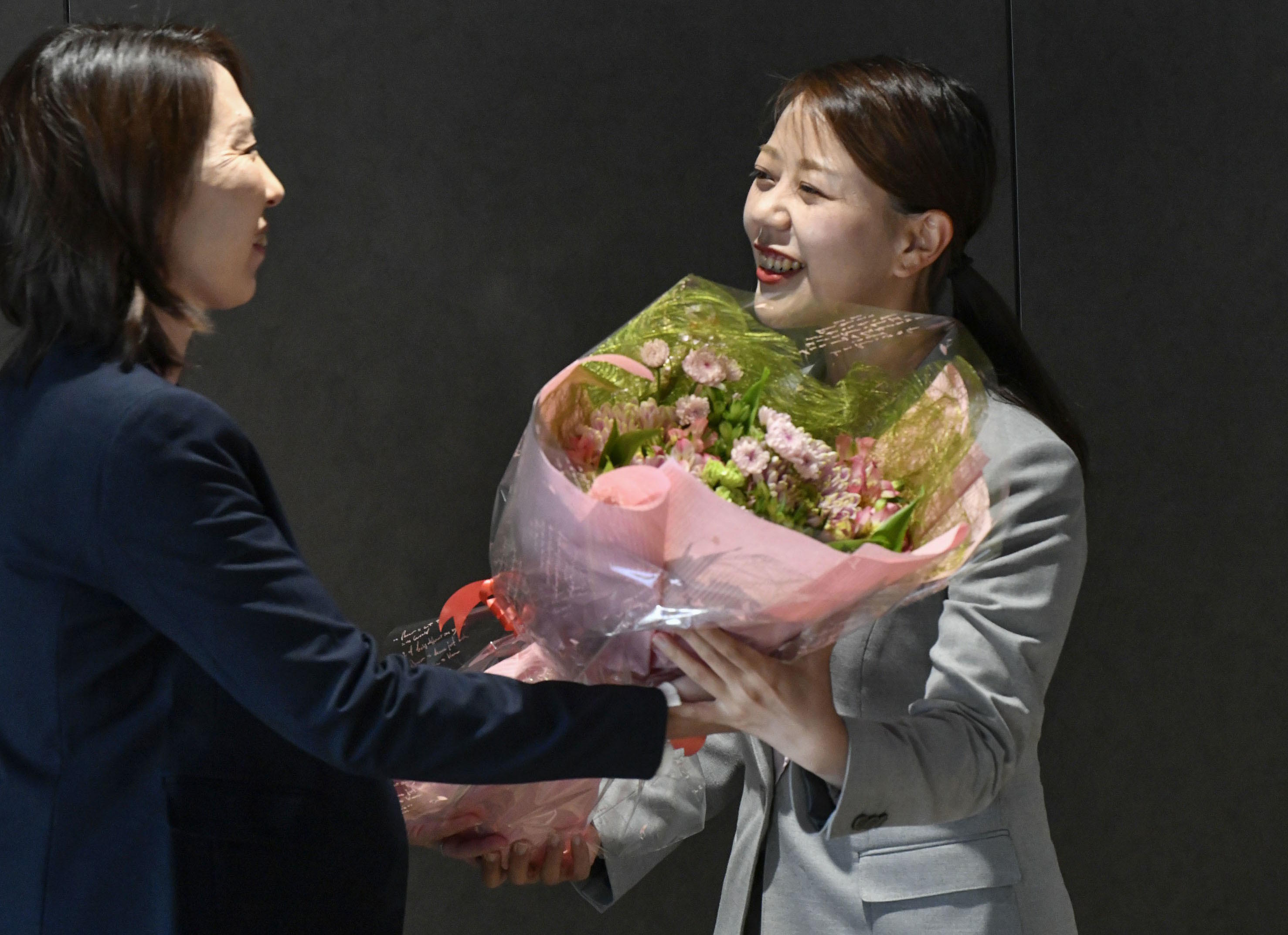
In any Western democracy, the news would have barely warranted a mention in the local press: a mayor announces she will take maternity leave to give birth to her first child. But when Shoko Kawata announced her decision, the news made national headlines and sparked a discussion that goes far beyond her personal case: the challenge of balancing power and motherhood in a very conservative society where both concepts are still seen as incompatible.
Since May, Kawata's decision, mayor of the city of Yawata in Kyoto Prefecture, to temporarily step away from her position to have a baby has sparked a national debate. What is being debated in 2026 is the ability of an aging society, obsessed with work, and still deeply influenced by traditional gender roles, to accept that a woman can hold political leadership without giving up motherhood.
At 35, Kawata had already broken several molds before becoming pregnant. In 2023, she became the youngest mayor in the country. An economist and former social worker, she campaigned on promises to improve family support policies and combat the depopulation affecting Yawata, whose population has steadily declined over the past two decades.
Now, unintentionally, she has become the face of another battle. The mayor announced that she will take 16 weeks of leave, eight before and eight after childbirth, following the usual scheme applied to Japanese workers.
The issue is that, legally, she is not just another worker. Mayors and other elected officials are excluded from labor legislation. There is no specific legal framework in Japan that considers maternity leave for those holding public positions elected by the people.
This has forced the Yawata City Council to improvise an unprecedented administrative solution. During her absence, a vice-mayor will assume executive functions. Meanwhile, Kawata will continue to receive information on important matters and participate, when possible, in online meetings.
"The decision to take maternity leave was not difficult because I never considered childbirth and public office to be incompatible," explained the mayor herself in an interview with the Japan Times.
"I simply felt it was something that should be accepted as normal". She also added that pregnancy and childbirth entail an obvious physical burden and that refusing to rest would send a dangerous message to other women. "I also felt it was important not to reinforce the idea that pregnant women should not take time to rest, even in a highly visible leadership position."
Her seemingly common-sense words have opened a small crack in a political culture where absolute availability is still considered an essential virtue of leadership.
Japan has a long tradition of personal sacrifice associated with holding power. Political leaders boast endless workdays, packed schedules, and almost total dedication to their positions. The idea that a mayor can be absent for months to care for her health and child has been criticized by some conservative sectors as a temporary resignation of her responsibilities.
Critical comments quickly emerged, both on social media and in more conservative media outlets. Some messages have questioned whether a person holding an elected position should have the right to be absent. Others have suggested that a woman aspiring to such high political responsibilities should postpone motherhood.
Such reactions are particularly concerning to feminist organizations that have been denouncing the low presence of women in Japanese politics despite a woman, Sanae Takaichi, currently serving as the Prime Minister of the world's fourth-largest economy.
Less than 15% of national parliamentarians are women and only 18% of local elected positions are held by women. Among the country's 1,741 municipalities, less than 5% have a woman in charge. Japan also continues to rank very low in international gender equality indices, lagging far behind the major economies of the G-7.
"There is a deeply ingrained pressure that the higher the position a person holds, the less right they have to take maternity or paternity leave," recently noted Miho Konishi, a researcher at the Tokyo Foundation, one of the country's leading think tanks. "This creates a vicious circle where those at the top do not take leave, and those below feel they cannot either."
The Mainichi newspaper, one of the most influential in the country, has firmly supported the mayor in a recent editorial. The problem, the publication argued, is not that a female political leader has a child, but that institutions have not yet developed normal mechanisms to handle something as common as pregnancy. "Japan needs to create an environment where people can take such leave as a standard practice", the editorial demanded.
Perhaps that is why the debate has taken on a dimension that transcends a small city in Kyoto Prefecture. What is at stake is not just the four months of absence of a mayor. It is the question of whether Japan is willing to abandon the old idea that leadership means sacrificing any personal life.