The soldiers of the 118th Mechanized Brigade proudly proclaim that their forces have surpassed the military record of any siege or battle fought in the past. They mention the 1,320 days of the Spanish-French siege of Gibraltar in the 18th century, the 1,100 days of the Roman assault on Carthage, or the more recent struggles for the control of Leningrad (872 days) or Stalingrad (200).
Mala Tokmachka surpassed the 1,600 days of siege several days ago, and as part of the aura that is being created around this enclave, the authorities of the so-called Ukraine Records Book awarded a diploma to the commander of the 118th attesting that he has "set a national record in the continuous defense of the village."
As reported by Pravda Ukraine, until February 2022 - when the general Russian invasion began - news about Mala Tokmachka "only appeared on the village's website," located in the province of Zaporiyia. Now, that name generates hundreds of thousands of links on Google and has been the inspiration for countless memes and even a video game.
According to Dmytro Pelykh, spokesperson for the unit, speaking to the BBC, the soldiers resisting in Mala Tokmachka have started to be called cyborgs, a nickname given to those who fought at Donetsk airport at the beginning of the war in 2014, which later inspired movies, books, and even wax figures in one of the main local museums.
The Russian narrative claims that Mala Tokmachka was captured by their forces on November 16, 2025. This was announced by the Ministry of Defense. The head of that department, Andriy Belousov, emphasized several times the importance of the occupation of the village and publicly congratulated the soldiers of the 42nd Motorized Rifle Division for this achievement.
The public statements of the Russian authorities were echoed by bloggers who fuel propaganda aligned with the Kremlin, turning something untrue into a mantra. The response on social media turned into pure mockery.
"Whoever controls Mala Tokmachka controls the world", read one of those memes, playing on the fact that the village had no more than 3,000 inhabitants before 2022 - now it is devastated - and occupies only 8 square kilometers.
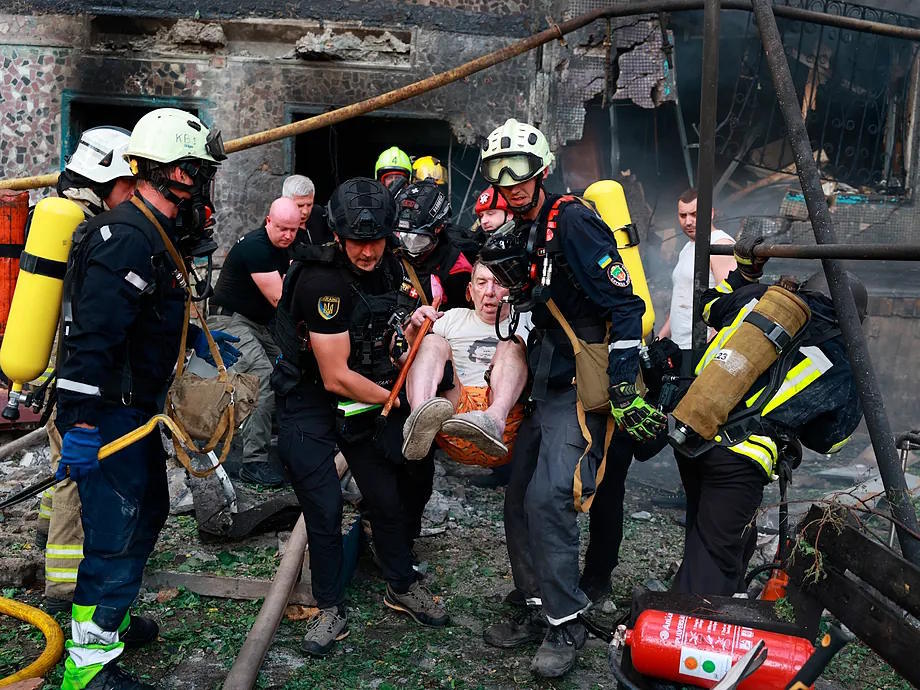
A rescuer from the State Emergency Service in front of a destroyed house in Zaporiyia.Dmytro SmolienkoGetty
"Every month, the Russians claim to have occupied Mala Tokmachka but have not advanced a meter. The Russians themselves make jokes about what their generals say, which have been banned in universities. They are also losing the information war," explains Dmytro Pelykh to this newspaper.
The mockery does not hide the fierce battles that have been fought for control of that enclave. The soldiers who have fought have witnessed close combat that has left the territory littered with decaying corpses in the fields.
Voices from Mala Tokmachka
Andriy Everest, a 36-year-old soldier, went through that harrowing experience. He was there until last March when he was injured. He spent four months hidden in a bunker with another Ukrainian, Yuri, unable to be relieved from his position. The Russian forces tried to assault the stronghold, bombarded it with artillery and drones, and practically destroyed it. But they could not capture it, he says.
"Once I was in the shelter with Yuri (his companion). Two Russians entered without realizing we were there. We were shooting until they were injured and fled. When they left the shelter, our drones killed them. Another time, six Russians attacked us. They threw grenades, but a mortar destroyed them. We could smell their bodies decomposing outside," he recalls.
The Ukrainian lost 25 kilos during that period. "When I left the bunker, everything had changed. The trenches no longer existed. They had been erased by the bombings," he adds.
The last major assault on Mala Tokmachka occurred just after the 118th received its particular Ukrainian Guinness for resistance. On June 16, the forces of Moscow launched an attack on the village with dozens of motorcycles. In broad daylight. Dozens also died, according to Ukrainian soldiers.
"They would have to be Harry Potter to avoid us detecting them. They usually die halfway. Long before they get close," explains Ivan Cruz, another 41-year-old soldier from the 118th.
Reasons to dominate the village
The Russian publication Meduza indicates that the endless struggle for control of Mala Tokmachka is a symbol of "the unrealistic goals set by the Russian command for its troops" and a reflection of the slowdown in the advances of the Moscow army this year, confirmed by a plethora of international observers.
Zaporiyia is the best example of this shift in the military situation, as at the end of last year, the Russian army made a significant advance in this province after capturing the city of Huliaipole. At that time, the soldiers of the neighboring country even distributed a video showing them in one of the local defense command posts of that city, surrounded by computers, documentation, military maps, and even personal phones, in a scene that seemed to indicate a hasty retreat by the Ukrainians.
"We are in the city center. Only a few streets remain. Victory is ours," could be heard from the Russian soldiers.
The Institute for the Study of War confirmed in February that the Moscow army had captured the town - where about 13,000 inhabitants used to live - after 3 months of fighting. However, the crisis that seemed to anticipate a rapid Russian progression towards the provincial capital, the city of Zaporiyia - a large urban center where nearly 700,000 people live - was contained after reinforcements arrived.
The head of the Ukrainian military, General Oleksandr Syrskyi, stated in March that the soldiers under his command had retaken at least nine villages in the region, confirming the shift in the battlefield.
Despite the Russians balancing these territorial losses with their constant advances in Donbass, the Institute for the Study of War (ISW) considered their announced spring and summer offensive a total failure as they are now only able to control a little over a square kilometer per day, compared to around 500 in the same period last year.
Russian President Vladimir Putin continues to cling to the hypothesis of an "imminent victory" for his army and in a meeting on the third of this month with several high-ranking officials, proclaimed that his country's military was only nine kilometers from Zaporiyia, when in reality they are dozens away. A "fabricated reality," as defined by ISW.
The Ukrainian army has created an intricate defensive line in Zaporiyia that can be seen when traveling the roads of the region towards Orikhiv or Huliaipole. Deep anti-tank trench lines, aligned in triplets, complemented with barbed wire and concrete dragon's teeth, extend for kilometers and kilometers.