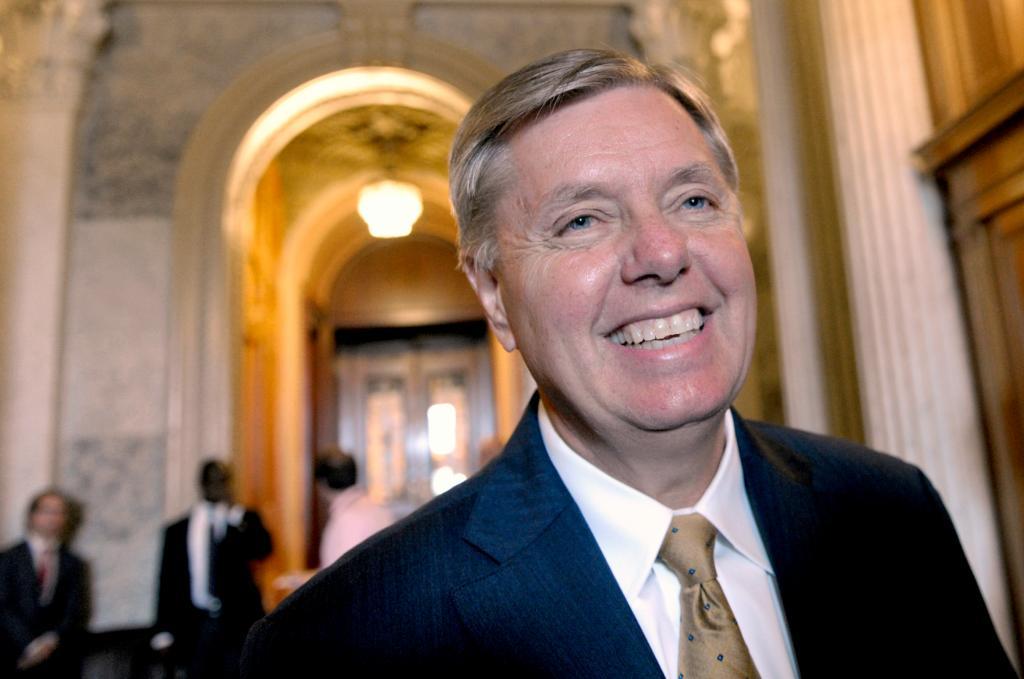
Lindsey Graham, a Republican senator for a quarter of a century, former presidential candidate, indispensable ally of Donald Trump and Israel, and one of the major hawks in recent U.S. foreign policy history, passed away on Saturday afternoon due to cardiac complications. He was 71 years old, with almost all of them dedicated to politics in one way or another, and was facing reelection once again this November, after recently defeating all those who aspired to replace him in his party's primaries.
Graham's death shortly after returning from Kiev, where he met with Volodymyr Zelensky, and while the U.S. was once again bombing Iran, perfectly illustrates the stance of one of the main lobbyists in favor of aggressive foreign policy and military use in the world. To confront Russia, China, and certainly in Iraq, Afghanistan, Iran, etc.
However, the senator's passing while another veteran colleague, Mitch McConnell, the Republican majority leader for 20 years, is gravely ill, even better summarizes an end of an era, that of politicians who lived through the Cold War, who played a role in the resurrection and transformation of their party, and who, through their actions and omissions, allowed Donald Trump to engulf the Grand Old Party, survive the Capitol assault, and return to the Oval Office.
Graham epitomized the Weberian ideal of that old guard of Republicans and the "warriors of the Cold War," the 'warmongers' or war advocates that Trump always criticized and scorned, but ironically adored. Always advocating for more intervention, more presence in the Middle East, more troop deployment. He transitioned from seeking consensus by reaching out to Democrats, for example on environmental issues, climate, or even immigration, to becoming a conservative hammer in search of leftist nails. Doing whatever was necessary to maintain power, but also to prevent the most isolationist wing of the MAGA world from taking control of international affairs.
"Senator Lindsey Graham, one of the best individuals and senators I have known, has passed away! He was always working and was a true American patriot. We will greatly miss Lindsey!," Trump wrote on his social media. Throughout Sunday morning, the president participated in numerous television programs to remember his golfing partner, friend, advisor, and former rival and critic.
With Graham's passing, the last generation of politicians shaped by the fight against the USSR, marked by 9/11, and believers, in their own way, in internationalist consensus under American leadership, begins to fade. During over three decades in Washington, first as a congressman and then as a senator from South Carolina (where he succeeded the centenarian segregationist Strom Thurmond, one of the most controversial and divisive figures in 20th-century American politics), Graham was a key figure in the Republican apparatus. In the South and then in the capital. In Budget and Judiciary committees, but also in the halls of Congress, on television sets, and in the foreign ministries around the world.
His political biography of the last decade was marked by paradox and contortion. In the 2016 Republican primaries, he was one of Trump's harshest critics, considering him a threat to the party. "He is a racist, xenophobe, and religious fanatic. He does not represent the Republican Party or the values fought for by the men and women who wear the uniform (...) Do you know how to make America great again?" he said in a 2015 CNN interview, "by telling Donald Trump to go to hell." However, once the magnate reached the White House, Graham engaged in one of the most striking reconciliations and ended up becoming one of his main foreign policy advisors and one of his most loyal defenders, in the Senate and on the streets.
While much of the new Republican Party embraced an isolationist discourse, Graham continued to advocate for an active role for the United States in the world and frequently visited conflict zones, from the Middle East to Ukraine. Taking advantage of the president's ear to constantly lobby: in support of Kiev, against Putin, to attack Iran, and to stand by Israel at all costs.
Just hours before his death, he had returned from Kiev, where he was pushing for new sanctions against Russia. "The United States and the world have lost a determined leader. Ukraine has lost a true friend as "a defender of freedom and the values that make our world a safer place," reacted Zelensky. "Senator Graham fought to the end to support Ukraine's fight for freedom and increase the cost of Russia's aggression war," added European Commission President Ursula von der Leyen. "A true friend and partner of Germany," agreed German Chancellor Friedrich Merz. "Lindsey understood that the security of Israel and the United States are inseparable. Israel has lost one of its greatest friends," lamented Benjamin Netanyahu.
Graham's passing not only leaves a key seat vacant in the South Carolina Senate, which will need to be temporarily filled before a special election. It also symbolizes the end of a way of understanding politics and the party of Lincoln, Eisenhower, or Reagan. A force that shifted from being ideological, institutional, focused on low taxes, small government, and a firm foreign policy to something completely changing, pragmatic, accommodating to the leader's desires and agenda.
Graham understood better than anyone that the only way to operate in the era of virality, nationalist populism, and Trumpism was from within. Close to the leader, pushing and whispering, never criticizing publicly. Similar to what Mark Rutte is trying to do to save NATO. No praise for Trump was excessive, no criticism of his enemies was too much. It was effective. Many on Capitol Hill believe that Graham was one of the main reasons why Trump, a man who returned to power promising no more wars and focusing on the U.S., bombed seven countries, attacked Iran, or captured Maduro.
In recent months, Graham has repeatedly attacked Spain and Pedro Sánchez, for example, urging Trump to close the Rota or Morón bases in response to the Spanish government's decision not to allow their use for the war in Iran. In an interview on Fox News, he said, "To our allies, I ask, if they cannot join this fight, what fight will they join? To Spain: if they do not allow us to use our air bases in their country, well, our air bases, to prevent a murderous regime from obtaining nuclear weapons that terrorize the world? Tonight, I urge President Trump to move all our bases out of Spain. We have a commitment to Spain under Article 5 of NATO; but should we have air bases in a country that does not allow us to use those planes to protect the world against a religiously Nazi regime?"
In fact, speaking of our country, Graham recently mentioned his pre-political life when he was an army lawyer in the mid-80s stationed at U.S. air bases in Spain. "I have great admiration for the Spanish people, and they have been great allies in the past. However, the current Spanish government is becoming the model of pathetically weak European leadership, which has lost its way, seemingly reluctant to condemn the terrorist Iranian regime and only critical towards the United States," he wrote condemning Sánchez's decision.