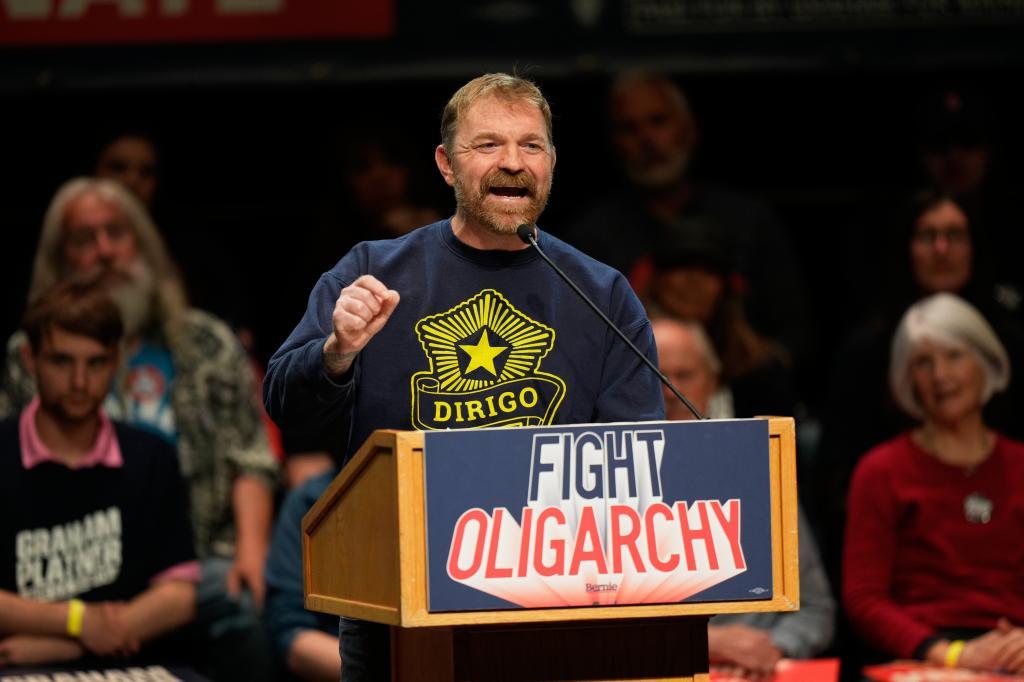
Graham Platner is one of the most peculiar and revealing political phenomena of today. On June 11, he clearly won the Democratic primaries in Maine despite a cascade of controversies that, under normal circumstances, would have sunk any Senate candidate. A former Marine and member of the National Guard, with multiple deployments in Iraq and Afghanistan, Platner worked as a security contractor for the State Department before returning to Maine and buying a small oyster farm.
When he decided to make the leap into politics, it was revealed that several ex-partners had accused him of abusive behavior, threats, and intimidating attitudes. He denies any physical violence, admitting only to being "a bad partner" at certain stages of his life due to military service-related issues like post-traumatic stress and alcohol abuse. But there is much more. During the campaign, sexually explicit messages sent to several women while he was married came to light, along with offensive and sexually explicit messages found on Reddit and other platforms, unsuitable for a Senate candidate. On Monday, Platner canceled his campaign events after a sexual assault allegation and later threw in the towel.
The main issue, at least until that allegation, was a tattoo of a skull and crossed bones that his critics linked to the symbolism of Nazi units or far-right groups. Platner stated that he never had any political intentions, was never a Nazi or anti-Semitic, and covered the tattoo when he realized it could be misunderstood. However, it caused a huge scandal in a campaign managed unprofessionally.
The fact is that Platner won. Despite everything. Or perhaps because of it. The combination of a war veteran and oyster farmer turned out to be a very appealing biography in his state, where he is considered almost anti-establishment, close to populism, and the best option to defeat Republican Senator Susan Collins. Rumors and allegations, far from deterring voters, have had the opposite effect.
The electorate (before the sexual assault allegation became public and before all Democratic figures called for his resignation) seemed to interpret the controversies as personal issues, flaws in character rather than political disqualifications. In a way, just as religious groups have supported Donald Trump, hardly an example of ethics, morality, or faith. For some, it is preferable to vote for the current president than any left-wing candidate because they believe he is less dangerous to their interests in the medium and long term. For others, Platner or someone like him, with all his flaws and 'red flags,' is preferable to someone who wants to ban abortion or cut healthcare.
Steve Bannon, the great guru of the alternative right and prophet of nationalist populism, has often recounted how in 2014, realizing there was a huge gap and that the soft voter had lost reference points, he shouted until he found the ideal candidate. He bet on many, but to his surprise, the good one turned out to be Trump. "Trump's version of populism is both cultural and economic, but above all, it represents a challenge to an established order of a truly globalist nature, which has lost touch with the American people, with the working class and the lower middle class of this country. They are the backbone of the nation," Bannon said.
Analysts describe Platner as a mix between Bernie Sanders and Trump: a new candidate, with popular and populist touches, very unconventional and long immune to scandals that would have destroyed more traditional candidates. The politician of the future. The politician of the present.
The Politics of Extremes
The big debate in United States right now, after a decade of Trumpism, is whether only a populist can defeat the master of populists. And if only the extremes have a chance in a polarized politics that rewards radicalism. It is not about equating or comparing extremes when one is currently destroying institutions, but rather a matter of relative terms rather than absolute. Because the mantra among campaign managers, on the Democratic side, is that although the drive, strength, and initiative seem to clearly be on the far left, the votes theoretically still lie in the center. But voters, especially the younger and urban ones, are moving in the opposite direction. A growing part is eager for a left-wing Tea Party, unapologetic and combative. Playing just as tough, or dirty, as their rivals.
The debate is doubly interesting because the prevailing populism, spanning America, Europe, Africa, or Asia, encompasses both substance and style. In the era of infinite scrolling, the most valuable commodity is attention. And for that, unconventional politicians are needed, capable of setting and dominating the media agenda, emotionally connecting with voters, and breaking the rules of political discourse. Experts in social media, in controversial statements. In what they say and how they say it.
Following Donald Trump's victories, the first Democrat to clearly step forward as a potential candidate for the 2028 presidential elections was outgoing California Governor, Gavin Newsom, someone plagued by personal scandals, infidelities, and controversies. Although he has not formalized his candidacy or has a platform yet, he has done two fundamental things. First, he courted young white males, the group that seemed to gravitate towards Trump in 2024. He did this by distancing himself from identity politics and launching a podcast where he invited controversial figures from the manosphere, such as the late Charlie Kirk. His explanation is that if his own son, in a clearly progressive home, was a fan of Kirk, then something is wrong among the Democrats.
But the second, more striking element, lies in the style. To garner attention, grab headlines, and seek confrontation with Trump, Governor Newsom began to mimic the president's style. His use of capital letters, mockery, insults. It was a parody, but one that seemed to reveal the belief that in the world of 2026, you can only compete against a populist by using their methods, style, and language.
"Commentators and the establishment fail to understand that this is not about me at all. This is a movement that concerns us all," proclaimed the fallen Platner in one of his most quoted speeches with a Trump-like rhetoric, speaking of a movement, like MAGA, that goes beyond himself. "In the end, they won't come for me. They are coming for you, I just stand in their way. "I was deployed four times in a war zone, I am afraid to name an enemy, and the enemy is the oligarchy. It is the billionaires who finance it and the politicians who sell us out," Platner said in his campaign videos.
Populist Democrats
To grasp the depth of the divide, one must consider Alexandria Ocasio-Cortez and Zohran Mamdani. The former is a clear option for the Democrats in 2028. She alarms the establishment because, like Senator Bernie Sanders, she is on the far left, embracing American-style socialism. She has been traveling across the country for months, testing the waters, gauging the American pulse. Demonstrating that drive and strength are indeed only found at that extreme, a mix of European social democracy in much of her program, but with marked identity politics and a woke spirit.
The second example is Mamdani, who cannot run for president because he was not born in the United States, but as mayor of New York, he is proving that there is, at least in the big city, an appetite for policies that unsettle the party establishment. Last month, three congressional candidates supported by him defeated lifelong favorites, national lawmakers with speeches against ICE, the police, and against Israel, heavily focused on identity and gender. With populist touches beyond redistributive policies, much more focused on the message than the substance.
Darializa Avila Chevalier, one of the rising stars, has become famous for telling Kamala Harris to "go fuck yourself," calling Joe Biden a "rapist," advocating for the nationalization of the means of production, blaming the West for the Russian invasion of Ukraine, downplaying the brutal attacks by Hamas on October 7, and saying she would use the American flag to wipe her hands. With that, she crushed veteran Hispanic politician Adriano Espaillat in the primaries.
Following Trump's victories in 2016 and 2024, Mamdani and the Democratic Socialists of America argued that the Democratic Party needed candidates with stronger ideology, a more combative style, and profiles that were less technocratic and less afraid of confrontation—candidates who didn't take refuge in the political center, as represented by great orators like Pete Buttigieg, a center that perhaps no longer exists. Trump sets an aggressive pace and fosters constant conflict, while the Democratic Party continues to function as an organization based on consensus and procedures. It searches for voters under streetlights like a drunk looking for his keys, sighing because that's where the light is—even though he lost them elsewhere.
Everyone can sense that the winds have changed and that 2028 is shaping up to be a clash between the two poles. Trump was the first to sense this, which is why his speeches on July 3 and 4—at Mount Rushmore and on the National Mall in Washington, D.C., celebrating the country's 250th anniversary—focused on "communism," the "Red Scare," and socialism as a greater threat to the United States and its identity than Nazism or 9/11. The president is clear on this: it will be a struggle between those he calls communists and those who say that he and his supporters are fascists.
Last November, the president welcomed the mayor-elect of New York to the Oval Office—a highly anticipated meeting because the two had exchanged harsh attacks during the campaign. Mamdani had called Trump a "fascist" and a "despot." The Republican had labeled him a "communist" and "dangerous." But the joint appearance was surprisingly friendly, with no tension. Quite the opposite. A reporter asked the socialist if he still maintained that Trump was a fascist, and when the mayor, flustered, began to give a nuanced response, Trump interjected with a smile: "It's okay, you can just say yes. It's easier than explaining it. I don't mind. I've been called much worse things than a despot."
This polarized, aggressive, and fast-paced era has been dubbed by political scientist Robert Pape "the era of violent populism." Perhaps it is not just that "everything is falling apart; the center cannot hold," as W. B. Yeats famously wrote in *The Second Coming*. Rather, it is that this happens because, when chaos, noise, and violence prevail, "the best lack all conviction, while the worst are full of passionate intensity."