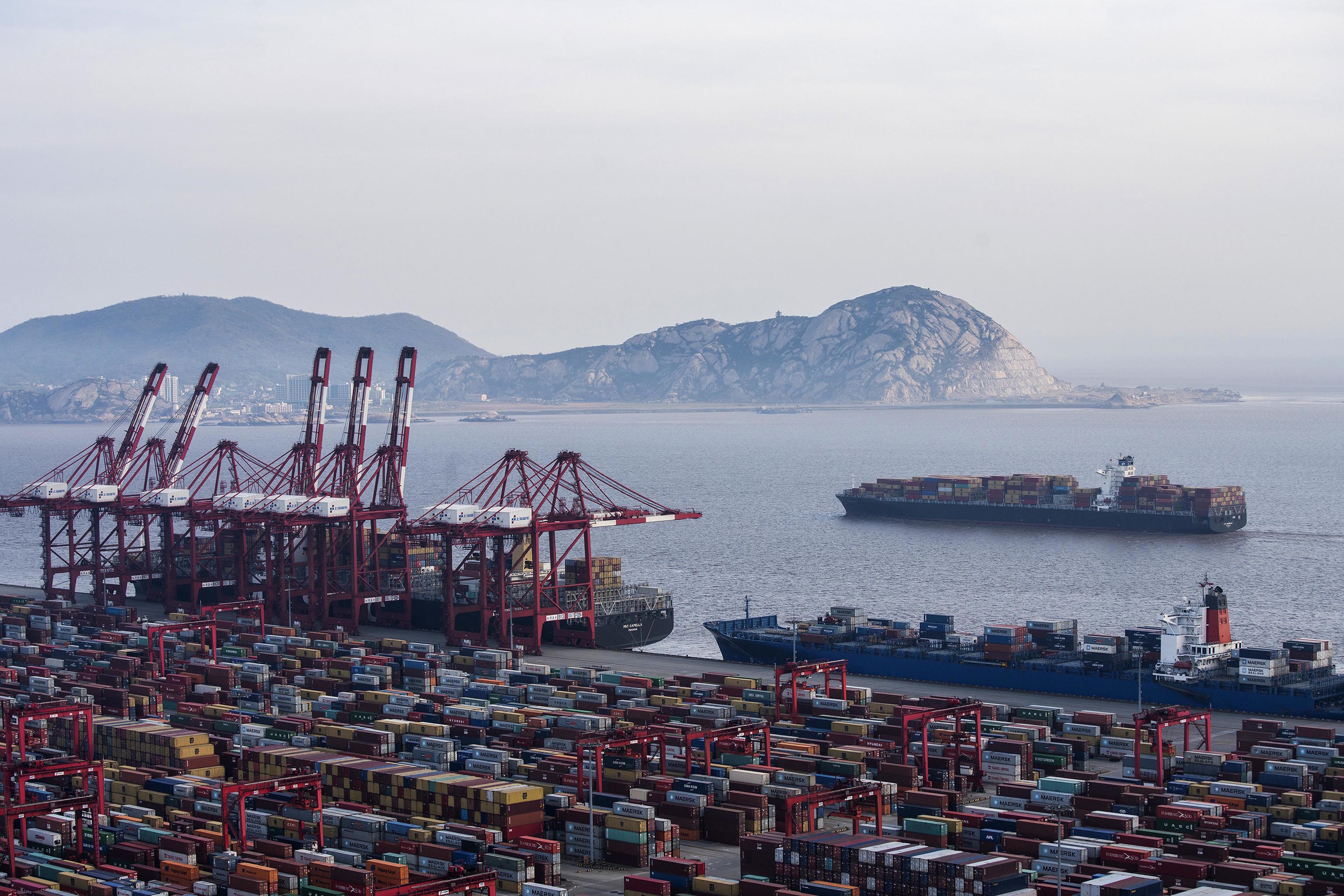
While car factories in Europe are cutting production, in Chinese ports, cargo ships continue to set sail at a record pace. Container after container leaves the ports of Shanghai, Ningbo, or Shenzhen carrying millions of electric cars, semiconductors, industrial machinery, and air conditioning units with the same destination: a world that is increasingly buying products manufactured in China.
The Asian giant has once again demonstrated that, despite the cooling of its domestic economy, it retains its enormous capacity to flood international markets. The weaker domestic consumption shows within China, the more the country depends on selling abroad.
The latest data published this week by the General Administration of Customs reflect this contradiction. Chinese exports reached a historic record of $412 billion in June, well above analysts' forecasts.
Exports grew by 27% year-on-year, accelerating from the 19.4% recorded in May and consolidating the largest trade surplus on the planet. Everything indicates that Beijing will once again approach, and even surpass, the record of approximately one trillion dollars in trade surplus achieved last year.
The growth has been driven by several simultaneous factors. On the one hand, the global explosion of AI continues to drive demand for chips and electronic components manufactured in China. In June alone, around 32 billion integrated circuits left the country. Semiconductor exports increased by 122% compared to the same period last year, while computer equipment grew by 53%, reflecting the global appetite for the infrastructure needed to fuel the AI revolution.
The other major player is once again the Chinese automobile industry. Monthly exports exceeded one million vehicles for the first time, with a 72% increase in volume compared to the previous year. Brands like BYD, Chery, Geely, or SAIC continue to expand their international presence, taking advantage of production costs that are hardly matched by their Western competitors. What seemed just a decade ago as an industry focused on copying foreign models has become one of the biggest headaches for European, Japanese, and American manufacturers.
This export success is particularly felt in Europe. Chinese shipments to the EU increased by 18.5% in June, well above the 7.6% recorded the previous month. Analysts point out that part of the increase also responds to the strong rise in air conditioning sales during the successive heatwaves that have hit the continent, but the phenomenon goes far beyond an unusually warm summer.
Electric vehicles, batteries, industrial machinery, chemicals, solar panels, or technological components continue to gain market share in Europe. According to an analysis by the Mercator Institute for China Studies (MERICS), China's trade surplus with the EU reached the equivalent of around 900 million euros per day during the first half of the year. A figure that summarizes the huge imbalance between the two blocs and fuels growing concern in Brussels.
In EU institutions, it has long ceased to be only about unfair competition. Now, the term heard most often is "China Shock 2.0", a reference to the industrial earthquake caused by China's entry into the World Trade Organization in 2001, when millions of manufacturing jobs disappeared in Europe and the United States due to the massive influx of low-cost Chinese products.
The difference, now warned by numerous European economists, is that this second wave affects precisely the sectors considered strategic for the industrial autonomy of the continent. It is no longer just about textiles or basic products, but about electric cars, batteries, advanced machinery, steel, chemicals, or green technologies, industries on which Europe intends to build much of its future competitiveness.
For that reason, Brussels and Beijing agreed to a kind of truce earlier this month. After threats of trade investigations and retaliations that were bringing both sides closer to a trade war, European Trade Commissioner Maros Sefcovic and Chinese Minister Wang Wentao agreed to open a new permanent mechanism of ministerial consultations to try to reach agreements before October.
The goal is to gain time. No one wants to repeat a confrontation similar to the one that China has been facing with the United States for years. Brussels denounces the lack of reciprocity, Chinese state aid, and the excess industrial capacity that ends up flooding European markets. Beijing responds by accusing the EU of adopting increasing protectionism and argues that much of the trade imbalance is due to European restrictions on high-tech exports to China.
Behind the diplomatic tone, both blocs continue to prepare their respective pressure tools. The European Commission is studying new mechanisms for trade defense and possible quotas for certain sectors, while China maintains controls on the exports of rare earths, essential for numerous European industries, and demands the lifting of technological restrictions driven under Washington's influence.
But the export strength fails to hide the internal weaknesses of the Chinese economy. Just a day after the record foreign trade figures were released, the National Bureau of Statistics published much less encouraging data. GDP grew by 4.3% during the second quarter, below market expectations, and registering the lowest level since late 2022. In the first half of the year, growth stood at 4.7%.
The figures once again highlight China's main economic problem: domestic demand remains unrecovered. Families continue to show high caution when it comes to consumption, the real estate market remains in a long crisis, and business confidence remains weakened despite the various stimulus packages launched by Beijing.
According to the latest data, real estate investment, a burden deeply rooted in economic growth, fell by 18% in the first half of the year.
Faced with a domestic market unable to absorb all production, many Chinese companies have intensified their search for buyers abroad. This strategy keeps factories running and sustains economic growth, but at the same time increases trade tensions with their main partners.
For Beijing, exports remain the lifeline of an economy that has not yet found a new engine capable of replacing the exhausted real estate model. For Europe, on the other hand, that same success fuels the fear that a new wave of Chinese products will end up cornering part of its industry.