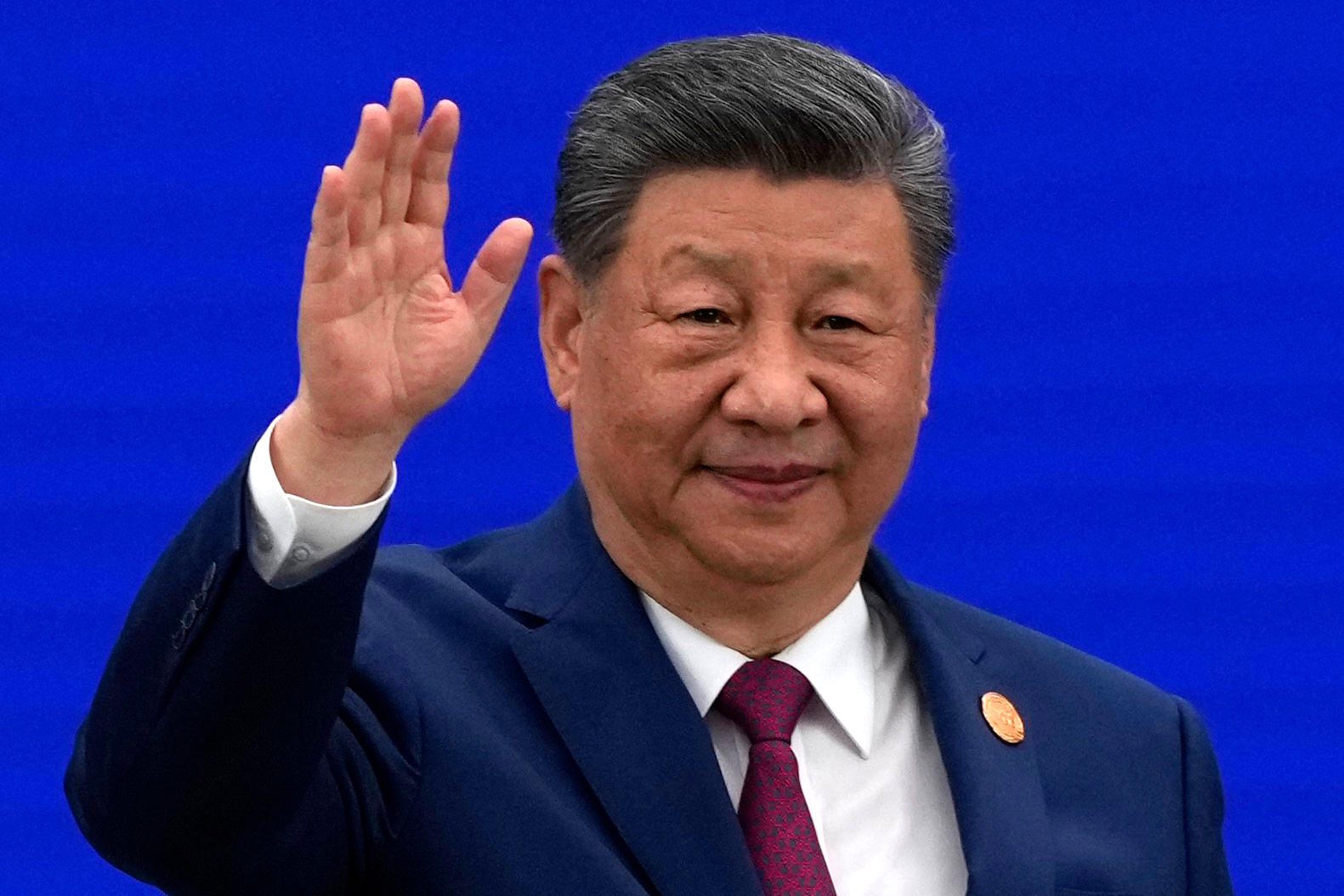
In the huge pavilions of West Bund in Shanghai, a technological race has begun this Friday that goes beyond building the most powerful artificial intelligence model or the most sophisticated humanoid robot. While over a thousand companies showcase the latest advances in AI, the true message of this year's World AI Conference (WAIC) came from the main stage. There, President Xi Jinping inaugurated the country's largest technological showcase with a speech that confirmed an increasingly evident ambition: that Beijing not only aims to compete with the United States in this sector but also to lead the definition of the rules by which the world will govern this technology.
Xi's presence, inaugurating this event personally for the first time, elevated the WAIC from an industrial fair to a state event. In a moment of growing technological rivalry with Washington, the Chinese leader presented AI as a "historic opportunity" and advocated for a model based on open source, international cooperation, and technological exchange.
Amid an increasingly fragmented international stage, Xi emphasized that AI development should not become a technological monopoly reserved for a few powers but rather "an accessible good for all countries," especially for the so-called Global South.
This speech summarizes the strategy that Beijing has been building for some time. If during the first phase of the AI revolution China seemed focused on narrowing the gap with the US in language models and computing power, it now seeks to open a second front: that of international governance.
Its most ambitious proposal is the creation of the so-called World Organization for Cooperation in Artificial Intelligence (WAICO), an international body driven by China that aims to coordinate standards, technical cooperation, and joint development among participating countries. The foundational agreement was signed this week by 29 nations, with Shanghai as the future permanent headquarters. According to Chinese officials, the organization "will democratize access to AI and prevent a few powers from controlling a strategic technology."
China's proposal clashes with the approaches of Washington and Brussels. The US has opted to maintain technological leadership through strong private investment, the dominance of leading companies, and restrictions on the export of advanced chips to China, while arguing that excessive regulation could hinder innovation. Europe, on the other hand, has placed emphasis on regulation, fundamental rights, transparency, and legal accountability of developers.
China, some analysts point out, is trying to position itself in an intermediate point. It advocates for international regulation but rejects that it be defined exclusively by the West. Its message is to present open-source AI as a tool to reduce the technological gap between wealthy and developing countries, while denouncing technological blockades and trade restrictions imposed by Washington.
This year, the WAIC brings together more than 1,100 companies and around 3,000 technological products, with over 300 global presentations. Leading Chinese developers showcase a new generation of large language models - including Qwen from Alibaba; new models from Tencent, SenseTime, MiniMax, or Moonshot AI - that are increasingly closing the gap with their American competitors.
The focus is no longer limited to chatbots: manufacturers display autonomous agents capable of performing complex tasks, assistants integrated into mobile phones, systems for programming, scientific research, and a new generation of humanoid robots that once again become the stars of the fair.
Technological self-sufficiency also takes center stage. US restrictions on access to Nvidia's most advanced chips have accelerated the development of a completely national ecosystem. Companies like Huawei showcase computing systems capable of training AI models using their own processors, while numerous Chinese manufacturers develop the entire technological chain, from semiconductors to software.
However, China's growing influence also raises concerns beyond its borders. Several Western governments are worried that Beijing may use international AI governance as a new instrument of geopolitical influence, just as it did previously with infrastructure, telecommunications, or digital commerce. Critics fear that the standards promoted by China may incorporate a more state-controlled vision, governmental oversight, and less stringent models regarding data protection, privacy, or freedom of expression.
There is also skepticism about the international expansion of open models developed by Chinese companies. While Beijing presents them as accessible tools to democratize AI, some Western analysts warn that this dissemination could increase the technological dependence of numerous countries on the Chinese ecosystem and expand the influence capacity of its major technology companies. China rejects these accusations and argues that the real threat lies in technological fragmentation and blockades driven by the US.