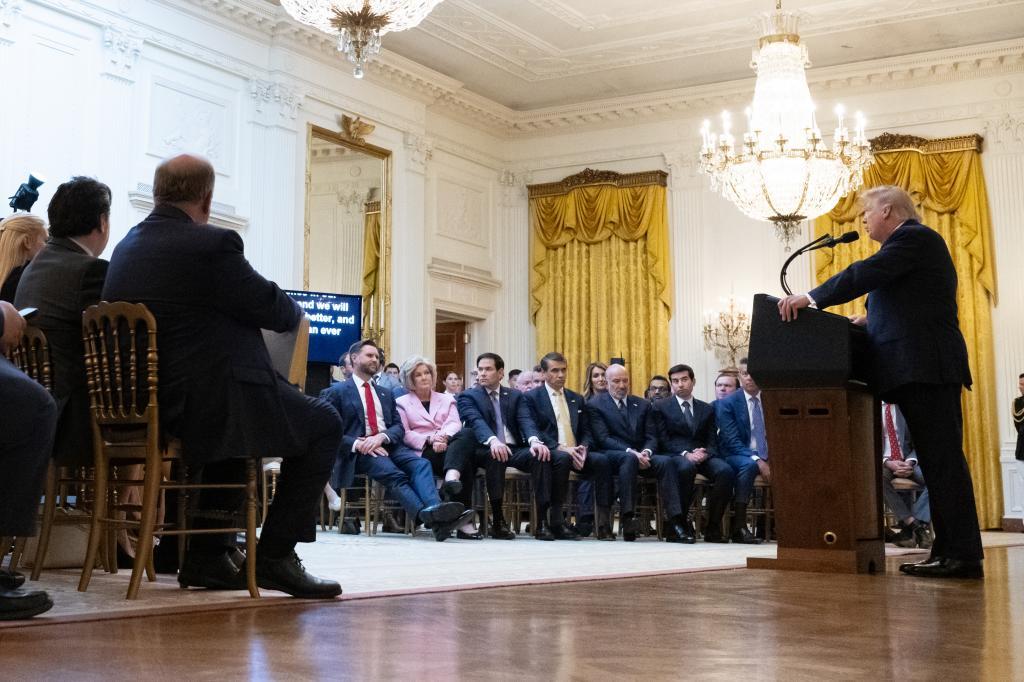
Over the past decade, Gabriel Pérez has been one of the most discreet figures in the universe of Donald Trump. Also one of his closest, most trusted, and highest-paid assistants, with an annual salary of $175,000. As a teleprompter operator since the 2016 campaign and a technical assistant in the White House since then, his work primarily but not exclusively consists of ensuring that the president's speeches appear on screen without errors. And in maintaining the pace, something extremely challenging with a politician who improvises, digresses, gets lost, and starts over time and time again.
Trump has referred to him on rare occasions in public, but he was only known to regulars. Until today. His name made headlines this Thursday as it became known that the Commodity Futures Trading Commission (CFTC), the regulator, is investigating whether he used insider information about presidential speeches to profit by betting around $100,000 in prediction markets.
As revealed today by major newspapers, Pérez conducted operations on Kalshi, the trendiest and most controversial platform that allows betting on future events. Specifically, he operated in the so-called mention markets, where users can bet on whether a famous person will say certain words or mention specific topics during a speech. As a teleprompter operator, Pérez had advance access to the full text of Trump's speeches, including the State of the Union and other televised messages.
According to the investigations, he would have made money on the most famous speech of each year, the State of the Union Address. But also on more than a dozen speeches by Trump over several months, including the World Economic Forum in Davos or at a Medal of Honor ceremony. Right after these events, the White House reacted and issued an internal statement warning staff about the consequences of illegal betting.
In reality, it was Kalshi itself that, upon detecting an anomalous pattern in an account that was consistently making extraordinary profits from Trump's speeches, took action. Investigators discovered that at times Pérez would retract certain bets mid-speech, when Trump, improvising, omitted what was written or skipped phrases or words that he had previously bet on mentioning, according to ABC sources.
After detecting these implausible maneuvers, the platform froze around $90,000 in profits and referred the case to the CFTC, which opened a civil investigation. According to ABC News, Pérez is cooperating with the investigation, and there is currently no open criminal investigation, which is noteworthy.
Prediction Markets on the Rise
This case is another scandal in a sector that has grown explosively in the last two years. Prediction markets allow betting on elections, central bank decisions, or even the words a president will say. Supporters argue that they add information and improve forecasts, while critics warn that they are particularly vulnerable to insider trading.
The CFTC has tightened its measures against these practices due to the proliferation of fraud cases. In recent months, actions have been taken against a Google engineer accused of earning $1.2 million using internal data to bet on Polymarket and against a U.S. soldier who, according to the Department of Justice, made hundreds of thousands of dollars betting with classified information about the military operation that led to the capture of Nicolás Maduro in Venezuela, in which he participated.
The investigation into Pérez also adds a delicate political component for the White House. One more. Although there is no indication that the president was aware of the operations, the Executive has been questioned since last year about hundreds of cases of politicians, assistants, or other officials with operations in markets that have reported hundreds of thousands or millions of dollars in profits. At key moments such as the start or end of a war or the imposition or removal of tariffs.
Earlier this year, the White House warned its staff about the use of insider information in prediction markets. In a famous memorandum dated March 24, it emphasized that "the misuse of non-public information by public officials for economic gain is a very serious offense and will not be tolerated." This was hardly believable when the president himself, unlike his predecessors, has not placed his assets in a blind trust and has made a fortune in the last 18 months through buying and selling stocks.
"Our surveillance team immediately detected these operations and referred them to the CFTC. We are cooperating and providing assistance to the regulators," reacted Bobby DeNault, chief legal officer of Kalshi, in a statement sent to ABC News. "The White House has strict ethical standards that we expect all employees and officials to adhere to," said Davis Ingle, a White House spokesperson.