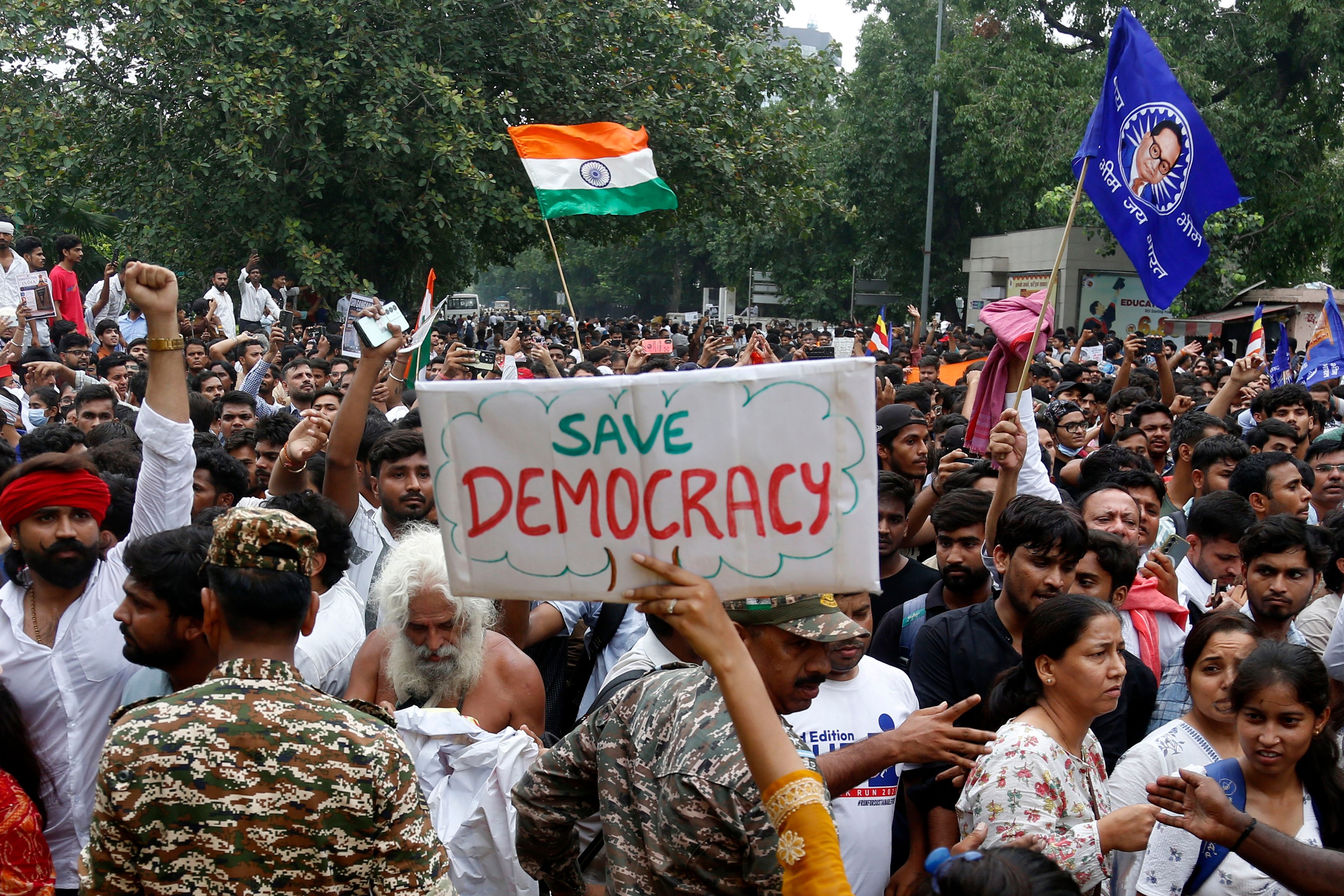
Under a downpour that barely allows the domes of the Parliament of New Delhi to be seen, hundreds of young people try to advance with flags of India in one hand and small cardboard cockroaches in the other. Some hold plastic roses as a symbol of peaceful protest; others chant a single slogan: "Resignation!". A few meters away, metal barricades, riot police, and paramilitary forces close all access to the historic Jantar Mantar observatory, once again turned into the epicenter of popular discontent.
What was supposed to be a march on Monday to demand an education system reform has ended up becoming the biggest show of force of a movement that just a few months ago was little more than an internet meme. The "cockroaches" have come out of social media to challenge Prime Minister Narendra Modi's government.
The protest also comes at a time of maximum tension. The trigger was the forced transfer to the hospital last Saturday of activist and educator Sonam Wangchuk, who had been on a hunger strike for 21 days supporting the demands of the Cockroach People's Party (CJP). Dozens of police officers stormed the gathering, covered him with sheets, and took him away while hundreds of protesters tried to prevent it with shoving and shouting.
Wangchuk remains hospitalized and has promised to continue the fast until the government takes responsibility for the scandals shaking the education system or until the Parliament publicly commits to addressing the issue.
Far from defusing the mobilization, the police intervention has further inflamed spirits. The CJP founder, Abhijeet Dipke, has raised the stakes against the government. If until now the main demand was the resignation of Education Minister Dharmendra Pradhan, after the hospital incident, the movement is now pointing directly at Modi. The government, for its part, maintains a strategy of silence. No government representative has met with the protesters, while Pradhan has dismissed the CJP as "the B team of subversive elements".
Abhijeet Dipke, founder of the Cockroach People's Party (center, seated), on Friday, at the start of an indefinite hunger strike during a protest.Shonal GangulyAP
It is hard to find a stranger symbol than a cockroach to lead a national protest. But therein lies much of the movement's success. The CJP was born in May as a satirical initiative on social media driven by Dipke, a graduate of Boston University specializing in digital communication.
It all started as a campaign of political humor after the controversial leaks of public exams. In a matter of weeks, that experiment became a viral phenomenon that accumulated tens of millions of followers and eventually moved from screens to the streets.
The cockroach, traditionally associated with dirt and contempt, was redefined as a symbol of resistance. If the system treats young people as a bothersome and insignificant plague, the organizers responded, that same plague can organize itself and become impossible to ignore. Humor, AI-generated videos, memes, and TikTok language replaced the solemn speeches of traditional opposition.
Political message behind the irony
But behind the irony, there was a deeply political message: demanding transparency, merit, and accountability in a country where millions of students feel that their future depends on a system incapable of guaranteeing fair rules.
The Medicine exam scandal was the final straw. The cancellation of the entrance exam to medical schools affected nearly 2.3 million applicants after leaks and serious irregularities came to light. Repeating the exam did not quell the outrage. For thousands of families, the case symbolizes the failure of a model where years of sacrifice can be nullified by corruption or administrative incompetence. According to relatives' complaints, more than twenty students committed suicide during the weeks of uncertainty generated by the process.
This discontent connects with a much deeper problem. India boasts of being the fastest-growing economy among the major powers and aspires to become the world's third-largest economy before the end of the decade. However, much of that optimistic narrative clashes with the daily reality of millions of young people. Nearly half of the country's over 1.4 billion inhabitants are under 25, while youth unemployment remains one of the major structural challenges.
Every year, millions of graduates enter the job market competing fiercely for a limited number of public and private jobs. For many of them, the dream of social mobility promised by Modi's India is beginning to show cracks.
The protests are no longer limited to Delhi. Over the weekend, there were massive gatherings in Mumbai and new marches in Bengaluru and Hyderabad, reflecting that the frustration goes beyond the scandal of a specific exam. Education has simply acted as a catalyst for years of accumulated discontent among a generation that has grown up practically under Modi's twelve years of government and is starting to seek different forms of political representation.
It remains to be seen if the "cockroaches" are capable of going beyond the current enthusiasm of an angry generation of Indians. But even if the CJP never becomes a party with real chances of governing, it has already managed to alter the country's political debate. It has forced the government to be accountable for the education system, given voice to a disillusioned generation, and shown that, in 2026 India, a simple cockroach can become the most uncomfortable symbol for Modi's government.