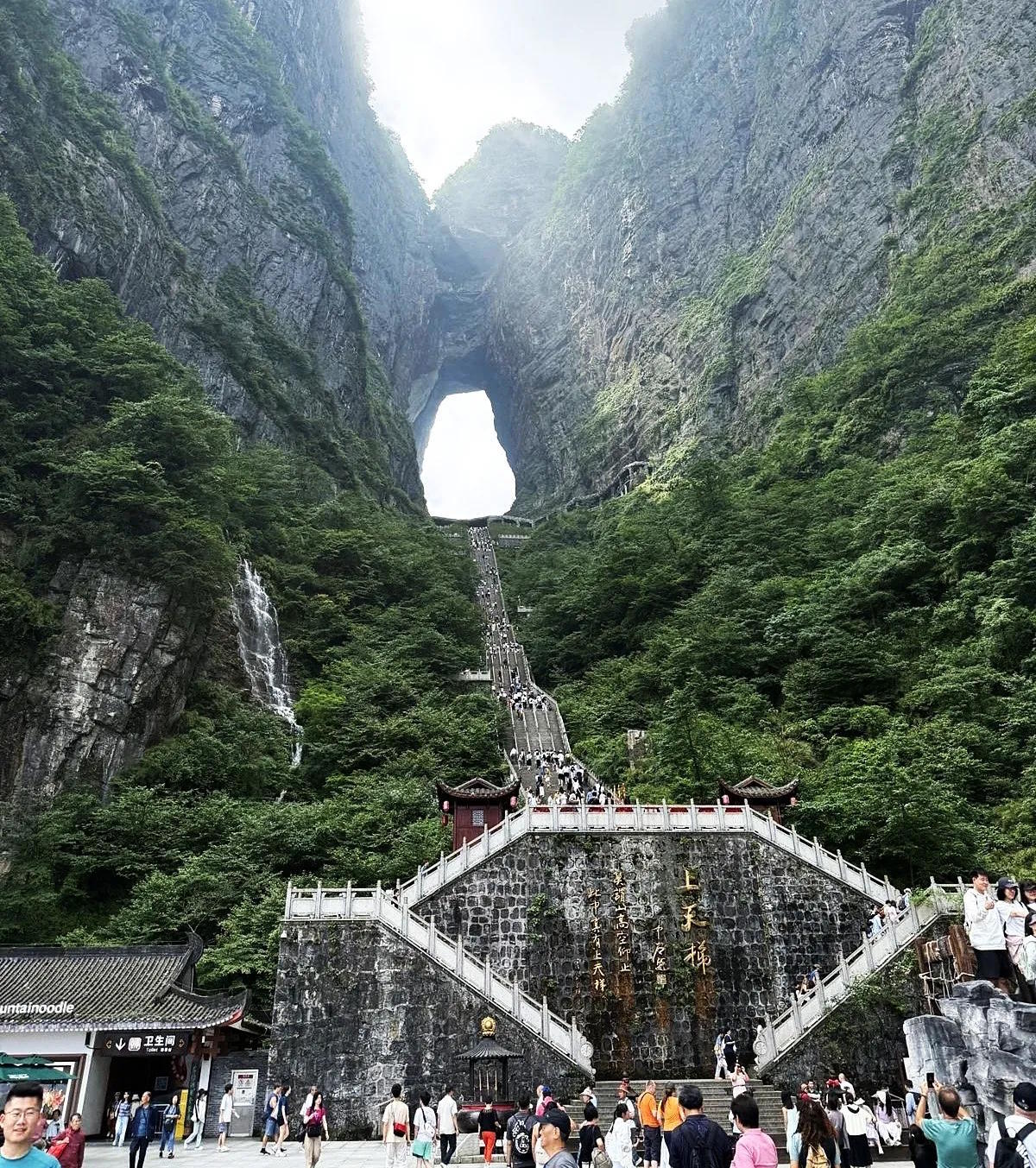
The mountains appear as a floating illusion. From the valley floor, hundreds of rock spires emerge among a sea of subtropical vegetation until they disappear into a thick mist that, at times, makes their base vanish, leaving them suspended in the air. Amid the constant buzz of cable cars, thousands of tourists make their way to the imposing Bailong elevator, a glass structure embedded in a cliff wall that ascends over 300 meters in just two minutes. In the access plaza, where visitors wait for hours to ascend, there are Spanish families, French backpackers, Thai tourist groups, and Australian couples.
"We have arrived in Pandora", exclaims Lorena, a Spanish tourist who traveled to China this July with her husband and 14-month-old son, referring to the planet in the movie Avatar.
We are in the Zhangjiajie National Forest Park, in the central province of Hunan, a place that long ago ceased to be just China's first national park to become one of the country's great visual icons. Hollywood ultimately transformed this remote corner into a global phenomenon.
During the making of Avatar, director James Cameron's artistic team used these formations as inspiration to design the floating mountains of Pandora. Following the film's success, local authorities renamed one of the most famous pillars as the "Avatar Hallelujah Mountain," forever sealing the link between fiction and reality.
The result is a well-oiled tourism machine. Shuttle buses traverse the park from end to end. Cable cars soar over the forests. Suspended walkways connect the main viewpoints. Even those who do not wish to walk can reach virtually any corner thanks to escalators carved into the mountain. At the summit, alongside traditional restaurants, a McDonald's serves as a reminder that this science fiction landscape is also part of China's new tourism industry.
An hour away, the world's longest cable car ascends slowly while the winding road of 99 curves snakes hundreds of meters below. At the top looms the immense rock arch known as the Heaven's Gate, a natural opening between two peaks that many pilgrims climb via a staircase of 999 steps. Many foreign visitors, like Lorena and her family, patiently wait for hours just to gaze for a few seconds at a landscape they already know by heart thanks to TikTok and Instagram.
After visiting Zhangjiajie, we continue the journey with the Spanish family 600 kilometers west to another radically different setting, transitioning from a science fiction backdrop created by nature to one built by humans. Chongqing, perched on impossible hills along the Yangtze River, is one of the trendiest places in China. "It's the craziest city we've been to," says Lorena.
Strolling through this mega-city is like entering a gigantic three-dimensional maze where the laws of gravity seem negotiable. Buildings rise directly on cliffs. Bridges connect floors belonging to different buildings. A metro station can be found on the eighth floor of a building, and the exit of a shopping center leads directly onto another rooftop. In Chongqing, one can live on the fifteenth floor and walk out onto the street without descending a single step.
This city of 32 million inhabitants, almost always shrouded in a mist that enhances the neon glow, has found in social media the best possible showcase. Every corner seems designed to become a viral video.
According to Trip.com, international tourist arrivals grew by 115% in 2025. A significant part of this surge has a specific name: IShowSpeed. The popular American streamer, with tens of millions of followers on YouTube and Instagram, live-streamed his tour of Chongqing for hours, showcasing subways traversing buildings, neighborhoods built on multiple levels, night markets, and an urban landscape that millions of viewers described as unreal. Millions of people worldwide then discovered a city they had never heard of before.
"We got to know Chongqing thanks to these videos," say Peter and Chloe, an Australian couple who continued their journey to Shanghai and Beijing. "What surprised us the most was the silence," says Peter. "We expected chaotic cities, full of noise and pollution, but it's just the opposite. Since most cars are electric, you can barely hear the traffic," explains Chloe. "We also imagined a much dirtier China, and we were struck by how clean and orderly the streets are. The image we had before coming was completely different."
As viral videos travel the world and more tourists arrive, the Ministry of Culture and Tourism was finalizing an ambitious five-year plan with a very specific goal: to turn China into a true tourism superpower before the decade ends.
This month, the Chinese government presented a new document setting a goal that just a few years ago seemed unattainable: receiving 190 million international tourists by 2030 and surpassing $150 billion in foreign tourism spending. In 2025, the country already recorded 154.5 million international arrivals, a 17.1% increase from the previous year, while tourism spending reached $131.1 billion, almost 40% more than in 2024.
Behind the figures lies a much deeper change. For decades, China barely needed to attract foreign tourists. Its massive domestic market filled hotels year-round. International tourism represented a very small part of an economy driven by exports and real estate. While Japan, South Korea, or Thailand invested huge amounts in promoting their image abroad, Beijing barely prioritized convincing foreigners to visit the country.
Now the context has changed. Economic slowdown, the real estate crisis, and weak domestic consumption have forced Xi Jinping's government to seek new sources of growth. Tourism emerges as one of them. "The expansion of visa exemptions has been one of the main drivers of inbound tourism growth," says Sienna Parulis-Cook, Director of Communication and Analysis at Dragon Trail International. "Social media also plays a significant role in changing perceptions about China. Millions of users discover a much more everyday, technological, and accessible image of the country than traditionally offered by institutional propaganda."
The World Travel and Tourism Council estimates that the sector, already valued at $1.8 trillion, could reach $3.5 trillion by 2036 and make China the world's largest tourism economy, surpassing even the United States. But the goal goes beyond money. China also aims to transform the world's perception of the country.
For years, much of the international conversation about China was dominated by issues like repression, digital surveillance, aggressive diplomacy, or pandemic lockdowns. Stereotypes about Chinese immigrants did not help either. But social media did.
Instead of producing institutional ads, Chinese authorities began inviting foreign content creators to tour the country. The itineraries often combine ultramodern cities like Shanghai or Shenzhen with spectacular landscapes like the Avatar mountains. Visitors then post millions of videos showing a clean, safe, technological, and surprisingly accessible China.
The strategy is yielding good results. Many tourists now exploring Zhangjiajie admit to discovering the park through TikTok. Others arrived after following live streams by IShowSpeed. In Chongqing, shops already sell maps pointing out the exact locations where the most famous influencers recorded.
China has realized that a 30-second video can be much more effective than years of traditional diplomacy. This has been crucial in changing the trend in international perception. A survey published this week by the Pew Research Center, conducted among over 45,000 people from 37 countries, reflects that the global image of the Asian giant has rebounded from the lows recorded during the pandemic and, for the first time in years, China's rating surpasses that of the US in the 20 countries where both powers have been continuously compared.