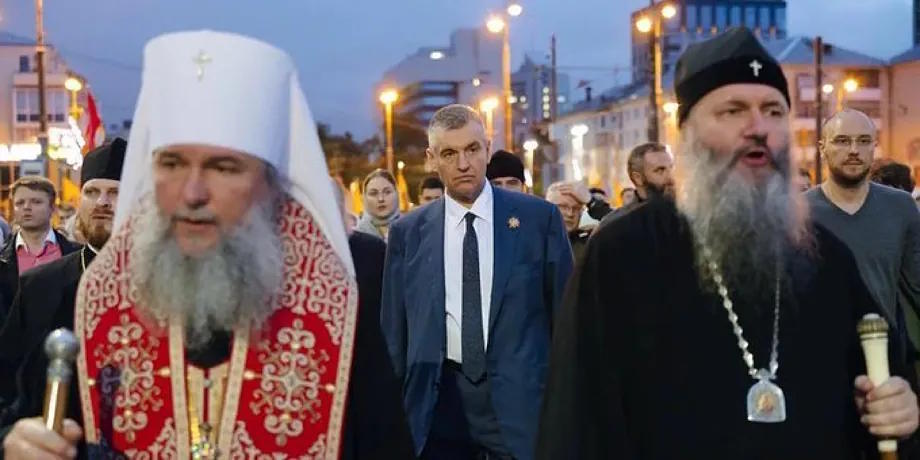
More than 44,000 people have participated in processions and tributes to Tsar Nicholas II of all Russias in Yekaterinburg - in the Urals - culminating in a massive event on Friday, the day when every year monarchist nostalgics and Orthodox faithful commemorate the date on which the last emperor and his family were murdered by the Bolsheviks. This is the figure given by the Russian authorities. Among the attendees at the celebrations was Deputy Leonid Slutski, president of the ultranationalist Liberal Democratic Party of Russia (LDPR), who stated that the execution of the imperial family in 1917 was not only an act of political reprisal but also an attempt to destroy the country's historical memory and national identity.
Although more than a century has passed since the fall of the Romanov Monarchy, there is a certain sense of nostalgia among sectors of the Russian population who perhaps long for the imperial imagery or compare their country's current situation with that of other great nations that preserved the Crown, such as the United Kingdom. 28% of Russians declare themselves in favor of the restoration of the Monarchy, according to some surveys that have been circulated in recent years. This data should be taken with caution. On the one hand, because the concept of a monarchical system is very diluted in the political culture of the former Soviet republic, and on the other hand, because there has never been a serious intellectual debate in Russia that has generated opinion trends on this matter. In fact, the same surveys reflect that many Monarchy supporters would see none other than Vladimir Putin as the perfect tsar. After all, the autocrat today only lacks the crown.
The institution, in any case, is so deeply embedded in Russian history that it still holds symbolic power. In 2017, coinciding with the centenary of Nicholas II's abdication, followed by the murder of the entire imperial family, the Kremlin rejected the possibility of opening a debate on the restoration of the Monarchy in Russia, although it emphasized the important role of Russian monarchs in the construction of the great nation. "Over the past five years, [Putin] has been asked several times about the topic and has been forced to respond in one context or another. Putin faces such ideas without optimism," Kremlin spokesman Dmitry Peskov responded to journalists on the matter, as reported by Efe. Shortly before, the head of the annexed Crimean peninsula, Sergei Aksyonov, had stated that "Russia needs the Monarchy". "We do not need a democracy like the one promoted by Western media. We have our traditional, Orthodox values. In the current conditions, facing an external enemy, democracy is unnecessary. I refer to that licentiousness that many understand as democracy," he argued.
Unlike during the long decades of Soviet rule, with Putin in power, the government has begun to reclaim historical figures like Tsar Peter the Great even to justify current foreign policy. And Nicholas II himself is the subject of a historical revision that has changed the assessment among many Russians of the last emperor of all Russias - he abdicated in favor of his younger brother Grand Duke Michael Alexandrovich, but the latter waited for a ratification from the Assembly that, as is well known, never came.
On August 14, 2000, the Episcopal Council of the Russian Orthodox Church canonized the last tsar and his family - Tsarina Alexandra, Tsarevich Alexei, and the princesses Tatiana, Olga, Maria, and Anastasia - for their "resignation" in death. "The last Russian Orthodox monarch and the members of his family are presented to us as individuals who sincerely sought to embody in their own lives the professions of the Gospel. In the sufferings they endured with patience and resignation, the imperial family from their arrest and martyrdom in Ekaterinburg shines the almighty light of Christ's faith," it was explained in a statement.
Nicholas II was arrested in February 1917, upon his return from a visit to troops fighting in the First World War. The Russian Revolution had erupted. With the Bolsheviks in power, the imperial family was initially confined to the Alexander Palace in Moscow, and later transferred to the former governor's house in Tobolsk, Siberia, where they enjoyed controlled freedom. However, with the advance of the counter-revolutionaries, in April they were taken by train to Yekaterinburg, in the west-central part of the country.
At midnight on July 17, 1917, Nicholas II and his closest family members were led to a basement in the so-called Ipatiev House, along with some servants, his doctor, and the Tsarevich's dog. They were told that a photo was going to be taken. The deposed tsar believed it, and even placed his Heir on his knees. Shortly after, Yurovsky entered the room with a revolver in hand, followed by 17 soldiers armed with rifles. Yurovsky informed the emperor that the Russian people had sentenced him to death. He barely had time to say "what?" before receiving a point-blank shot from Yurovsky.
Since the tsar's elevation to the altars, the marches in his honor in Yekaterinburg are very massive every year. The most crowded took place in 1918, coinciding with the first centenary of the assassination. The Orthodox Patriarch Cyril led a procession that brought together nearly 100,000 people. Pilgrims carried Orthodox crosses, icons, and portraits of the tsar and the murdered members of the imperial family. "We pray for Tsar and Emperor Nicholas, a martyr, we pray for those who suffered with him," Cyril declared to the crowd, holding lit candles.