The private beaches of the Kim family never appear in official photographs of North Korea. Neither do the Olympic pools, equestrian tracks, yacht docks, or mansions hidden among pine trees. These are places the regime tries to keep out of the spotlight because they contradict the narrative that has been presented about Kim Jong-un for decades: the leader who shares the hardships of his people.
But satellite images tell a different story. While millions of North Koreans struggle with chronic food shortages, the dictator's summer is spent renovating luxury residences and visiting a gigantic tourist complex built to project the image of a prosperous country that only exists for a few.
On the east coast, near the city of Wonsan, workers have been working for weeks on the roof of one of Kim's favorite villas. Nearby, his leisure yacht, valued at around seven million dollars, is usually moored. In Pyongyang, work is also progressing on another residential complex. The same is happening at a retreat by a lake and on a vast family estate that even has platforms for missile tests.
According to a recent analysis of satellite images by NK Pro, a media outlet specialized in monitoring everything that happens in North Korean territory, at least nine residences linked to the leader began remodeling work between late May and early June. Experts estimate that Kim owns more than a dozen properties scattered throughout the country.
These are residences for which there are hardly any exterior photographs. However, for years, satellite analysis has allowed the location of facilities including pools, airstrips, stables, and yacht docks. Russian Foreign Minister Sergey Lavrov appeared last summer in official images sailing with Kim aboard a two-story, 29-meter-long yacht. A few years earlier, former NBA player Dennis Rodman, a friend of the North Korean leader, likened a ride on these boats to a luxury vacation in Hawaii or Ibiza.
While the North Korean economy remains subject to international sanctions, Kim continues to find ways to access prohibited luxury products. He has been photographed wearing high-end Swiss watches, traveling in Mercedes-Maybach vehicles, and, as South Korean intelligence revealed years ago, he and his wife installed German-made saunas in several of their residences.
A report published in 2024 by a research center linked to the South Korean Ministry of Defense estimates that the regime has allocated up to 1.8 billion dollars to maintain the privileges of the ruling elite through cars, luxury items, exclusive housing, and preferential medical care.
Just like his father, Kim Jong-il, who used expensive watches, French cognac, or imported vehicles to reward the loyalty of high-ranking officials, the current dictator keeps the elite cohesive by distributing privileges inaccessible to the rest of the population.
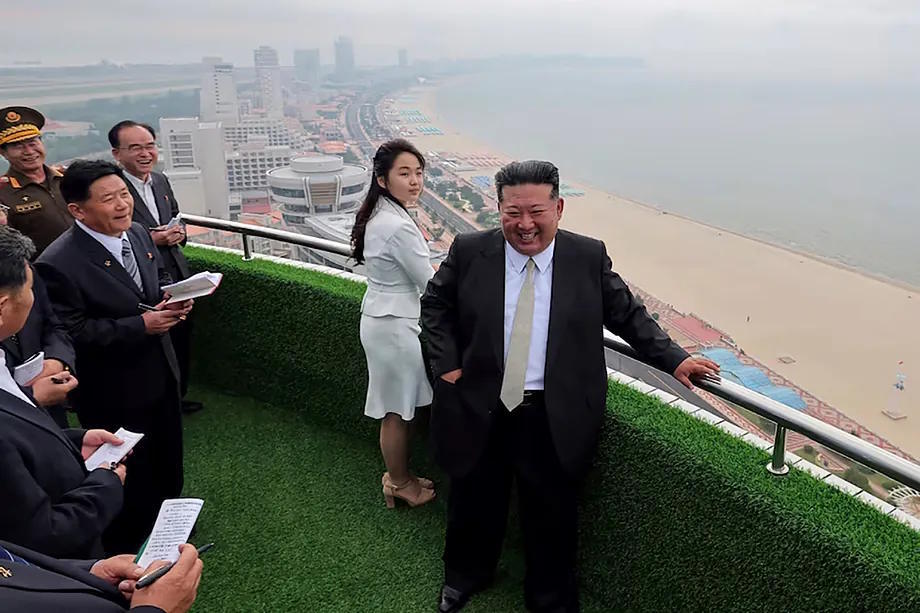
One of the leader's most personal projects at the moment is the Wonsan-Kalma tourist complex, dubbed by the press for years as the "Benidorm of North Korea".
The gigantic resort spans several kilometers of coastline and consists of hotels, apartments, water parks, sports facilities, shopping centers, and artificial beaches with the capacity, according to the regime, to accommodate up to 20,000 visitors per year.
The idea was born over a decade ago when a North Korean delegation discreetly traveled to the Spanish Mediterranean coast to study tourist complexes in Benidorm and theme parks like Terra Mítica.
The pandemic thwarted the initial plans. The complex, which was supposed to open in 2020, remained for years a ghost town of empty buildings. Some specialized media even reported that many of those abandoned constructions had ended up serving as shelters for homeless people.
Kim finally managed to inaugurate the project last year amid grand celebrations broadcast on state television. Surrounded by high-ranking officials and accompanied, as usual, by his daughter Kim Ju-ae (the 12-year-old girl increasingly presented by Pyongyang as the heir to the family lineage), the leader described the complex as "one of the greatest achievements of the year" and stated that it would mark the birth of a new North Korean tourism culture.
Kim returned to his resort in early July to personally inspect the new infrastructure. As reported by the official KCNA agency, he reviewed the railway station built to serve the complex, praised the speed at which it was erected, although he criticized some finishes, and ordered that model to be used to modernize stations in other provinces.
But all this tourist showcase coexists with a much darker reality: a large part of the population continues to suffer from chronic food insecurity. The United Nations Food and Agriculture Organization has been warning for years of persistent deficits in agricultural production, exacerbated by sanctions, natural disasters, and border closures during the pandemic.
"The regime invests enormous resources in propaganda projects while the basic needs of the population remain unmet," summarizes South Korean researcher Hong Min from the Korea Institute for National Unification. Similarly, American specialist Andrei Lankov has been arguing for years that "the large constructions driven by Kim seek to reinforce the regime's legitimacy through symbols of prosperity primarily aimed at the elite and external propaganda, not at improving the standard of living for the majority of citizens."
While the most isolated country on the planet continues to demand sacrifices from a population subjected to rationing and harsh repression, its dictator spends the summer renovating seaside villas and inspecting artificial beaches inspired by the Spanish coast.