Nicolás Maduro and his wife, Cilia Flores, will be tried in the United States starting on June 1, 2027. This was set by Judge Alvin Hellerstein on Wednesday after a short procedural hearing at the Federal Court of the Southern District of New York, in the third appearance of the deposed president of Venezuela in the criminal process where he faces charges of drug trafficking and terrorism.
The hearing lasted just over 15 minutes, as both parties had previously agreed and submitted a proposed schedule to the judge. As expected, both once again pleaded not guilty to the charges brought by the U.S. prosecution, which alleges that the Bolivarian government was leading a criminal network responsible for sending large drug shipments to the United States using the Venezuelan state and military structure. The accusations include drug trafficking and conspiracy, for which, if convicted, they could face life imprisonment.
Everything is unusual, starting with the age of the judge, who will turn 93 in December. Until January 3, Maduro was leading Venezuela when he was arrested and taken out of the country by special forces following orders from Donald Trump. His defense argues that the capture was illegal and violated international law. But they have already made it clear that they will request the dismissal of the case, claiming, among other things, that Maduro had and has immunity.
During the hearing, the judge approved a procedural schedule that foresees the start of defense motions in September of this year and a second round in mid-October. Subsequently, in November, the court will hold a new hearing to consider these requests before deciding whether the process continues towards the trial set for June 2027. And if so, there were six other milestones marked until the summer. Both the prosecution and the defense have acknowledged that additional issues are likely to arise, especially due to the need to handle classified documentation and the legal complexity of the case. Therefore, starting in June actually seems very optimistic.
Maduro and Flores have been detained at a federal facility in Brooklyn since the beginning of the year and have not requested bail so far. Their access to money is very limited, and there has been a parallel process to decide whether they could access their accounts to pay for the expensive defense or if the Venezuelan state had permission to fund it. Barry Pollack, a heavyweight who has defended figures like Julian Assange, is the lead counsel, although the team has also included other lawyers such as criminal defense attorney Bruce Fein, who was involved in Edward Snowden's case.
For obvious reasons, the case has also become one of the most relevant international criminal proceedings held in a U.S. federal court in recent decades. Much more so than the major trials of other former Latin American presidents, such as the Honduran Juan Orlando Hernández, convicted of drug trafficking but recently pardoned by Trump. Or the leaders of Mexican cartels.
Additionally, the case is running parallel to that of Alex Saab, who also recently pleaded not guilty before a Florida court, which had scheduled a hearing for the end of this week. Saab, a Colombian businessman who became a Venezuelan citizen and was recently handed over by Caracas to U.S. authorities, is considered something like Maduro's frontman, an essential figure for managing contracts and operating to evade sanctions.
The resolution of preliminary issues regarding immunity, jurisdiction, and the legality of Maduro's capture, as well as the testimonies of Saab or Hugo El Pollo Carvajal, will have consequences beyond the trial itself. And they come just as the Trump Administration, for example, has promised to do everything possible to dismantle the International Criminal Court, with a discourse denying the jurisdiction of courts and judges thousands of kilometers away to prosecute American citizens or soldiers.
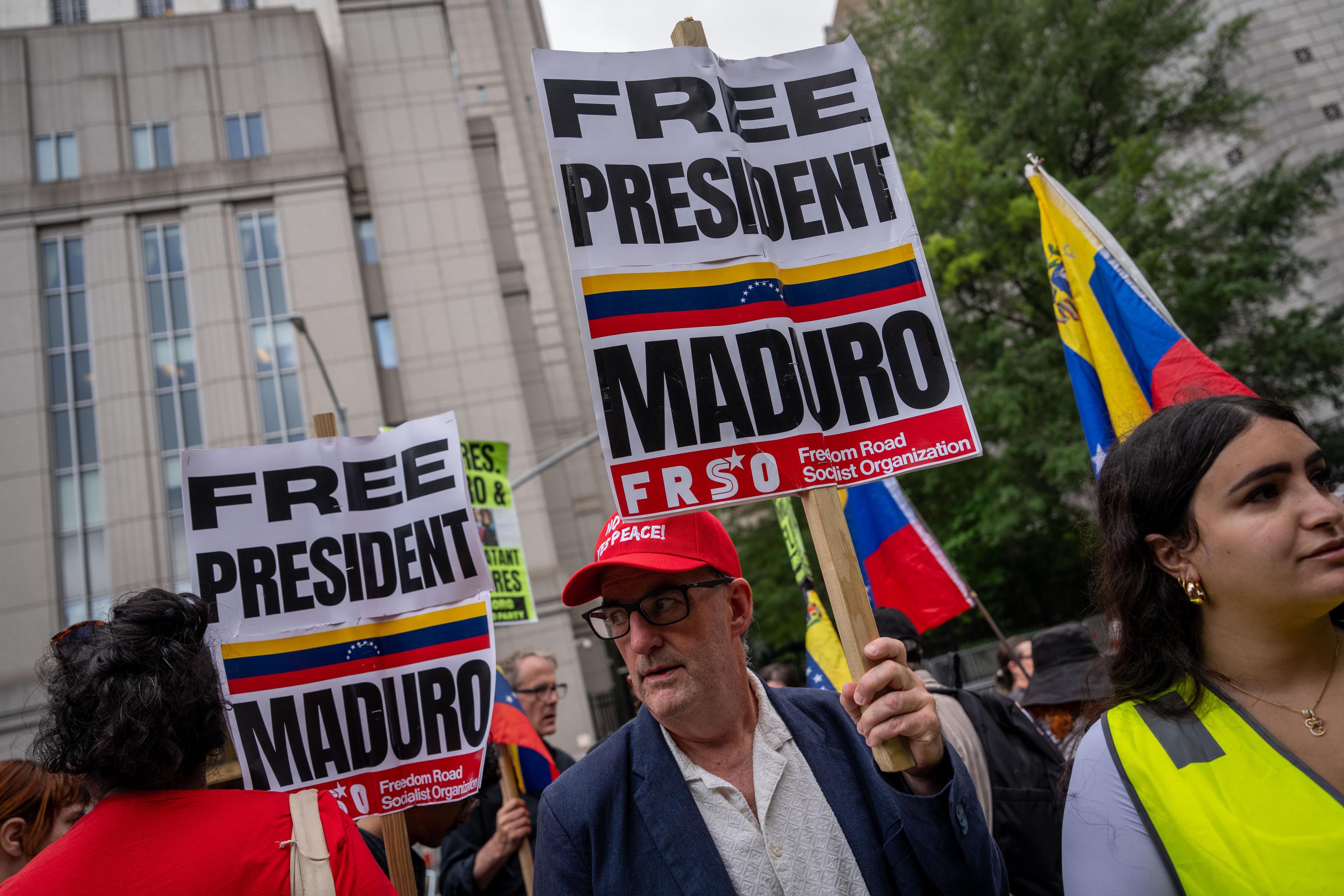
Outside the New York court, there have been two small gatherings of both supporters and detractors of the Venezuelan politician, as in previous occasions, but with less presence and media coverage.