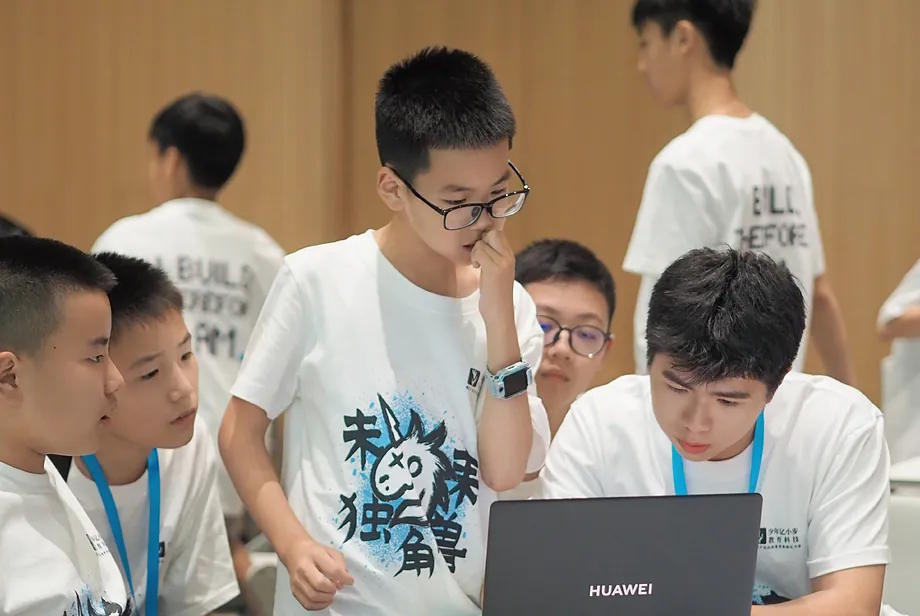
A group of twenty children aged between 10 and 14 enter a bright technological laboratory in Shanghai. On the tables, there are state-of-the-art computers, small humanoid robots, mechanical arms, and virtual reality glasses. An instructor projects the logo of a well-known Artificial Intelligence model on a huge screen and presents them with the first challenge: "In less than a week, you will have to create your own AI startup and convince a jury that your project deserves an investment." Some of those present have not even finished primary education. But their parents already envision that their professional future will depend on mastering the technology that is revolutionizing the world.
This scene is being repeated this summer in many major Chinese cities. In a country where academic competition starts practically in kindergarten and where every educational trend quickly becomes a massive business, AI is the new obsession of urban middle-class families. Provincial television channels are filled with advertisements for summer camps promising to turn children and teenagers into programmers and tech entrepreneurs.
Tech giant Tencent opened several centers across the country in July to train minors in AI, robotics, and quantum computing. Other camps offer exclusive access to the factories of sought-after semiconductors or to the headquarters of some of the country's most prestigious tech companies.
This year, the Chinese government decided to integrate AI into all stages of the education system and aims for the teaching of this discipline to be practically universal in primary and secondary schools before the end of the decade. Additionally, the education industry has found a gold mine in the fear of millions of parents that their children will fall behind in the tech race.
Prices reflect this fever. A week of technological immersion can cost up to 13,000 yuan (around 1,700 euros). "For our children's generation, AI will be their natural environment," summarizes a mother from Shanghai explaining why she considers it essential for her child to learn to master these tools from a young age.
About 170 kilometers from Shanghai, in the modern city of Hangzhou, the obsession slightly changes its name, although pursuing the same goal: succeeding in the overwhelming digital economy. The city where Jack Ma founded Alibaba has become the great laboratory of Chinese e-commerce, giving rise to a new generation of children's camps. In these courses, children learn to become content creators.
The days are spent among spotlights, mobile phones mounted on tripods, and small studios resembling those used by major 'influencers'. Students practice live broadcasts for Douyin, the Chinese version of TikTok; they learn video editing techniques, product photography, digital marketing, and on-camera communication.
Some even conduct real-time sales broadcasts presenting cosmetics, toys, or small appliances while instructors correct their tone of voice, gestures, and ways to capture consumer attention.
It is no coincidence that this industry flourishes precisely in Hangzhou. For two decades, the city has established itself as the Chinese capital of e-commerce thanks to the ecosystem built around Alibaba and hundreds of tech companies dedicated to digital commerce, logistics, marketing, and live streaming.
Millions of young people have found a professional outlet linked to the platform economy there, and academies have extended that dream even to children, convincing thousands of families that the sooner they start mastering algorithms and online sales, the greater their opportunities in this field.
But the race to create the perfect child does not end in AI labs or live streaming studios. For several years now, China has also experienced a true explosion of extreme camps aiming to shape children's character through military discipline.
In one of these centers on the outskirts of Beijing, the alarm clock goes off at 6:30 in the morning with the national anthem. Children, aged between nine and 13, have less than three minutes to dress in military uniform, line up perfectly in front of the flag, and start a day that includes marches with sand-filled backpacks, survival exercises, forest orientation, training with martial arts sticks, rescue drills, and even classes to decipher codes used during the war against Japan.
They also learn first aid, combat techniques, or how to free themselves from restraints after a simulated kidnapping. The motto of one of these centers encapsulates its philosophy well: "Here, there is no weakness; only perseverance and victory."
Other parents prefer to strengthen the mind rather than muscles. Camps promising to improve memory, develop both brain hemispheres, or teach to read thousands of characters in record time through exercises with abacuses, puzzles, and accelerated memorization techniques have proliferated.
There are also intensive programs to reinforce mathematics or prepare for academic competitions. In all of them, it seems that the same message is repeated: any advantage gained during the summer can make a difference when it comes time to compete for a spot in top universities or for a job at major tech companies.