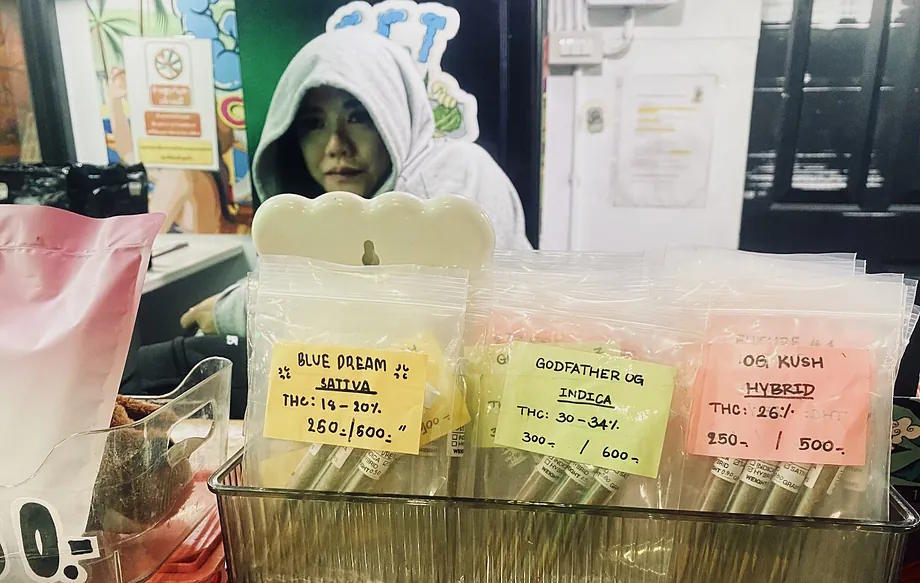
The sweet, earthy, and slightly citrusy smell of cannabis mixes with the smoke from the barbecue skewers, the spiciness of the street food stalls, and the incessant roar of the motorcycles on Khao San Road, the heart of the party in Bangkok. In the surroundings, there is a succession of storefronts illuminated by neon marijuana leaves, glass jars filled with perfectly arranged buds, and young attendants who welcome customers with the same enthusiasm as a barista offering a specialty coffee.
Inside one of these establishments, the aesthetics resemble more a boutique than a traditional smoking den. Light wood, warm lights, reggae music playing in the background, and a long menu of varieties with names imported from the United States: White Widow, Gelato, Gorilla Glue, Blue Dream. A gram costs around 300 baht, which is eight euros at the exchange rate. Pre-rolled joints, gummies, oils, and vaporizers are also available. "What are you looking for? Something mild or something that will make you float?" asks the vendor.
In the store, there is a group of Australian backpackers flipping through the catalog as if choosing a bottle of wine. On the counter, there is a small sign reminding that cannabis is solely for medicinal use and that the buyer must have a medical certificate. No one seems to pay much attention to it.
"The law has changed, now it's more restrictive. But the truth is that the business seems to be the same," says the attendant. The sentence sums up the confusion surrounding cannabis in Thailand. On paper, the country has reversed its regulatory policy. In practice, everything remains in a legal limbo.
When the Thai government removed cannabis from the list of narcotics in June 2022, the announcement was hailed as a great revolution. It was the first time an Asian country broke away from decades of prohibitionism and promised to build a completely new industry around a plant that until then symbolized the war on drugs. Ministers spoke of medicine, scientific research, and opportunities for thousands of farmers and entrepreneurs.
What happened next exceeded all expectations. Thousands of dispensaries popped up all over the country. Bangkok and other tourist cities like Pattaya or Phuket were filled with luminous green leaves. The country went from being one of the toughest in the region against marijuana to becoming, for many travelers, the Amsterdam of the continent.
The problem was that regulation never fully materialized. "Decriminalization progressed much faster than the development of a specific legal framework, creating enormous uncertainty for companies, authorities, and consumers," explains Thai lawyer Atthachai Homhuan, a cannabis regulation specialist. According to the jurist, the absence of a comprehensive law made it difficult in practice to distinguish strictly medicinal use from recreational use and created a scenario of legal uncertainty that marked the market's early years.
Now, that experiment is starting to crumble. The government is tightening the rules. Dispensaries need licenses, sales are limited to medicinal use, and buyers, in theory, must demonstrate a clinical need. Some establishments are closing after not renewing their permits, and authorities threaten to completely criminalize the plant again if smuggling and the black market are not controlled.
By the end of December, the Buddhist kingdom had 18,433 cannabis dispensaries nationwide, according to data from the Ministry of Public Health. After the latest regulatory change, licenses were not renewed for nearly 9,000 establishments, although many continue to operate clandestinely. These are added to the many makeshift stalls set up on the streets.
A stroll through Bangkok shows that laws progress much slower than reality. In another dispensary, an employee denies that the business is disappearing. "Tourists still come in every day. Now we remember that we only sell for medicinal use, but we don't ask for certificates or questions," he assures.
But the reality is that many traders are unsure if they will be able to remain open in a few months. There is a bill that should definitively regulate cannabis, but it remains blocked in Parliament, and no one knows for certain who will be able to cultivate, who will be able to sell, or under what conditions.
Meanwhile, farmers are facing another crisis. Production skyrocketed much faster than demand. Prices plummeted to unthinkable levels, and many small growers, who dreamed of getting rich thanks to Thailand's new star crop, can barely cover expenses. Some sector operators denounce that this collapse has favored the emergence of criminal networks that buy large quantities of cheap cannabis to illegally send it to Europe and other markets where its value multiplies.
Recent seizures of cannabis from Thailand in Germany, the United Kingdom, or Hong Kong have increased political pressure on a government that just four years ago presented this same industry as one of the future economic engines.
"No matter how strict our measures are, if people can still smuggle drugs, we have to rethink our approach," declared Prime Minister Anutin Charnvirakul a few days ago. "We have to figure out what we need to do to prevent other countries from blaming Thailand for being the weak link in this problem." The leader added that he was willing to "shut down the entire industry" if experts determined that it was causing more harm than benefit.
"We are not asking to return to a free-for-all, but for clear rules. Without that legal certainty, the only ones benefiting are those operating outside the system," laments Jerry, the owner of a dispensary in downtown Bangkok.
As night falls, Bangkok lights up. Tuk-tuks weave through traffic, food stalls fill the sidewalks, and dispensaries remain open, with their fluorescent displays. But behind those shop windows, a battle is being fought over the kind of country Thailand wants to be. In just four years, it went from imprisoning consumers to becoming the Asian paradise of cannabis and then trying to rebuild a control system that was never fully designed.
The result is a legal limbo where the law says one thing, the street practices another, and thousands of entrepreneurs, farmers, and workers wait for someone to decide which direction an industry that was born promising wealth and modernity should take and that today survives shrouded in uncertainty.