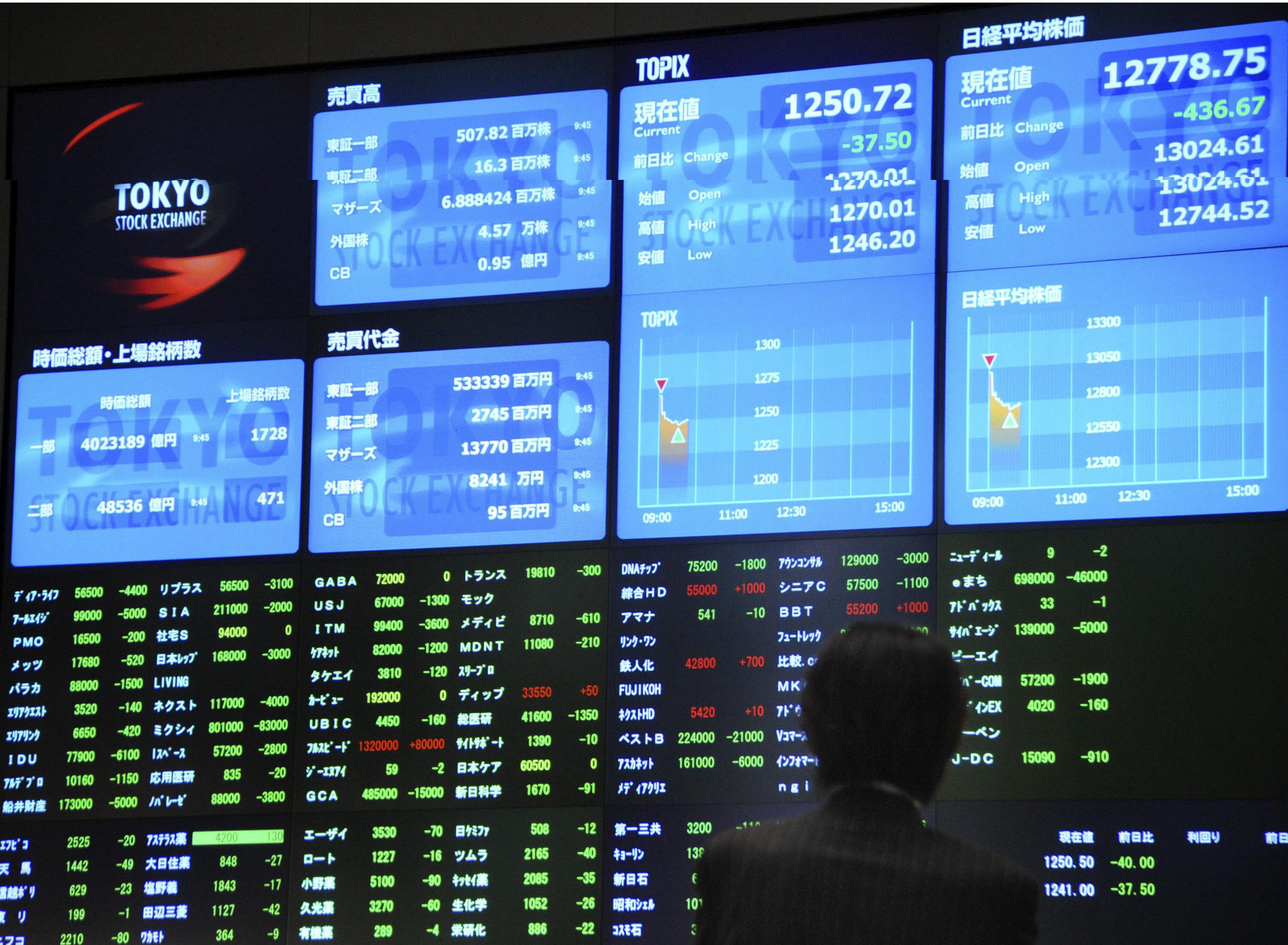
There are four types of economies in the world: developed, developing, Japan, and Argentina." The phrase, attributed to Nobel Prize in Economics Simon Kuznets, stopped working this week. On Tuesday, the Japanese yen fell to its lowest level in 40 years, in a brutal acceleration of a structural collapse that began in 2021. It could be the 'checkmate' to the country's policy since 1991, based on the State spending as if there were no tomorrow (and, for 35 years, there wasn't) with the central bank buying a large part of the bonds that financed that policy. Now that nominal growth and fear of inflation have returned, Tokyo cannot raise rates because it would skyrocket the cost of financing a public debt equivalent to 204% of GDP (more than double that of Spain). Perhaps it is a warning of what could happen in the US and the EU, whose central banks also buy debt and manipulate the market for States to spend.
Ukraine leaves Russia without diesel to harvest wheat
The idea that "that bunch of drug addicts," as Vladimir Putin called the Ukrainian government on the second day of the invasion, would corner the Russian oil and agricultural industries was, on February 25, 2022, a delusion. But, through bombings, Ukraine has left Russia without diesel for the harvesters that collect its main crop, wheat. And right in the middle of the harvest. The Kremlin has reacted with helplessness. If it was providing subsidies to oil companies so they wouldn't export diesel and sell it in the Russian market at a lower price, now it has banned the remaining diesel exports (see graph) and on Tuesday approved subsidies for imports. Since Russia produces twice the wheat it consumes, the harvest left in the fields will not be exported. This will drive up the global food prices, already under pressure due to the lack of fertilizers caused by the closure of the Strait of Hormuz.
The electric 'boom' is not in ChatGPT, but in the thermostat
Air conditioning requires three times more electricity than Artificial Intelligence data centers. By 2035, it will be five times more (4,500 terawatt-hours for air conditioning versus about 700 for data centers). The reason for the increased consumption by air conditioning is the combined effect of the 'greenhouse effect' and the increase in per capita income in developing countries. For example, less than 3% of the 250 million inhabitants of the Indian state of Uttar Pradesh, where the thermometer reached 48 degrees in May, have air conditioning. But the demand for air conditioning is more manageable than that of AI. Appliances do not need to run 24 hours a day, can be supplied in a decentralized and cheaper way - with solar panels on houses, for example - and with systems that have other uses (e.g., generating heat in winter) than the thermal and nuclear power plants that AI requires.
The global trade crisis is structural, and it started before Trump
Donald Trump's tariff mania hit another peak this week with the end of the deadline for the US to maintain the 10% import tax that the president set when the Supreme Court overturned the tariffs he had established in 2025 (including those levied on imports from two subantarctic islands inhabited by penguins, seals, and seabirds). But global trade was already in trouble before that tariff frenzy. According to the US investment bank Lazard, the crisis began to simmer in 2013, and Trump unleashed it in 2018, during his first presidency. Subsequently, protectionism was enthusiastically replicated by other countries - and by Trump's successor, Joe Biden - as foreign trade and investment dependence began to be seen as a threat to the national security of States. It's a two-way war, with the US and the EU on one side and China on the other.
Southeast Asia, the 'free port' of the world economy
We all know that the global economy changes day by day. But for the group formed by eleven middle-income economies in Asia such as Brunei, Vietnam, Indonesia, Laos, Malaysia, the Philippines, or Myanmar to be a global leader in trade liberalization is excessive! And yet, that's how things are. When the Foreign Ministers of the Association of Southeast Asian Nations (ASEAN) met this week in Manila, all attention was focused on the meeting between the US and China. But that ignores that the bloc is seeking a free trade agreement with Canada, has just expanded the one it already had with China, has started updating the one it maintains with South Korea, and is considering doing the same with Japan. ASEAN has become the 'free port' of the world: a neutral territory in which the major powers waging economic warfare against each other - China, the US, and the EU - invest and trade.
Six months' salary if you enroll in a tanker passing through Ormuz
The war between the US and Iran is serious. Two Indian state oil companies, IOC and MLRP, have canceled the loading of over three million barrels of crude oil (half a million liters) on two super tankers in Iraq for fear that the ships would explode when crossing the Strait of Hormuz. India is the world's third-largest importer and consumer of oil, and Iraq is its second-largest supplier, so the decision - similar to the one made in the first phase of the war, between February and June - reflects the seriousness of the situation. For Iraq, it is a step closer to the abyss because, like Kuwait, Qatar, and Bahrain, the country can only export oil through the Gulf. Meanwhile, the world's largest super tanker shipping company, the South Korean Sinokor, offers a six-month bonus to each sailor who enrolls on a ship to cross the Strait. It's an attractive offer. But with a problematic detail: the money is only paid after the crossing. That's how anyone can offer bonuses.