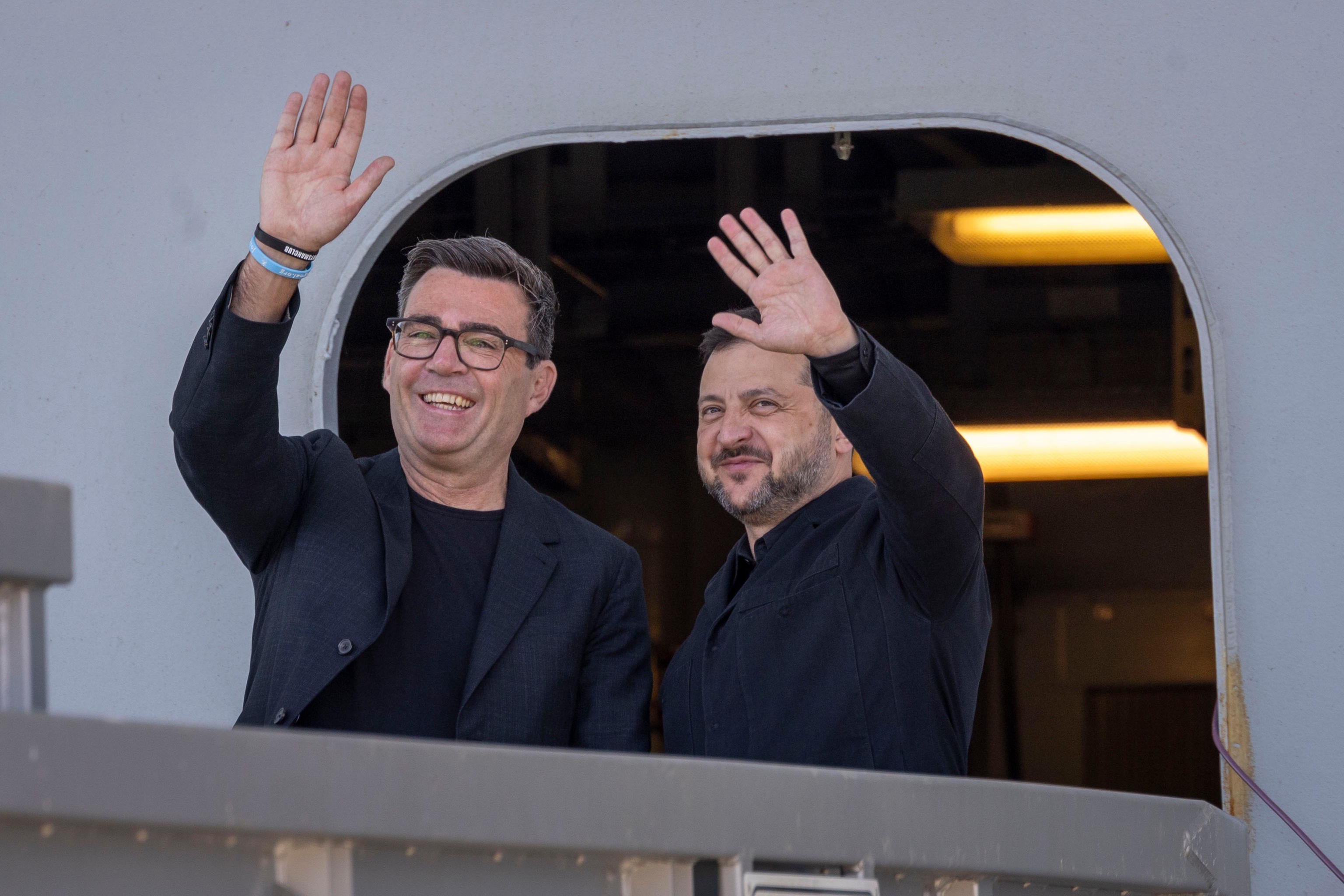
So far, the President of Ukraine, Volodimir Zewlenskyy, had met with five different British Prime Ministers since Russia invaded his country on February 24, 2022. Today, Monday, he met with the sixth, Andy Burnham. They held a meeting at the Portsmouth naval base in southern England, in a symbolic setting: the aircraft carrier Queen Elizabeth, one of the two owned by the UK and which Donald Trump unsuccessfully tried to involve in the war against Iran.
Zelenskyy was making a stop on his way to the United States, where he is attending the funeral of Republican Senator Lindsey Graham, an ally of Donald Trump and a strong supporter of aid to Kiev. Although the meeting with Burnham is less significant than the one he will have tomorrow, Tuesday, with US President Donald Trump, its importance is considerable.
The UK is the main supporter of Ukraine in Europe, a stance maintained by the five Prime Ministers preceding Burnham and one that the new Prime Minister will uphold. Burnham made this clear after the four and a half hours of the meeting, stating on the public broadcaster BBC that "I can assure you and them [referring to the Ukrainians]" that unwavering support for Ukraine "is shared by all parties." The Prime Minister left the Queen Elizabeth looking delighted, saying that, on a personal level, "we got on very, very well."
Zelenskyy embarks on this journey with Ukraine in a position of unprecedented strength since the outbreak of the war. Until this year, Kiev was primarily seen in the West as a recipient of military aid. Now, it is a partner. And a very important one. In the areas where the wars of the 21st century will be decided, such as robotics, drones, and missiles, Ukraine is now a country that NATO countries want to collaborate with to learn from.
Kiev has the technology and tactics. And not just for offensive missions. Also for defense. Since the autumn of 2023, Ukraine has been relentlessly subjected to Russian missile and drone attacks - many of them of Iranian design and with Chinese technology - and has learned to defend itself. This is how its anti-aircraft defense systems are being used by several Gulf countries, such as the Emirates, to defend against Iranian drone and missile attacks. It's not just Europe and the Middle East. On Thursday, the Ukrainian company UForce announced that its US division has reached a preliminary agreement to manufacture naval drones - essentially, unmanned kamikaze boats - and software for their operation at its factory in the state of Oregon for the US Armed Forces.
The Ukraine war extends to Iran
Zelenski has also arrived in London as the new major enemy of Iran, after attacking over the weekend with missiles or drones a ship from that country carrying Russian weapons in the Caspian Sea. In the action, according to the Government of Tehran, an Iranian sailor was killed and the ship suffered an explosion, although the exact extent of the damage is unknown. Kiev has claimed to have attacked more Russian ships carrying arms to Iran. Neither Moscow nor Tehran have confirmed this.
These actions not only demonstrate Kiev's military capability by striking the Caspian Sea, which is mostly an inland sea surrounded by Russia and over a thousand kilometers from Ukraine's borders. They also position the country as a Western ally, as it is doing more than what the UK agreed to do during the worst moments of the war between Washington and Tehran, when Donald Trump unsuccessfully tried to involve European NATO countries in the US 'counter-blockade' of the Strait of Hormuz. Zelenski's alignment against Iran has been accompanied by accusations that Russia is sharing satellite information with Tehran to enhance Iranian missiles' precision in targeting US bases in the Middle East.
However, none of this was mentioned in the official information about the meeting between Burnham and Zelenskyy. What the British Prime Minister did confirm is that the UK will grant Ukraine intellectual property rights to electronic warfare systems so that it can, on one hand, evade Russian measures (many provided by China) to divert its missiles and drones, and on the other hand, ensure that the projectiles Moscow launches do not hit the target. The idea follows the new concept of European aid to Ukraine, focusing not so much on providing heavy military equipment but on providing technology or simply funding for Ukrainian technicians and military personnel to develop the necessary weapon systems. Among these weapons are the Dutch cruise missiles Ruta that Ukraine is using to bomb Russian territory, although the delivery of these missiles had not been officially announced by the Dutch government.
The UK's electronic countermeasures are crucial because the US is almost out of anti-aircraft missiles due to the war against Iran. As a result, Washington is not sending Patriot missiles to Kiev, essential for defending Ukrainian cities from Russian bombings. Therefore, as Burnham stated, the most important thing now is to ensure that Ukraine "can protect its critical infrastructure."
Although Italy and France have provided Ukraine with several Iris-T systems - the European equivalent of that American missile - it is a very recent weapon of which there are barely any units, and both countries have limited production capacity, only enough for a few units per year.