The student is about to fall asleep when a loud noise shakes the door of his room. Before he can react, an armed man bursts in, blinds him with a flashlight, and starts shouting in English. "Get on the ground! Give me your phone!" In a matter of seconds, he is blindfolded and his hands are tied behind his back.
The kidnapper orders him to record a video for his parents begging them to pay a ransom. At that moment, another man enters the room and begins pointing out the mistakes the student made during his kidnapping: he should have lowered his head sooner and raised his hands more slowly.
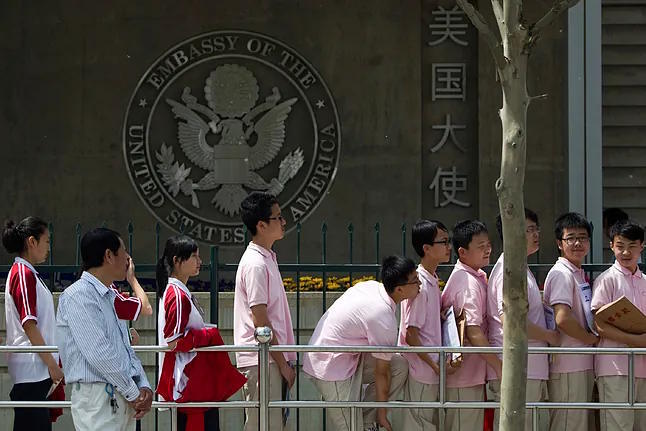
This is not a real kidnapping but one of the exercises offered at the new camps in China to prepare young people who will travel at the end of the summer to study at universities in the United States.
In another room, several young people wait in line with their passports in hand. Suddenly, several men in vests resembling Immigration and Customs Enforcement (ICE) agents appear. They interrogate them in English, demand documentation, separate them from the group, and subject them to a surprise immigration control simulation. The exercise ends with a session where instructors teach them how to respond, stay calm, and assert their rights during an inspection.
The courses include simulated kidnappings, immigration raids, phone scams, hate crimes, bullying, and racist situations. Their existence reflects how much the perception of the so-called "American dream" has changed among Chinese families.
For decades, getting a spot at an American university represented the pinnacle of social ascent for millions of students. Today, even before boarding a plane to California, New York, or Washington, many rehearse how to react if ICE agents knock on their dormitory door.
Lulu Lu, a student from Beijing who will start her studies in September at a university in Washington, told the South China Morning Post that she decided to enroll at her mother's initiative. After completing the kidnapping simulation, instructors reviewed every move with her: lying on the ground, avoiding challenging the aggressor, interpreting his demands, and buying time.
These camps have recently added tutorials on ICE immigration checks. Promotional ads promise to train students to face surprise inspections in residences, universities, or public spaces by replicating US authorities' procedures.
They also include specific modules on how to respond to racist insults, detect fraud targeting international students, or what to do if they become victims of bullying.
All this fear did not arise out of nowhere. Over the past years, in China, it has been widely reported that American authorities have tightened scrutiny on Chinese researchers and students in the name of national security.
Restrictions on certain scientific areas, interrogations at airports, threats to cancel visas, and the increasingly tough rhetoric of the Trump Administration have fueled the perception that Chinese university students are potential suspects in the strategic rivalry between the two largest powers on the planet.
A few months ago, the Chinese Ministry of Education issued specific warnings to those heading to American universities, alerting them to possible interrogations and a more hostile environment. Meanwhile, propaganda machinery has been insisting for years on the violence in American cities, shootings, racism, or insecurity, reinforcing the concerns of many parents.
As a result, the academic exchange that for decades served as one of the main bridges between China and the West is beginning to crack. Various analyses published in the last year agree that studying in the US is no longer such a safe bet for many Chinese families.
The number of Chinese students has dropped from the peak of nearly 370,000 enrolled in 2019 to around 278,000 in recent years. Meanwhile, the UK and Australia are gaining ground as preferred destinations, while elite Chinese universities are retaining an increasing number of students who would have previously sought a spot at Harvard, Stanford, or Columbia.
Many families continue forward simply because they have been investing huge amounts of money for years in preparing for this academic leap. A father from southern China admitted that it was already too late to change plans, although he acknowledged that perhaps his son would have to look for work in Hong Kong instead of staying in the US after graduating.
The climate of suspicion is also transforming the daily lives of those already studying across the Pacific. An academic study published this year in the academic journal Higher Education concluded that numerous Chinese students try to hide their nationality, Americanize their way of speaking, avoid political conversations, or stay out of certain public debates to avoid drawing attention in an environment marked by the growing rivalry between Washington and Beijing.
While both governments proclaim the need to stabilize bilateral relations, the human contact that for decades helped cushion political differences is going through one of its most delicate moments. Students have long been the best informal ambassadors between the two societies. Now some are rehearsing how to survive an immigration raid before even attending their first class in a country they once saw as the land of opportunities.