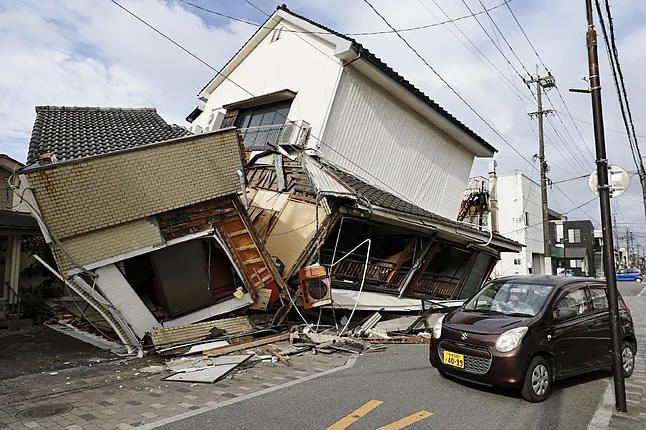
As hundreds of rescuers silently advanced among piles of concrete, attentive to the slightest sound that could reveal the presence of a survivor, Japan faced a scene all too familiar this Wednesday. The death toll from the earthquake that shook Kumamoto Prefecture on Tuesday on the island of Kyushu continued to worsen with each passing hour. The number of fatalities had already risen to 13 people, while dozens remained missing under the rubble of buildings, factories, and a shopping center partially destroyed by an explosion that occurred shortly after the earthquake.
"I offer my deepest condolences to those who have lost their lives," declared Prime Minister Sanae Takaichi, who stated that the government will mobilize "all available resources" to locate survivors.
More than 3,600 members of the Self-Defense Forces, along with hundreds of firefighters, police officers, and emergency teams from other prefectures, are participating in search operations that are progressing against the clock amid stifling heat exceeding 34 degrees, further complicating the work of the rescuers.
The earthquake, with a magnitude of 7.1 according to the Japan Meteorological Agency (JMA), left one of the most dramatic scenes in an Aeon shopping center, which suffered a violent explosion shortly after the quake.
Images broadcast by Japanese television show part of the roof torn off, twisted steel beams, and tons of debris scattered across the parking lot. Authorities confirmed the deaths of two women and fear there may be more victims.
Although initially it was reported that between 20 and 30 people were trapped, the police now believe the number could be lower. The main hypothesis points to a gas leak triggered by the earthquake, although the causes are still under investigation.
Several kilometers away, in the city of Yatsushiro, another operation is keeping rescue teams on edge. The collapse of a huge chimney at a Nippon Paper Industries factory buried several workers. Three were rescued alive, although one later died in the hospital. Other employees remain missing under a structure of concrete and steel that threatens to collapse.
As rescue efforts continue, the population faces another threat: aftershocks. Since the main earthquake, more than 60 tremors have been recorded, several of them of considerable intensity. The JMA maintains the alert for the possibility of new earthquakes of similar magnitude for approximately a week, especially in the next two or three days, in addition to the high risk of landslides due to the shallow depth of the epicenter, located just 16 kilometers below the surface.
Almost 50,000 homes remained without electricity during the first night, and around 140,000 lost water supply. Thousands of residents chose to sleep in their cars, a common sight after major earthquakes in Japan, out of fear that new tremors would collapse weakened buildings.
Authorities ordered the evacuation of hundreds of thousands of people, while hospitals affected by water and power outages tirelessly treated hundreds of injured with fractures, burns, and injuries caused by collapses.
The earthquake also paralyzed much of the economic activity in Kyushu. Kumamoto Airport temporarily suspended operations, bullet trains stopped running to inspect the tracks, several sections of highways were closed due to cracks and damaged bridges, while major companies like TSMC, Sony, or Fujifilm evacuated their employees as a preventive measure. Authorities confirmed, however, that the region's nuclear power plants did not experience any issues.
Despite the tremendous intensity of the earthquake, the number of fatalities has been considerably lower than what might be expected in a less prepared country. Japan has strengthened its building codes for decades to become some of the most stringent in the world.
Many modern buildings incorporate seismic isolation systems capable of absorbing much of the vibrations, while a sophisticated early warning network automatically stops high-speed trains, closes sensitive facilities, and alerts the population just seconds before the destructive wave arrives. This ongoing culture of prevention explains why such a strong earthquake has not yet resulted in a much larger tragedy.
Although in Kumamoto, no one forgets that the earth already showed a decade ago what it is capable of. In April 2016, two powerful earthquakes left nearly 280 dead, thousands injured, and destroyed part of the city's iconic castle, whose restoration works have not yet been completed and will not be finished until mid-century.
That disaster remains ingrained in the collective memory of a country accustomed to living with earthquakes. Located on the Pacific Ring of Fire, Japan accounts for around 20% of magnitude 6 or higher earthquakes recorded on the planet.