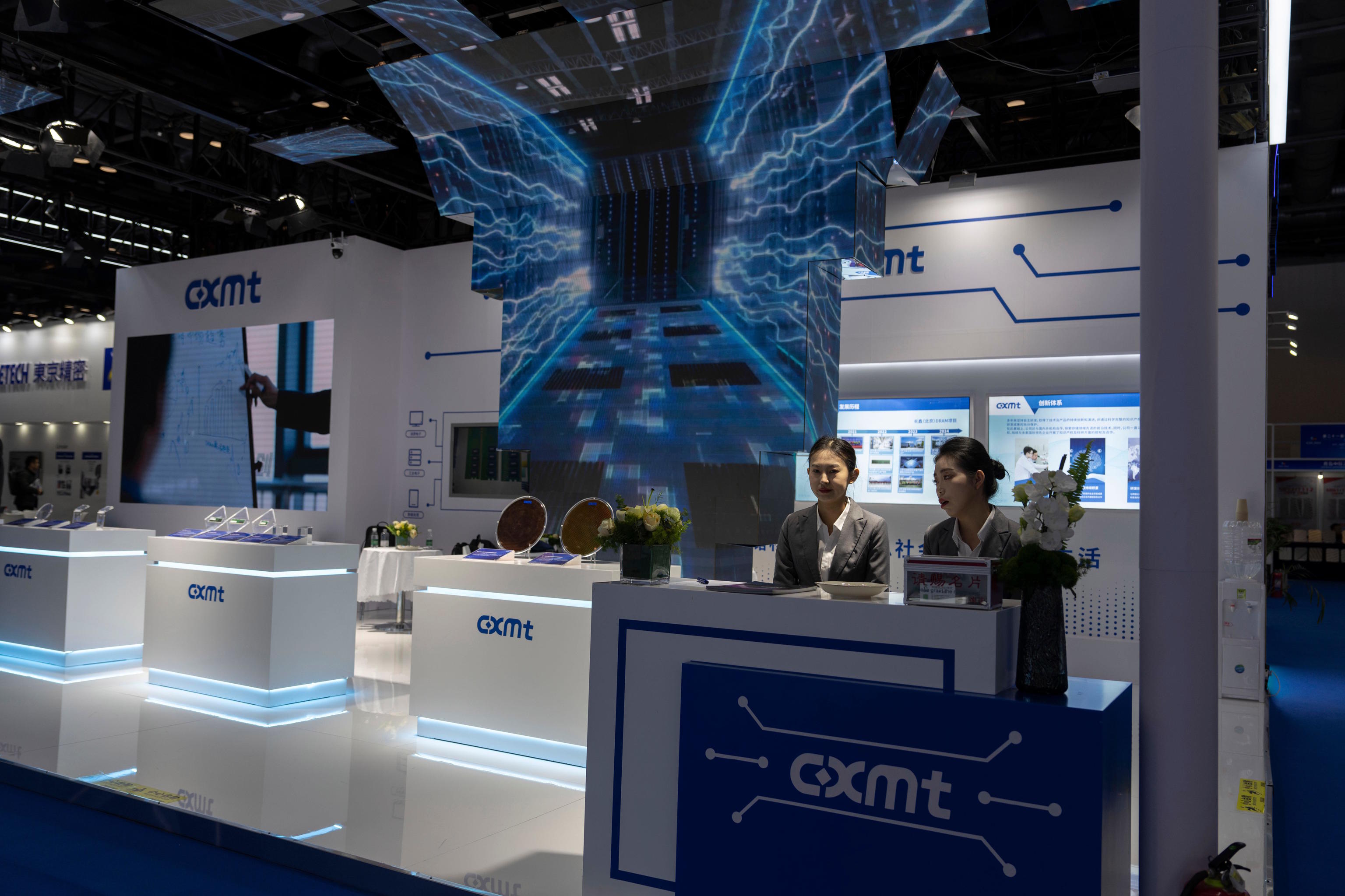
For a few hours on Monday, a company virtually unknown to the general public did something that just a few years ago seemed unthinkable: become the most valuable company in China. The memory manufacturer ChangXin Memory Technologies (CXMT), based in the city of Hefei, surged 466% in its debut on the Shanghai Stock Exchange and briefly surpassed tech giant Tencent in market capitalization.
More than a stock market frenzy, the phenomenon was interpreted in Beijing as a symbol of a significant change. The market, in addition to rewarding a semiconductor company, celebrated the possibility that China can build an industry capable of becoming less dependent on the West.
CXMT's IPO has been almost hailed as a national victory. The manufacturer, specialized in DRAM memories (chips that store short-term memory used in servers, computers, mobile phones, or cameras) raised $8.5 billion, the largest initial public offering in mainland China since the one carried out by the Agricultural Bank of China in 2010. Its shares closed the day at 49 yuan compared to an initial price of 8.66 yuan, after a session marked by massive purchases fueled by the AI fever.
What happened, some Chinese analysts now point out, reflects the growing interest of domestic investors in semiconductor companies at a time when Xi Jinping's government is accelerating its strategy to achieve technological self-sufficiency. Since the US began restricting Chinese companies' access to the most advanced chips, as well as essential machinery and software to manufacture them, Beijing has made the development of its own supply chain a strategic priority.
The semiconductor industry has become one of the major battlegrounds in the technological rivalry between the world's two largest economies. For decades, China was the world's largest consumer of chips but heavily relied on foreign suppliers. In DRAM memories, South Korean companies Samsung Electronics, SK Hynix, and the US company Micron account for around 90% of global production. CXMT currently holds the fourth global position and is by far the largest Chinese manufacturer in the sector.
The Chinese company has gone from accumulating million-dollar losses for years to making profits thanks to the AI boom, which has boosted the demand for memories used in data centers and inference systems. In just the first quarter of the year, it generated 33 billion yuan (around 4.3 billion euros) in revenue.
Chinese media highlight that CXMT's spectacular stock market debut also multiplied the fortunes of several of its top executives. The company's president, Zhu Yiming, saw the value of his stake rise to nearly 80 billion yuan (about 9.5 billion euros), while the chairman and chief technical officer, Cao Kanyu, came to control shares valued at over 10 billion yuan (around 1.2 billion euros).
The company has explained that the funds raised in the stock market will be used to expand both its production and research and development. It already operates three DRAM wafer factories and plans to continue increasing its capacity. The consultancy SemiAnalysis estimates that it will reach a production of 350,000 wafers per month by the end of this year, very close to Micron, and could reach 500,000 before the end of 2028. The Japanese bank Nomura estimates that CXMT could increase its share of the global DRAM memory market from approximately 10% currently to close to 18%.
China's market structure itself offers enormous room for growth. Although China accounts for about a quarter of global demand for DRAM memories, domestic production barely covers around 30% of its own needs. The rest still depends on imports.
In June alone, Chinese purchases of memory chips reached a record $32 billion, a 250% increase from the previous year, reflecting that phone manufacturers, computer makers, and cloud computing services continue to heavily rely on foreign suppliers.
This dependence explains why Beijing has turned companies like CXMT into key pieces of its technological strategy. The goal is to build a complete innovation ecosystem that spans from chip design to manufacturing machinery, materials, software, and industrial equipment.
In recent years, authorities have increased subsidies, public funds, and tax incentives for the sector. But the path to technological self-sufficiency remains full of obstacles. According to Nomura's latest report, companies like CXMT still lag significantly behind in the most advanced technologies. The biggest gap, they explain, lies in High Bandwidth Memory (HBM), essential for powering the latest AI processors used by giants like Nvidia.
The pressure of US sanctions has not disappeared either. A significant portion of the critical machinery used by CXMT still depends on foreign suppliers. Advanced lithography equipment and certain chemical materials remain particularly vulnerable to possible new export restrictions imposed by Washington.
Despite external limitations, the Chinese government continues to invest in developing its own capabilities in the most strategic sectors of the semiconductor industry. In the new chip war, CXMT's phenomenon suggests that China is eager to demonstrate that it can also build the foundations for the artificial intelligence revolution.