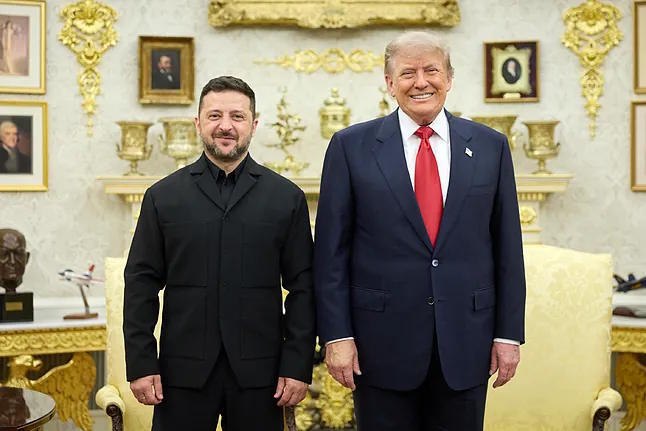
If in politics there are times when a year feels as long as a geological era, in the White House of Donald Trump, twelve months are simultaneously an eternity, a sigh, and above all an adventure. Here alliances, sympathies, and priorities change at a speed that defies any diplomacy manual, as the president, like 19th-century United Kingdom, only has his own interests as the permanent fixture.
Few days summarize the current geopolitical roller coaster better than this Tuesday, where at the White House, the Ukrainian president, Volodymyr Zelensky, and the Israeli Prime Minister, Benjamin Netanyahu, crossed paths. Both attended Washington for the funeral of Senator Lindsey Graham, a common friend and one of the last representatives of the old world, and met with Trump, an essential partner.
The capital bid farewell to the veteran legislator almost like a head of state, with a spectacular ceremony at the Capitol Rotunda, with his colleagues in line paying tribute to one of the great Congress veterans and Vice President JD Vance delivering some words. Before his transfer to the Cathedral, where his family and President Trump spoke, joking about his ally's bellicosity: "He never met a war he didn't like, he was a great hawk," he said.
The meetings, succinctly described by Trump's press secretary as "positive and productive," highlighted several unthinkable things in 2025. Firstly, the meetings were held privately, without cameras. The recently returned Trump to power was constantly live and orchestrated all his visits before the media. An unpredictable and chaotic show to disarm the guests, sometimes it went well, sometimes it ended badly, as the Ukrainian remembers well. Not anymore. For political, health, or caution reasons, most meetings with world leaders are now held privately, like in the rest of the world. And that is a significant change.
But the most striking aspect was not in the form, but in the substance. The tables have completely turned. If last year Zelensky was little more than a pariah, someone whom Trump and his team criticized publicly and privately, complained that he only wanted money, reproached his way of dressing and speaking while literally cutting aid to his country to pressure him, now, even the most radical MAGA influencers are starting to change their opinion and define him as a "hero" or the "Lincoln of this generation."
Conversely with Netanyahu. In his eighth visit to the White House since Trump's electoral victory, the Israeli Prime Minister arrived more weakened and questioned than ever, including in the electoral polls in his country. The initial meetings between the two, old friends, were always a display of that special relationship between nationals. The attacks on Iranian nuclear facilities last summer further strengthened the bond. But the war in Gaza, operations in Qatar, and bombings in Lebanon have worn out Trump's patience, who has openly reprimanded and criticized Netanyahu loudly in recent months. His increasingly harsh messages, directly or through interviews, reflected weariness and helplessness. Just yesterday, referring to the Israeli lobby to deteriorate US-Turkey relations, Trump once again called his friend to order, urging him not to meddle where he is not called.
Exactly a year ago, Zelensky was going through the most delicate moment since the start of the Russian invasion. Republican support for Ukraine was eroding, Trump openly questioned the volume of military aid, and the now infamous Oval Office meeting turned into an unprecedented grotesque spectacle. Ukraine had ceased to be a consensus cause in Washington since the invasion to become another battleground.
Zelensky arrived today, however, in a significantly stronger position, as seen in the few images that have emerged, with a relaxed face and broad smiles. Not because the war has improved for Ukraine, which partly thanks to unparalleled drone dominance that even allows them to attack Russia on its territory. But because Trump himself has hardened his stance towards Moscow or at least is no longer enthusiastic and praising. The US president's frustration with the lack of progress, growing doubts about the Kremlin's real willingness to negotiate, and the perception that Putin is using the talks to buy time while helping Iran attack the US and its allies have introduced a significant shift in the White House. Without abandoning his aspiration to end the conflict, Trump today shows much more skepticism towards Russia than he did a year ago.
"A good meeting with President Trump in the Oval Office. Thank you for all we do together to protect the lives of Ukrainians and advance peace. Above all, I offered the president our condolences for the passing of Lindsey Graham, a true friend of Ukraine. The president and I discussed licenses for Patriot interceptor production and several other ideas that could help. We also talked about diplomacy because it is important for the diplomatic process to be revitalized. Our teams will work out the details of their further communication. I am grateful to the United States for its strong support," briefly said the Ukrainian in a social media post after the meeting.
The Ukrainian attack last weekend on an Iranian cargo ship in the Caspian Sea has earned Zelensky many extra points, who in this visit has emphasized the links between the wars both countries are fighting to get closer to Trump. After helping Gulf countries defend against drones, Ukraine attacked the ship claiming it was transporting military equipment from Iran to Russia. Just as they provided evidence of how Moscow uses its satellites to identify targets for Tehran. However, this has not been enough to improve his relationship with Netanyahu. Both exchanged tense words in the Cathedral corridors, showing that the disagreements of the past four years have not disappeared.
But the transformation in recent months is even more striking in the case of Netanyahu, whom some in the White House are beginning to see as a lost cause if he fails to stay in power and with the legal problems ahead. The personal relationship with Trump still exists, obviously, but the political bond is no longer immune to problems. It does not mean that Washington has ceased to be Israel's main ally, quite the opposite, but it does reveal a change in perception as the American public opinion is also shifting. Trump always uses the analogy of having good cards, and now they have changed, even though the Ukrainian is going through the most serious internal crisis since 2022, with dismissals and appointments that have sparked massive protests and accusations of authoritarian management.
The White House continues to evaluate international relations from a deeply transactional logic, where support is never a blank check, and even the closest allies can become the subject of mockery or threats if they are deemed not to serve American interests. Iran has become a problem from which it does not know how to escape, and demands collaboration from Israel, not more obstacles.
"I don't need Bibi to tell me. Bibi tells me because he wants me to stay involved," said the president this morning in a television interview about the possible evidence that the Israeli government wants to present to him regarding Iranian nuclear activities. "We destroyed their nuclear facilities, and we will have to destroy Pickaxe if we don't reach an agreement," Trump continued about the mountain where it is suspected that there are secret facilities in Iran.
A statement released by the Israeli Prime Minister's office simply said it was "an excellent and thorough conversation on the key issues of the moment, mainly Iran," and that they "reaffirmed their firm commitment to ensuring that Iran never possesses nuclear weapons." In line with the messages of several ministers who in recent hours have publicly lamented that Washington does not want to destroy Iran's energy facilities.
Zelensky, who spent just over an hour at the White House, then met with the Finnish President, Alex Stubb (who has forged an unexpected bond with Trump thanks to golf) and headed to the National Cathedral for the memorial event for the senator. And in the afternoon, he will meet with a group of senators from both parties who support the Lindsey O. Graham Sanctions on Russia and Iran Act. Richard Blumenthal (Democrat from Connecticut), Katie Britt (Republican from Alabama), Jeanne Shaheen (Democrat from New Hampshire), Roger Wicker (Republican from Mississippi), and Jim Risch (Republican from Idaho), along with other members of the House.