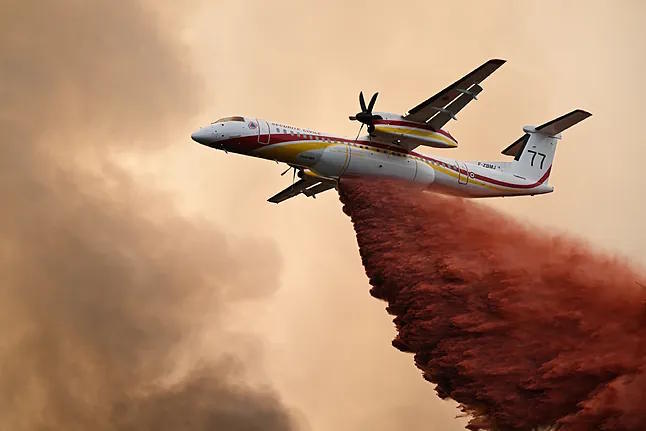
A red spray falls from an airplane onto a burning mountain. Although it looks like a gaseous cloud, it is actually long-term retardant liquid: a new generation substance that is starting to be applied on a large scale in forest fires inside and outside of Spain as a last barrier against the fire's advance. "The soaked area becomes sticky, so when the flame arrives, it is unable to burn it. The relationship between fire, air, and fuel is not generated," explains Federico Grillo, spokesperson for the College of Forestry Engineers.
"In the case of active firefighting, the usual practice is to use retardant in what is known as indirect attack. It is generally applied aerially, advancing along the fire front," adds Xavier Vaquer, vice president of Perimeter Solutions, the parent company of the Asturian company Auxquimia and a global reference in the retardant sector. Founded over 50 years ago, it currently leads the sales of red water in Spain, although 90% of its sales come from exports. Their retardants are the only ones that have been certified by entities such as the U.S. Forest Service and the CEREN (Center for Testing and Fighting Forest Fires) on the other side of the Pyrenees.
This liquid has become a fundamental tool in the current emergency context in Spain. "It creates a firebreak barrier that allows to stop the advance and containment of the fire," says Vaquer. So far, the fire has devastated 80,000 hectares between Madrid, Ávila, and Toledo, and another 9,300 in Castellón. Just a few days ago, it burned 32,000 in La Mierla (Guadalajara). Four of the five most serious fires in the history of Spain have occurred in 2025 and 2026.
"Something this big had never happened before. Our country has a lot of experience, which makes us quite efficient, but a historical event of such magnitude demands a very good strategy. And in these extraordinary situations, there is always room for improvement," acknowledges Grillo regarding the innovative contribution of retardants.
"It requires a certain level of anticipation in planning, preparation, training, and investment of the necessary resources for their correct use in extinguishing forest fires," admits the vice president of Perimeter Solutions, who struggles to find time in the midst of this firestorm. "During the fire season, especially during active firefighting and extinguishing, the workload and demand are usually high, as we must ensure our customers' capabilities in fighting forest fires," he points out.
The horror of witnessing the environmental disaster contrasts with the relief of seeing the deployment of forest firefighters. Over these days, we have seen how the retardant works. Its red color comes from an iron and oxide-based pigment. It is not arbitrary either: it helps mark the area where it was dropped to better identify from the sky the areas already sprayed. For the production of this product, Vaquer explains that it is necessary to add several active compounds to the water used in other agricultural applications, as well as components that improve the long-term effectiveness and stability of the product.
For its effective application, the water bomber plane must head to an aerodrome or airport, park next to pools equipped with a motor pump - which stirs the water to prevent the product from settling - and proceed with the injection of the liquid, explains the forestry engineer. Vaquer highlights that the retardant works in the long term for the prevention and protection of strategic or critical areas, as it takes several months to be eliminated by precipitation. "It remains adhered to the vegetation, completely safe and harmless, and will only react in the presence of the high temperatures caused by the fire," he assures.
"Phosphate retardants, ammonium polyphosphate are components of fertilizers and the amount is very small," Grillo assesses the degree of environmental impact, although he warns against spraying them in places like ponds or streams, as they can degrade the water, promote the growth of algae, and be toxic to fish, amphibians, and other animals.
The United States, Canada, and Australia - scenes of some of the worst environmental catastrophes caused by fire in recent centuries - are the countries that are using the retardant the most, although its use is increasingly spreading to more countries. France has introduced an Airbus A400M capable of releasing up to 20,000 liters of 'red water'. Spain is not lagging behind, although it currently prioritizes other techniques. "There is no definitive solution, each tool has its advantages and disadvantages," warns Grillo. "The combination of different techniques offers a range of possibilities," he adds.
In addition to Auxquimia's product, another with similar characteristics called Ecofire Fighting appeared last year. Its creator, César Sallén, appeared on some television programs to demonstrate how a liquid that promises to be 30 to 40 times more effective than water works. Although it has been studied, such as by INIA-CSIC, which has certified its effectiveness as a fire extinguisher, it currently does not have the same scientific support as the competition.
The major drawback of the retardant is its high cost. "We are talking about million-dollar figures to extinguish a fire: a discharge of 1,000 liters can cost between 600 and 1,000 euros," notes the spokesperson for the College of Forestry Engineers. Additionally, as this expert argues, foam is more economical, as it requires a very low percentage of the concentrate diluted in water compared to the retardant. However, Vaquer clarifies that investing in one product or the other will depend on the strategy to be implemented. "Both are complementary and effective in their respective applications," he emphasizes. "They have completely different mechanisms of action. Foams help improve the extinguishing capacity of water, while retardants prevent the generation or spread of fire. It breaks the cellulose-oxygen-heat fire triangle," he specifies.
Furthermore, according to the forestry engineer, the use of this innovative technology requires a more complex logistics. "We would waste a lot of time going to an airport with a helicopter to load. In the case of amphibious aircraft that collect water in reservoirs, the flight approaches the water, refills, and drops again," he explains.
However, the Airbus A400M used this week in France has a greater capacity than other aircraft. Currently, it is the only model in operation, despite Spain announcing its acquisition in May and the involvement of the Spanish Air Force and the Ministry of Ecological Transition in its manufacturing. Four months ago, the Spanish Prime Minister, Pedro Sánchez, announced that Spain would have 15 Airbus A400M with firefighting kits, but their systems are still in the process of development and certification.