Mohammed VI indulged in a self-congratulatory exercise in the national address on the occasion of the Throne Day with which Morocco commemorated its 27th anniversary as king yesterday. The monarch of the Alaouite dynasty boasted of the country's stability as a "strategic force" against regional turbulence, highlighted strong economic growth - 4.9% in 2025, with a forecast that this year the rate will equal or improve - and emphasized Moroccan consolidation as "a reliable, respected, and listened to international actor".
Many Moroccans would have missed references in the speech to the extraordinary problems afflicting the kingdom, such as deep inequality gap, endemic institutional corruption, or the serious issue of youth unemployment. In fact, social unrest in Morocco is so widespread that at the end of 2025, the last major citizen outburst took place, the massive protests of the so-called Generation Z that spread throughout the country, with which mainly young people denounced the complex economic situation, the significant deterioration of public services, and the fact that the government is concentrating its major investments in infrastructure for mega-events like the 2030 World Cup - they are already close to snatching the final from Spain as the host - while neglecting sectors such as education and healthcare.
And yet, Mohammed VI is enjoying a particularly smooth Throne Day because social problems in the kingdom seem to take a back seat while the Monarchy boasts of progress in its unwavering goal of consolidating the Moroccan identity of Western Sahara - the great transversal factor of internal cohesion and which spurs nationalism like nothing else, as well as the excellent moment that Rabat's relationship with Washington is going through.
In reality, both are intertwined. The tuning and strategic alliance forged between Mohammed VI and the US president have led Morocco to unprecedented geopolitical prominence that allows the king such excessive self-satisfaction. As he neared the end of his first term, at the end of 2000, Trump announced that he recognized Morocco's sovereignty over Western Sahara, a shift in policy with neutral tones that Washington had followed for decades regarding the former Spanish colony. Biden, despite barely taking a stand on the Sahrawi issue, also did not backtrack on the path paved by his predecessor. But it was Trump's return to the White House that constituted the definitive triumph for Rabat's aspirations.
The US diplomatic machinery did not stop until it managed to get the United Nations Security Council to approve a resolution in the fall that represented the last great betrayal to the Sahrawi people and was an extraordinary victory for the Moroccan territorial claim, embracing the idea that autonomy for Western Sahara under Moroccan sovereignty "could constitute a viable solution" to the conflict that has been going on for over half a century. All this in a context where various nations, including Spain or France, have capitulated in the same direction, and more recently many African countries are also aligning with Rabat, both due to effective checkbook diplomacy and the weight of the US position.
Although the dispute remains open, Rabat de facto exercises full sovereignty over Western Sahara, an entity increasingly diluted in the plans of the ongoing Greater Morocco. And the collaboration of the Trump Presidency is invaluable. The US ambassador to the Maghreb country, businessman Richard Duke Buchan III, recently announced with great fanfare "a new stage" in bilateral relations, with a reinforcement in economic cooperation and investments, while the first US federal funding for a project in El Aaiún, the largest city in Western Sahara, a hydrogen and ammonia production plant, was launched.
So much does Mohammed VI owe to Trump's fundamental support that even modesty has no place to strengthen the friendship, as evidenced by the announcement that the 1,000-kilometer highway between the Moroccan city of Tiznit and Dakhla - thus crossing the entire Western Sahara - will bear the name of the US president, as he boasted on his social media, thanking the Alaouite king for such an honor and showing willingness to visit the road as soon as possible.
The deepening of the bilateral relationship between Washington and Rabat responds to a multitude of factors. For the United States, Morocco is a strategic partner to defend its interests in the Sahel and curb the diplomatic and economic expansion of Russia and China in the African continent. In a broad regional view, Western Sahara has also served as a bargaining chip for the Alaouite kingdom's rapprochement with Israel in the midst of the US Administration's crusade to add Arab countries to the Abraham Accords. And the Maghreb country is also key in accessing critical minerals. The former Spanish colony offers lucrative business opportunities with which Mohammed VI trades on his diplomatic missions, as it has large deposits of phosphate, iron, titanium, or uranium, not to mention its proven hydrocarbon reserves and fishing grounds.
US investments in projects on Moroccan soil have skyrocketed in recent years, both in industrial and defense matters, an area in which Washington is also proving to be a decisive supporter of Mohammed VI's interests, something that from a Spain at its most tense moment with the White House is a cause for concern.
In mid-July, the creation of a large military training and drone center in Tan-Tan, in the semi-desert southwest of Morocco, was announced. This is one of many news items in the midst of the military modernization process that Morocco is undertaking precisely through the incorporation and maintenance of state-of-the-art American technologies. A contract worth $333 million was signed days ago. The North African country is among the beneficiary allies of the Joint Helmet Mounted Cueing System (JHMCS) maintenance program, which enhances the operational capability of combat aviation and reflects the strengthening of bilateral strategic defense cooperation.
Celebrations, near Ceuta and with Infantino
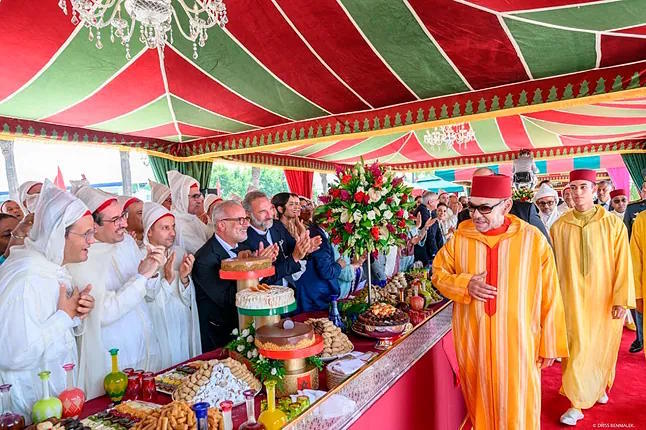
THE 'GLORIOUS' THRONE DAY. Morocco's most important national holiday commemorates the king's ascension to the throne. Mohammed VI presided over a reception in M'diq -Rincón del Medik-, near Tetouan and very close to Ceuta, where the Alaouite sovereign usually spends the first part of summer.
RECEPTION WITH THE FIFA PRESIDENT. After the flag tribute and a 21-gun salute in honor of the king, he received greetings from almost all national authorities, representatives of the diplomatic corps and religious confessions, and foreign guests. One of those who did not go unnoticed at the official reception was the president of FIFA, Gianni Infantino, in the midst of the race towards the 2030 World Cup organized by Spain, Portugal, and Morocco.