What started as two separate wars on two different continents has been dangerously converging in one direction for months. The chain is now fully visible: Iran supplies drones to Russia to attack Ukrainian cities, Russia shares satellite intelligence with Iran for more precise missile attacks on U.S. bases in the Middle East, and Ukraine attacks Iranian ships in the Caspian Sea (it has already done so with two freighters) to cut off that supply line. Starting from two regional conflicts, there is an increasingly high risk of escalation towards a global war.
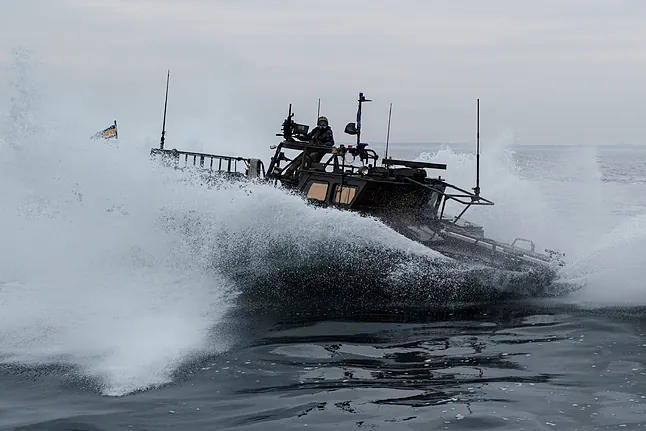
The Caspian Sea has become the point where the wars of Iran and Ukraine have physically collided, but the merger threatens to go far beyond that inland sea. If Iran decides to respond militarily to the Ukrainian attack on its ships, Ukraine would be formally at war with a third actor, something unprecedented since the start of the Russian invasion. Sources close to the Tehran regime claim they have considered responding with a ballistic missile against Ukraine fired in a "symbolic" manner as a response, but diplomatic pressures have so far convinced the ayatollahs not to do so.
If Russia escalates its support to Tehran beyond intelligence sharing - with weapon systems, air cover, naval presence in the Caspian Sea - the conflict would no longer be two parallel wars but would become a war with interconnected fronts. The scenario that most worries analysts is not a deliberate decision to escalate, but a chain of retaliations in which each response leads to the next until no one remembers when the single war actually began.
Why is the Caspian Sea important in this new phase of both conflicts? It is the largest lake in the world and has become since 2022 the great clandestine highway for Russian-Iranian rearmament. Being an inland sea surrounded exclusively by Russia, Iran, Azerbaijan, Kazakhstan, and Turkmenistan, it is completely out of reach of Western naval forces and practically invulnerable to international sanctions. Western analysts describe it as the ideal place for discreet military transfers and evasion of sanctions: dark maritime traffic has surged since the Russian invasion of Ukraine, and both Moscow and Tehran have perfected methods to conceal shipments, routes, and real operators.
Through this route have flowed Iranian components (technology and designs) that feed the Russian Shahed drone factory in Alabuga, as well as around 13,000 tons of explosive material of Iranian origin that reached Russia through its closest entry point to the Caspian Sea. Ukraine already attacked the Russian port of Olya in 2024, accusing it of being a logistical center for that traffic, and Israel struck the Iranian port of Bandar Anzali for the same reason. The recent Ukrainian attack on two Iranian freighters in the Caspian Sea is not, therefore, an improvisation: it is the logical reaction of a deliberate strategy to cut off the supply line that has been feeding the war in Ukraine for years with weapons designed and manufactured in Tehran.
The first venomous episode that linked Ukraine with Iran was tragic and one-sided. Iran mistakenly shot down a Boeing 737 of Ukraine International Airlines in January 2020, killing 176 people. Although Tehran eventually admitted responsibility, the initial Iranian response resembled the Russian one after the downing of Malaysia Airlines MH17 over the Donbas - denial, destruction of evidence - which permanently clouded relations between the two countries. For Ukraine, Iran was already a hostile actor before the Russian invasion.
Putin's regime's brutal attack on its neighbor aligned Tehran with Moscow at levels of wartime allies. In July 2022, the White House confirmed that Iran was about to deliver armed drones to Russia. Starting in October 2022, Moscow used Iranian Shahed-136 drones, one of the most terrifying weapons of war, in an attack on Kyiv in which four civilians, including a six-month pregnant woman, were killed. For Ukraine, Iran became a de facto co-belligerent from that moment: its weapons were killing Ukrainian civilians. Iran provided Russia with cheap and expendable ammunition to saturate Ukrainian defenses instead of risking expensive aircraft. Russia has even set up a factory in Alabuga, 1,000 kilometers from Moscow, to produce over 5,500 Shahed drones per month. The war in Ukraine has thus become the largest testing ground for the Iranian arsenal.
This is one of the lesser-known and most revealing episodes about Zelensky's strategy to gain allies among Iran's traditional enemies. In August 2025, the Ukrainian president brought to a closed meeting at the White House a presentation that included a map of the Middle East and explained how Iran was threatening regional stability. Zelensky was offering Trump intelligence on Iran in exchange for continued support for Ukraine. It was the first step in a deliberate strategic repositioning. But Trump, always inclined to believe Putin, did not pay much attention to the Ukrainian.
In the case of Israel, Kiev has also not managed to obtain much support from Netanyahu's government. Israel is the only Western democratic country that has not supplied weapons to Ukraine. The reason is historical: over a million Israelis have Russian or Soviet passports or roots. Netanyahu has governed for years with the support of that community and cannot ignore his family ties to Russia. At the same time, Ukraine has the largest Jewish community in Europe, and Zelensky himself is Jewish. The war has painfully divided these communities. Additionally, Russia has routinely hosted Hamas delegations in Moscow without Israel raising its voice against the Kremlin.
The reality is that Benjamin Netanyahu has practiced calculated balancing for four years: maintaining a good enough relationship with Russia to operate in areas of Syria previously occupied by the Russians, not irritating Washington enough to lose its support, and not committing enough to Ukraine to close any doors.
But the war against Iran this year has made that balancing act impossible. For the first time, Israel and Ukraine's strategic interests point in the same direction, and that is changing a relationship that for four years was one of the great enigmas of the war. That's why Netanyahu personally called Zelensky to start talks and why he sought his greeting at Senator Lindsey Graham's funeral this week.
In reality, both conflicts are already much more intertwined than it seems. In March 2026, just days after the start of the war between the U.S., Israel, and Iran, Ukraine deployed over 200 specialized military experts in anti-drone defense in Saudi Arabia, Qatar, the United Arab Emirates, Kuwait, and Jordan. It was the confirmation of a historic shift: the country that had been the recipient of Western military aid for four years suddenly became an exporter of security and a partner with experience. "Knowledge is not a drone, it is a comprehensive capability: strategy, system, and training," explained Zelensky, emphasizing that Ukraine not only offered technology but a complete defense model adapted to new threats.
What Ukraine brought to the Gulf was exactly what the countries in the region urgently needed and what the Pentagon acknowledged in a closed meeting before Congress that it did not have: years of combat rejecting massive waves of Shahed drones, the same ones that Iran was now launching against oil facilities and U.S. bases.
"For five years, Ukrainians have been resisting the same type of attacks - ballistic missiles and drones - that the Iranian regime is currently carrying out in the Middle East," said Zelensky in Jeddah, where he signed with Saudi Arabia a 10-year defense cooperation agreement that included technological transfer, unit training, and future supply contracts. The irony is perfect: the drone that Iran designed, which Russia used to destroy Ukrainian cities, and from which Ukraine learned to defend itself, is now the same drone that Ukraine is teaching the Gulf countries to protect themselves against. Ukrainians shot down quite a few of them in the Persian Gulf.
The evidence is solid and comes from multiple independent sources: the Ukrainian intelligence assessment sent to Washington was reviewed by Reuters, leading to these conclusions: Russian satellites conducted at least 24 detailed reconnaissance missions of military installations and critical sites in 11 Middle Eastern countries between March 21 and 31, covering 46 targets.