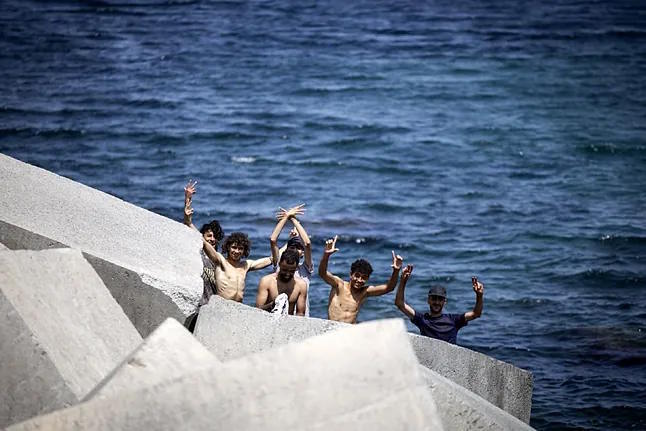
That the mafias made a "self-interested" interpretation of the sentence from the Supreme Court prohibiting immediate pushbacks of those who irregularly enter by swimming. More than 120 hours after a tide of around 60,000 people headed to Ceuta from Morocco, that is the only explanation Moncloa offers for why Spain suffered an "attack," the largest in democracy, on its "territorial integrity," according to Sánchez. Six days after that milestone, what stands out are the silences regarding Rabat, the divisions in the Government in an attempt to evade blame... And the dismissal, revealed yesterday, of an official who told the truth on Friday - the number of arrivals at that time - before it was communicated by the Ministry of the Interior.
"Today's events are related to a sentence," Spanish Foreign Minister José Manuel Albares stated late Thursday, in the Government's first position on why such an avalanche of people tried to cross into Ceuta. Spanish Prime Minister Pedro Sánchez would delve into that thesis the following day, already from the autonomous city, adding the nuance that it was the mafias that had encouraged a call to action exploiting the legal loophole opened by the Supreme Court's ruling. No one in the Government has deviated from that argument in recent days, avoiding explaining what else could have gone wrong, and how: from the information that Spanish intelligence services should have provided to the role that Morocco could have played.
First, Sánchez did so on Friday, focusing on praising the good "dialogue" with Rabat during the crisis to avoid clarifying how it is possible that he did not warn of the influx of people heading to the border. And Albares, yesterday, five days later, stuck to that thesis. Spanish Interior Minister Fernando Grande-Marlaska also did so, only committing to a future "evaluation" with the neighboring country, while the Government Delegate in Ceuta avoided the question. Only yesterday did Robles call on Rabat to "get to the bottom of what happened."
However, by not pointing to Morocco, the Government has been plunged into an internal clash over the other point that everyone is looking at for explanations on how it could have happened: the national intelligence services. Interior cast doubt on them when Marlaska, on Saturday, stated that there was "no report that a situation like that of the 30th could have arisen." And Government spokesperson Elma Saiz reiterated that yesterday: "There was no report warning of the magnitude of the figures that had to be addressed." When asked on TVE if this means Intelligence failed, she avoided the question and only repeated that "the magnitude of this situation was not known."
Defense Minister Margarita Robles, on Monday, during her visit to the Zaragoza Air Base.Ramón ComeEuropa Press
With the spotlight on her, the Defense Minister, whose department oversees the National Intelligence Center (CNI), avoided clarifying yesterday whether this agency warned before 60,000 people crossed the border into Ceuta. She simply defended the work of those dedicated to intelligence tasks, and only lightly clashed with Interior when she recalled that there are "information services" that also depend on that ministry. In any case, without acknowledging that any of them could have failed if they did not actually warn: "They do exceptional work. I won't engage in any argument."
Asked about who is responsible for the "attack" on Spain's "territorial integrity," Minister Robles reiterated the only thesis the Government has endorsed: "Those who organize, through the mafias; those who deceive people; those who tell them they will enter irregularly. They are the ones responsible."
Under this framework, five days after the largest irregular entry into Spain in half a century - precisely since the Moroccan Green March to occupy Western Sahara - the Government avoids explaining what went wrong and how it could have failed, and there are still no responsible parties beyond the "mafias."
During these 120 hours, however, there has been a change in the government: Moncloa has removed an official from the National Security department, reports Efe, who published the data that Interior had on the number of arrivals counted in Ceuta last Friday. She revealed, and then removed, that data hours before the Government made the same figures public, of a magnitude that still lacks an explanation.
Rabat says it warned days before the risk of the Supreme Court ruling
Morocco alerted Spain days before the crisis in Ceuta that the Supreme Court's decision at the beginning of July weakened a crucial element of cooperation, a source from the Moroccan Ministry of Foreign Affairs stated on Monday, adding: migration management is "a shared responsibility."
This source is not affirming that there was a warning of an avalanche like the one experienced, but of the risk that existed after the Supreme Court ruling, as it banned 'hot returns' of those who arrive by swimming. "Morocco assumes its responsibilities (...). It is a commitment, not a speech. (...) Morocco does not act under pressure or blackmail," the source said in a meeting with international agencies, in response to Von der Leyen's mention of Rabat's "pressure" on Spain.