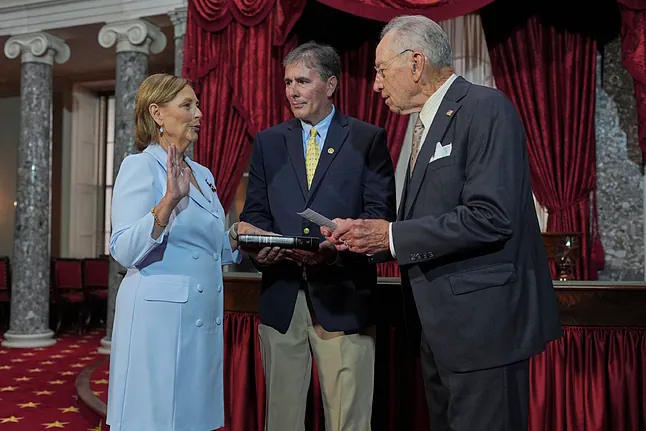
Occupation? United States Senator. Political experience? None. Ideology and program? Uncertain. Loyalty to the president? Unwavering. Passage through the polls? Unnecessary. The death in July of Lindsey Graham, the last great hawk of the 20th century, deprived the Republicans of one of their most powerful figures in the Senate, left Ukraine without its great advocate in Washington, and Donald Trump without a loyal ally. But above all, it reopened one of the most unique debates in American politics, the one that affects the replacement of a member of Congress who dies or resigns from office.
The United States elects its representatives directly. Most run in primaries within their parties and then all candidates go to the general polls in single-member constituencies. In districts for the House of Representatives and two per state for the Senate. But when it comes to replacing them, each house does it in a different way and with different rules. And quite peculiar ones.
In this case, the Governor of South Carolina, Henry McMaster, chose andappointed the deceased's sister, Darline Graham Nordone, to temporarily occupy the seat until the corresponding election is held. Not someone from the party, not a prominent figure or with political experience. On the contrary, a total unknown designated solely and exclusively by her last name.
The decision came after Donald Trump publicly suggested that option, without giving many explanations. Although the person in question has no political background or even her ideas are known. The bet, somewhat controversial but by no means unprecedented, has now escalated, as Trump, very interested in having the sister also run in the upcoming elections, has convinced her to try to win the seat.
The rules even allow her to use the money already raised by the deceased in the past, a significant advantage to face the rivals who will challenge her in new primaries, to be held between August 11 and 25. "I'll be honest. I wasn't sure I could make it here. I'll be brief because it's been a very difficult week," said the new senator, 62, at a prayer breakfast in her state. "I will work with all my might to continue his legacy, help the people of South Carolina, and serve this country."
After a lifetime working in the field of public services for visually impaired individuals, in her early days as a politician, Graham supported the SAVE America ACT, Trump's obsession with electoral reform, and supported immigration control measures, bills against abortion and in favor of the right to bear arms, as well as the law on sanctions against Russia, one of her brother's main causes. From zero to 100 in five days.
Direct appointments are the norm. But 'special elections,' which occur in the lower house, are also common in the country. In the 118th Congress (2023-2024), there were 11 to fill vacancies. And in the 119th, which began in January 2025 and will end with the expected midterm elections in less than 100 days, there have already been half a dozen, with as many more called. Due to deaths, forced resignations, or job changes for those who moved to the administration. Nearly 100 cases have been recorded in the last decade.
There is another even more striking variant that occurs when a candidate in the elections dies during the campaign, but before the vote. In all cases where it is too late to remove their name from the ballot (deadlines vary by state), their candidacy remains. And if the deceased candidate receives enough votes to have won the election had they not died, a vacancy is declared and filled as established by law. In other words: the second-place candidate is never automatically declared the winner.
One of the most well-known cases, studied in all political science faculties, is that of the Democrat Mel Carnahan, governor of Missouri who was running for the Senate and died in a plane crash weeks before the elections. According to the state's electoral law, it was too late to present substitutes. He won because his voters chose a deceased candidate rather than allowing the opposition to win, knowing that the acting governor, his second, would appoint the widow, Jean Carnahan, to fill the vacancy.
It happened exactly as described, and Mrs. Carnahan, with just one announcement, one interview, and one campaign event, became a senator, the first woman in Missouri's history, defeating the famous John Ashcroft, who would soon be appointed attorney general by George W. Bush. She remained in office for two full years, to "complete her husband's legacy," without much surprise in Washington. She even wanted to continue until completing the six-year term, but lost by just 22,000 votes when the special election was finally held, with a significant delay. Her two sons, by the way, followed in her political footsteps, holding state positions and even reaching the Capitol.
Another recent case involves the other deceased senator in office, Dianne Feinstein of California, who died on September 29, 2023. The Governor of California, Gavin Newsom, who is the only Democrat clearly interested in running for president in 2028, appointed Laphonza Butler to fill the seat temporarily until the election was held to decide who would complete the rest of the term (ending in January 2025). Butler, president of EMILYs List (an organization that supports Democratic candidates in favor of abortion rights), thus became the third black woman in history to serve in the U.S. Senate, but did not run in the special election in November 2024 to retain the position permanently.
But undoubtedly, the most important historical example of this practice, known for much of the 20th century as widow's succession, is that of Margaret Chase Smith, who, like the previous cases, entered politics in 1940 after her husband's death, Congressman Republican Clyde H. Smith. She managed to win the elections, repeat several times, and eight years later took a step further by becoming the first woman elected to the Senate in her own right, where she remained until 1973. Far from just preserving her husband's legacy, Chase Smith built an independent political career and eventually became one of the most respected voices in the Republican Party.
It was she who in 1950 delivered the historic Declaration of Conscience, a speech denouncing the excesses of McCarthyism and openly challenging Senator Joseph McCarthy when very few in Washington dared to do so. Years later, in 1964, she also became the first woman whose name was formally put forward for the Republican presidential nomination at a national convention, although Barry Goldwater ultimately chose a man. Showing that sometimes what matters is not how you get there, but what you do.