Hours before tanks took to the streets of Yangon and the generals buried the fragile democratic spring of Burma, the then de facto leader Aung San Suu Kyi made a final call to her son. She did not openly speak of a coup, but hinted that dark times were approaching. Kim Aris, a 49-year-old carpenter, understood everything shortly after. That conversation, on January 31, 2021, was the last time he heard his mother's voice.
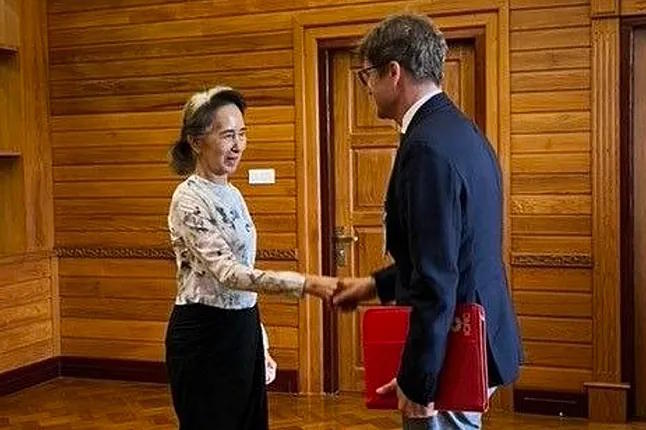
For over five years, the Nobel Peace Prize laureate has been missing behind the walls of the military regime. Her family has not been able to speak with her, no one has been able to independently verify her health status, and the few images disseminated by the coup junta have always been met with great skepticism. Therefore, the news that the former Burmese leader, 81 years old, received a visit from a representative of the International Committee of the Red Cross (ICRC) on Monday has been interpreted as the first truly hopeful sign of life in a long time.
Kim Aris, who resides in London and is currently traveling in Southeast Asia, receives the news with a mix of relief and caution. It has been him who, in recent months, has spearheaded the Proof of Life campaign. "My biggest concern has always been to know if my mother was still alive", he explains in an interview with EL MUNDO.
"The last time we spoke was just a few hours before the military coup. Since then, my family has had no direct contact with her or received any information about her health that could be independently verified."
For Aris, the Red Cross visit represents much more than a mere diplomatic gesture. "This is the first positive humanitarian step in over five years." But Suu Kyi's son insists that a photograph or a single meeting is not enough to dispel years of uncertainty.
"This should be the beginning, not the end. I hope it leads to greater humanitarian access, direct contact with my mother, credible and independently verified information about her condition, and ultimately, to her immediate and unconditional release, along with that of all political prisoners."
Aris avoids presenting his demand as a political battle. He prefers to speak of a deeply human issue. "It has never been a political demand. It is a humanitarian request. Every child should be able to know how their mother is doing. Every mother should have the right to communicate with her family."
Since the coup on February 1, 2021, the Burmese Army has made secrecy one of its main weapons. The current government, led by General Min Aung Hlaing, overthrew Suu Kyi's democratically elected government - where she served as State Counselor - alleging an unproven electoral fraud.
Shortly after, a cascade of closed-door trials began, ending with Suu Kyi being sentenced to 27 years in prison for a long list of crimes ranging from corruption to alleged violations of pandemic-related health restrictions. International organizations, Western governments, and legal experts consider those trials a farce aimed solely at permanently removing her from political life.
During these years, the military authorities have never allowed independent visits or any contact with her family. The Nobel laureate's son believes that now international pressure is finally starting to yield some results. "For years, the military authorities did not respond to our requests for a credible proof of life. What has encouraged me is the growing support from governments, parliamentarians, humanitarian organizations, and citizens worldwide who have understood that this is, above all, a humanitarian issue."
Therefore, he calls for countries like Spain and other EU allies to increase pressure on the Burmese military junta. "A single humanitarian visit is not enough. We must achieve regular access, direct contact with my mother, verifiable information about her health, and her immediate release. The international community must not allow secrecy to become the norm. Human rights do not disappear because someone is hidden from the world."
While Suu Kyi remains isolated, Burma is bleeding. More than five years after the coup, the country is engulfed in a civil war pitting the Army against ethnic militias and pro-democracy militias that emerged after the coup. The fighting, aerial bombardments, and repression have resulted in tens of thousands of deaths and millions of displaced people, while the economy has collapsed and poverty spreads throughout the country.
"The Burmese people continue to pay an unbearable price," laments Aris. "Millions of people have been displaced, entire communities have been devastated by the conflict, political prisoners remain incarcerated, and humanitarian needs continue to grow."
He describes a country where young people no longer see a future, thousands flee abroad to escape forced recruitment, and children in rural areas grow up without schools because many have been destroyed or closed due to the war. He also warns of the expansion of transnational crime. "Scam centers, human trafficking, internet fraud, and drug trafficking are no longer just a crisis for Burma; they have become a problem for the entire region."
Despite everything, he has not lost hope. "But hope must be accompanied by actions. A lasting future cannot be built through violence or fear. It must be built on respect for the will of the people, accountability, human rights, and the rule of law."
He also knows that his mother's figure will continue to be debated due to her controversial defense of the Army against international accusations of persecuting the Rohingya minority. However, he believes that history's judgment should not overshadow the current situation.
"History should remember my mother in all her dimensions, not just through the prism of a specific moment. She dedicated her life to the people of Burma and sacrificed decades of her personal freedom for democracy. Before history judges her legacy, the world has a responsibility to ensure she receives humane treatment, can communicate with her family again, and regains her freedom."
After over five years without hearing the voice that warned him of the approaching storm, Kim Aris now clings to a single hope: that the visit of the International Committee of the Red Cross marks the beginning of the end of one of the biggest information black holes in Southeast Asia, and that the woman who symbolized the fight for democracy in Burma for decades will finally cease to be an invisible prisoner.