Mountains of cash, jewelry, silver bars, and offerings that millions of believers deposited with the conviction that they were honoring their god. All of this accumulated daily in the temple of Ram Mandir, transformed into the great political and religious symbol of the new India of Narendra Modi. But the sanctuary that Hindu nationalism presented as the rectification of a historical injustice is now engulfed in a scandal of misappropriation of donations.
A police investigation, several arrests, and growing suspicions of cover-up by the authorities threaten to erode one of Modi's Government's most emblematic projects.
The allegations began when Mahipal Singh, former head of temple accounting, publicly stated that systematic irregularities had occurred in the management of donations. According to his account, he was removed from his position after warning the trustees about them and now receives daily death threats. His statements triggered a national political storm.
The temple is located in Ayodhya, in the northern state of Uttar Pradesh, where the Police have initiated a criminal case, arrested a dozen people linked to the donation counting, and recovered significant amounts of allegedly diverted money. The investigation has also expanded to bank employees responsible for depositing donations after serious control protocol failures were detected.
The temple receives up to 100,000 devotees per day. The scandal is particularly uncomfortable for Modi's Government because this place has never been solely a religious project. From the beginning, it was the major political project of contemporary Hindu nationalism.
To understand the scope of the case, one must go back to December 6, 1992. On that day, tens of thousands of Hindu radicals demolished the Babri mosque, built in the 16th century by the Mughal emperor Babur. The protesters claimed that the mosque had been built on the exact spot where Ram, one of the most revered deities of Hinduism, was born.
The demolition triggered some of the most violent religious riots in modern India: around 2,000 people died, mostly Muslims, in clashes that spread across the country for weeks.
That image of the mosque reduced to rubble changed India's political history. The Bharatiya Janata Party (BJP), Modi's party, still far from power at the time, made Ayodhya the flagship of Hindu nationalism. For three decades, it kept alive the promise to build a grand temple dedicated to Ram there.
The decisive moment came in 2019 when the Supreme Court definitively resolved the dispute over the land ownership and granted the plot to Hindu groups, while also ordering the delivery of a different plot to build a new mosque. The ruling unlocked the project that Modi had been presenting for years as a matter of national identity.
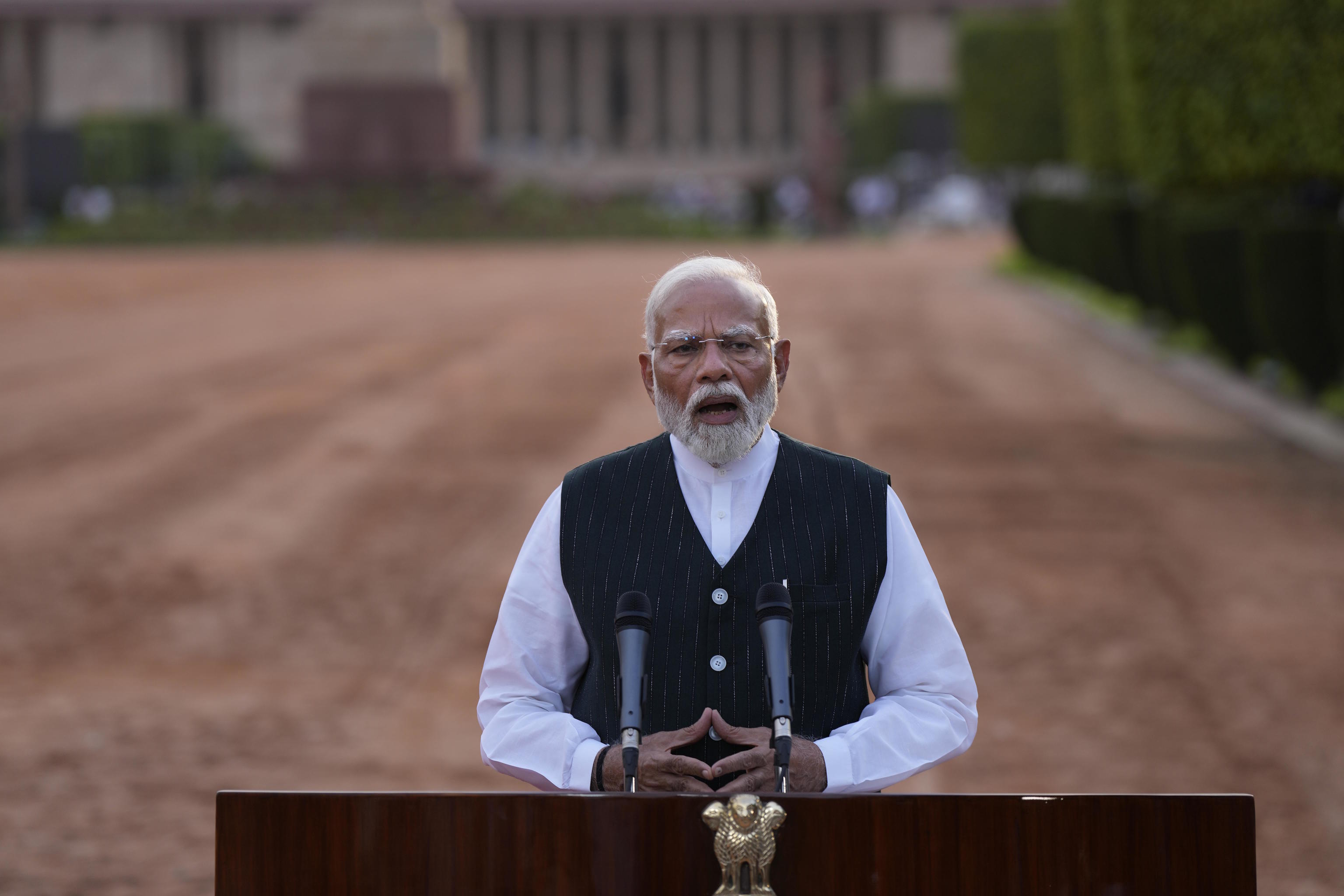
Five years later, the Prime Minister personally presided over the consecration ceremony of the new temple. The image was carefully crafted: Modi appeared dressed in traditional attire, performing religious rituals before millions of viewers as the country witnessed the inauguration of the most important sanctuary built in India in decades. Millions of devotees traveled to the site to be present.
The complex is impressive in size. It covers about 283,000 square meters, combining pink sandstone and black granite. Around it, towers nearly 50 meters high were erected, forming the centerpiece of a massive urban transformation of the city of Ayodhya. This led to the construction of new highways, an international airport, luxury hotels, railway stations, and major infrastructures financed with significant public investment.
Erecting the main building cost around 183 million euros, and its management was entrusted to the Ram Janmabhoomi Teerth Kshetra foundation, now tainted by the scandal, created by the current Indian Government and closely linked to the Rashtriya Swayamsevak Sangh (RSS), an ultranationalist Hindu organization from which Modi originates.
Local media have published images from the police report showing foundation members responsible for the count hiding bundles of donation money in their pockets and shoes.
BJP leaders even dubbed the complex as the "Hindu Vatican" because it symbolizes the desire to turn Ayodhya into the great spiritual heart of a new India defined by the Hindu majority. This is precisely where the main criticism of Modi's detractors lies.
Since coming to power, human rights organizations, jurists, and numerous intellectuals have denounced a growing marginalization of religious minorities, especially Muslims, numbering around 200 million people.
This is compounded by widely questioned citizenship laws, campaigns against religious conversions, home demolitions, and an increase in the rhetoric of ultranationalist groups that, in some cases, have even publicly called for the extermination of the Muslim community.
The Government maintains that it only protects Hindu cultural heritage and applies the law equally to all citizens. For the Congress Party, the main opposition party, Ayodhya has become the most visible symbol of a much deeper transformation: the transition from the secular India designed after independence to a model where Hindu identity occupies an increasingly central place in the official discourse.
Now, that same symbol is tainted by a corruption scandal that directly hits the narrative built over decades. The temple that was supposed to represent the moral purity associated with Ram is facing uncomfortable questions about millions of dollars in missing donations precisely from where millions of believers deposited their faith... and also their savings.