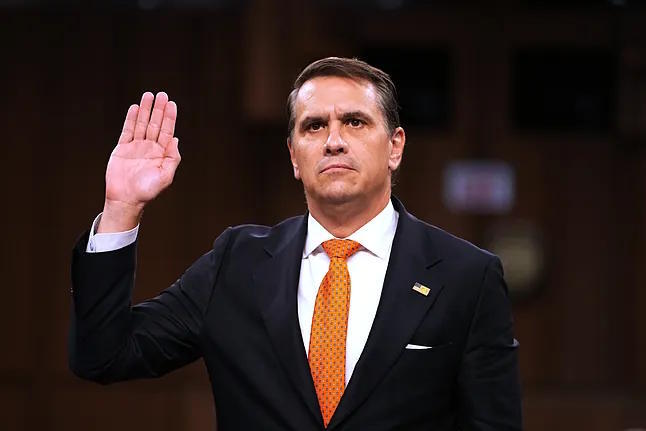
The Senate Judiciary Committee cleared the way on Tuesday for Todd Blanche, the current interim Attorney General of the United States, to be definitively confirmed in the position. Members voted in favor, with 12 votes to 10, practically ensuring no obstacles in the full Senate.
Blanche's confirmation process, who had been the number two at the Department of Justice since January 2025 and was promoted following the dismissal of his boss, Pam Bondi, has become a new internal showdown within the Republican Party, a battle of attrition between the White House and several conservative senators who decided to use the nomination as leverage to stop one of the most extravagant and scandalous proposals of Donald Trump since his return to power. But the case also symbolizes all the deficiencies of the system, the weakness of a party unable to truly confront its leader and having to settle for small gestures, as well as an opposition that barely achieves anything outside the courts.
Blanche, a lawyer with a long career and closely linked to the president, whom he represented in his criminal cases, was never a comfortable candidate for part of the Republican Senate. His proximity and loyalty to Trump, his role in defending some of the most sensitive cases that the president denounces as political persecutions, and above all, the perception that he is willing to push the Department of Justice even where his predecessor did not dare, made his confirmation, just a few months before the elections, critical.
The conflict focused in recent weeks on one of the White House's most provocative decisions, the launch driven by Blanche himself of a $1.8 billion compensation fund to indemnify those the Administration considers victims of so-called "political trials," a category that would include numerous allies and collaborators of Donald Trump, prosecuted or investigated in recent years, including those who stormed the Capitol. The fund was halted by the courts and, in the end, the Administration seemed to give it up, but only temporarily.
The proposal, met with disbelief even among the usually disciplined Republicans, became something akin to a red line for some senators, disgusted with the possibility of using public money for such purposes. For weeks, Blanche's nomination was blocked in that confrontation. The White House needed to close the promotion of the head of the Department of Justice as soon as possible, while the senators took advantage of having an instrument of pressure in their hands that they can rarely use without severe repercussions. The message from the skeptics was apparently clear: without guarantees about the abandonment of the compensation fund, there would not be enough votes to ensure a smooth confirmation.
And so it was. More or less. The main players in this challenge were mainly Senators John Cornyn and Thom Tillis. Both avoided publicly breaking with the president, and even criticizing him, but made it clear that Blanche would not have their support (essential, as conservatives have a very narrow majority in the Senate, exacerbated by the fact that one of the most senior members is in the hospital and unable to vote). The negotiation was intense and lasted until the final hours of the weekend. In the end, Cornyn and Tillis confirmed that they would vote in favor of the nomination after the future Attorney General committed in writing to renounce the controversial $1.8 billion fund. A reason for celebration for them, but of enormous concern for the opposition, as not only is that issue unresolved, but another equally important one remains: a possible tax amnesty for Trump and his family.
"From the beginning, Senator Cornyn and I were clear that we needed a written document addressing our concerns about the IRS audit agreement and the Fund against Instrumentalization, which included limiting the scope of audit protection to the Settlement Agreement parties and legally ending the fund. We are pleased that the Department of Justice has issued a formal order ending it. Additionally, the Department has acknowledged in a binding written order that the audit agreement is limited to the plaintiffs and that its scope does not extend beyond the defendants in the lawsuit, the IRS, and the Treasury, addressing concerns shared by several of our Republican colleagues," Tillis celebrated.
Their rivals completely disagree, pointing out that a document signed by Blanche is of little use, as the one making the decisions is Trump. And because the agreement does not suspend the audit that Tillis refers to, and which they consider essential. The $1.8 billion fund was presented by the Department of Justice as an agreement with Trump and his family. The president had sued the Internal Revenue Service (IRS) for leaking his tax returns years ago (a case closed criminally with the culprit now serving jail time) and was demanding a fortune. Justice reached an agreement for Trump to withdraw the lawsuit and waive compensation for himself, but in exchange for two things. Those $1.8 billion to compensate his allies and the promise that the IRS would permanently close investigations into his finances, which, according to some estimates, could cost him up to $100 million for irregularities.
"To be clear: Senate Republicans are caving in on an agreement that grants Donald Trump and his family immunity from potential tax audits worth up to $100 million," denounced Democrat Elizabeth Warren. "Todd Blanche knows that this document is unenforceable and not even worth the paper it's printed on. It means nothing! Trump didn't even sign it and is not bound by it," Senator Cory Booker agreed. "Unbelievable. Senate Republicans are about to confirm Todd Blanche, Trump's former personal lawyer, as Attorney General, even after he told them that the Department of Justice's signed agreement granting Trump and his companies broad immunity for crimes is still in place. Trump faces an IRS audit that could cost him up to $100 million. Republican senators are making sure he gets away with it without paying," added Congressman James E. Clyburn.
The paradox is evident, and in Washington, no one ignores it. Blanche can promise not to push that compensation mechanism from the Department of Justice, but the real decision does not depend solely on him. The fund is a political initiative of the White House, directly linked to Donald Trump, and any effective renunciation would require the president to abandon a proposal he has publicly defended. "I see that fund as something positive, and many Republicans do too (...) I didn't review it, I don't know what they agreed on," Trump said on Monday about the negotiation between his senators and his Attorney General nominee.
Trump does not tolerate disloyalty, understood as absolute obedience to his orders, nor does he digest defeats. He dismissed Pam Bondi shouting to the rooftops that she was not being forceful enough against his political enemies and for her handling of the Epstein case. Additionally, several media outlets have reported that he was even considering dismissing the Washington prosecutor, a former Fox presenter appointed a few months ago to cover a delicate vacancy, after Jeanine Pirro agreed to drop charges against a former Olympic athlete whom Trump and his associates wanted to send to prison for allegedly sabotaging the pond in front of the Lincoln Memorial. Pirro presented a case but had to admit she had no evidence, something the president has publicly mocked.
"The Department of Justice has thrived under Blanche's leadership," said Chuck Gassley today, 92 years old with nearly 50 years of legacy in the Upper Chamber, the most veteran politician, the one with the least to fear, and still loyal to the president. Very different is the opinion of Dani Bensky, one of Epstein's victims, who recently met with Blanche and believes his confirmation will have "a huge deterrent effect on sexual abuse survivors across the United States."