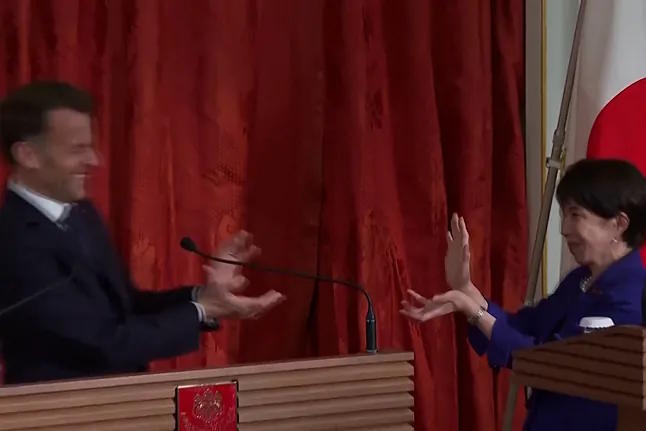
Sanae Takaichi raised her hands, joined her palms, and performed an imaginary Kamehameha in front of the cameras. In front of her, French President Emmanuel Macron responded with a knowing smile. The gesture, carried out in front of the cameras last April in Tokyo, was enough to overshadow discussions on the Middle East, Ukraine, and Indo-Pacific security.
Japan, a country where diplomacy has always been associated with restraint, solemnity, and rigid protocol, had just presented the world with an image unsuitable for a summit between two major powers. Japanese media quickly dubbed that episode as "Dragon Ball diplomacy."
That scene was not improvised. Macron had confessed his passion for Akira Toriyama's manga, and Takaichi knew perfectly well the impact that gesture would have. In a country where the concept of omotenashi - Japanese hospitality understood as an art of anticipating the guest's desires - is part of the national identity, the prime minister has decided to reinterpret that tradition and apply it to the realm of high international politics.
Instead of sticking to official banquets, measured speeches, and handshakes, she chooses to surprise her counterparts with personal gestures, cultural references, and jokes.
Takaichi, the first woman to hold the Japanese government's leadership, has made her way of interacting with other leaders one of the hallmarks of her tenure. Where her predecessors appeared almost stoic, she smiles, touches, hugs, sings, and turns summits into stages where she seeks to establish an emotional connection even before delving into the content of the negotiations.
The episode with Macron is just one more example of a long collection of striking scenes. In January, she surprised Italian Prime Minister Giorgia Meloni by singing "Happy Birthday" in Italian and giving her a box of Sanrio products for her daughter. To Singapore's Prime Minister, Lawrence Wong, a guitar enthusiast, she played a snippet of Eric Clapton's Layla while presenting him with a gift. Canadian Mark Carney received a hockey stick due to his past as a university player. British Keir Starmer found among the official gifts several items intended for his cats.
Takaichi, who played the drums in a band when she was young, organized an impromptu musical session with South Korean President Lee Jae-myung, performing BTS's hit Dynamite and other popular K-pop songs. The image contrasted with decades of relations marked by the open wounds of Japan's occupation of the Korean Peninsula. Instead of solemn speeches on historical reconciliation, the photo that went around the world showed two leaders sharing a relaxed moment to the rhythm of a song.
The strategy responds to a simple logic: if international politics is also built on personal relationships, creating complicity can later facilitate difficult conversations. Gifts, cultural references, or private jokes aim to break the ice before addressing much less pleasant issues such as China's military pressure on Taiwan or trade tensions with the United States.
However, that same spontaneity that many foreign governments receive warmly also triggers deep rejection in many sectors within Japan. Local media abound with columns and editorials that consider the prime minister has crossed a delicate line between closeness and theatricality.
In a country where leaders rarely show their emotions in public, seeing her sing popular songs or address other leaders by their first names produces a feeling that many Japanese describe with a word widely used on social media: hazukashii (embarrassing).
For some Japanese analysts, Takaichi is modernizing the image of an excessively rigid Japan and projecting soft power through references to manga, music, or popular culture. For others, however, the prime minister is confusing diplomacy with a constant search for personal sympathy, turning strategic meetings into a succession of gestures designed to generate headlines and viral photographs rather than strengthening the country's institutional authority.
The scene that sparked the most criticism was during her visit to the White House in March. When she saw U.S. President Donald Trump waiting for her at the entrance, Takaichi quickened her pace and, instead of the traditional handshake, went in for a hug.
Throughout the meeting, she repeatedly addressed him as "Donald" and concluded the meeting with a statement that immediately resonated in the Japanese press: "I firmly believe that only you can bring peace and prosperity to the world." Critics interpreted this declaration as an unnecessary display of subordination towards the country's main ally.
In an interview with the Japanese newspaper Asahi, Professor Ki-young Shin, a specialist in politics and gender at Ochanomizu University, interprets Takaichi's attitude as a reflection of decades of political survival within the conservative Liberal Democratic Party, dominated almost exclusively by men. "The leader would have learned that closeness, praise, and sympathy could become effective tools to make her way in a deeply male-dominated structure. The problem arises when those tactics, useful in domestic politics, are transferred to the international representation of the State," explained the expert.
Takaichi's trip to India in early July once again demonstrated that she does not intend to change course. During the summit held in New Delhi, Indian Prime Minister Narendra Modi affectionately introduced her as his "younger sister," a phrase loaded with symbolism within Indian political culture. The meeting served to strengthen cooperation in artificial intelligence, clean energy, economic security, and defense against China's growing influence in the Indo-Pacific. However, once again, the strategic content was partially overshadowed by the personal dimension of the relationship between the two leaders.
An image worth a thousand press releases
Perhaps therein lies the great mystery of the so-called "Dragon Ball diplomacy." In a world where political leaders also compete to dominate social media and turn every summit into a viral event, Takaichi has understood that an image can travel the planet much faster than a joint statement of dozens of pages.
This July, Takaichi made headlines again, but for a very different reason. The prime minister revealed in a social media post that since taking office, she barely sleeps between zero and three hours a day and celebrated having managed to rest "five hours straight for the first time in a long time."
She explained that her nights slip away between reading official documents, preparing for parliamentary sessions, and the household chores she claims to still personally perform, from doing laundry to ironing handkerchiefs.
What was intended as a lighthearted confession about the demands of the position ended up causing a wave of concern in Japan and reopened the debate on the culture of overwork in politics and the risks it poses for those in government leadership.