Last November, Zohran Mamdani, a young socialist of Ugandan origin, with little political experience, a lot of charisma, and a great command of new narratives, became the mayor of New York. His overwhelming victory, after a brutal xenophobic campaign by Republicans and the MAGA world, was the first sign of a small leftist wave that has since led candidates considered too radical until recently to win more primaries and almost guarantee a few seats in Congress in the upcoming November elections.
But Mamdani's case was much deeper than a municipal or anecdotal issue in New York, a city with its own rules. It was, and is, the perfect example of the fierce battle for the soul of the Democratic Party.
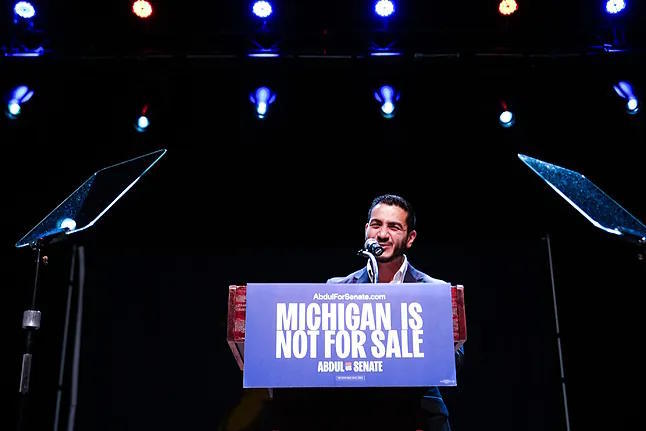
On one side, the unapologetic leftists, partly redistributive, partly identity-based. On the other, the moderates, the centrists, those who reject the right, Trumpism, and policies that they say only benefit the rich and tech gurus. But who flee from words like socialism as if from the plague and constantly feel the need to steer clear of extremes, maintaining that the old mantra that the voter, the true American, is in the middle. The latest battle for that soul took place on Monday night in Michigan, and it has leaned towards the former when Dr. Abdul El-Sayed, from the more progressive (but not socialist) wing and very open in his criticisms of Israel, narrowly defeated the moderate Haley Stevens.
"Great news for the Republican Party. El-Sayed, a losing communist who hates Jews and Israel, is the favorite to win his contest against the socialist. As always, the polls were completely wrong. Such a good result was not expected. Now, the Democrats' crazy policies will only get worse!" reacted Donald Trump immediately on Wednesday upon learning the primary results.
El Sayed, who aspires to become the first Muslim senator in the country, will compete in the fall against Republican congressman Mike Rogers, a contest that could be decisive for control of the Senate. Polls suggest that Democrats will regain the House of Representatives (which is entirely renewed) in November, in the so-called midterm elections. But there are serious doubts about the Senate, where only a third of all legislators (with six-year terms) face the polls.
Michigan has been a swing state for years, one of those where it is not clear which way it will go. In 2020, Joe Biden won, but in 2024, Donald Trump prevailed by just over 92,000 votes. Partly because the more left-leaning electorate, and the significant Arab and Muslim community in the state, refused to vote for Kamala Harris as retaliation for the White House's stance towards Israel, especially in the Gaza war.
Israel has also been one of the protagonists in the Democratic primaries campaign. The country is changing, and support for Israel is at a low, while for the first time some polls put support for Palestinians above. Especially among younger voters. Stevens, for example, received over 60 million dollars in funding from out-of-state actors, including over 30 million from the American Israel Public Affairs Committee (AIPAC), one of the main pro-Israeli lobbies in the US, according to The New York Times.
El-Sayed, replicating things that worked for Mamdani (videos in the gym or relaxed at a party), managed to channel the discontent of the Arab and Muslim community in the state, but also that of the younger population, skeptical of his rival's support for Israel. El Sayed focused on issues such as public health (his field), housing prices, cost of living, economic inequality, and the fight against "the power of money" in politics, but the national debate undoubtedly revolved around the issue of Israel and Gaza.
The most progressive wing of the Democratic Party argues that the strength right now is within their ranks. That's where the energy is, the most aggressive opposition to Trumpism. And they argue that their rhetoric, populist at times, has many more chances to mobilize voters across the political spectrum dissatisfied with the status quo and the "system." However, as with Mamdani, Democratic leaders had rallied around Stevens, a centrist and staunch supporter of Israel, fearing that El-Sayed's positions, a former public health official, would scare off moderates and jeopardize the chance of retaining a crucial seat.
Party's classic strategists are nervous. El-Sayed's victory, as well as that of another socialist candidate for a state position, in line with other similar victories across the country, question the widely held idea that to regain swing states, one must moderate the discourse, focus on Trump, and also avoid criticism of Israel. What has been seen in the last nine months shows that, at least in some primaries, there is a considerable political space for candidates with much more defined profiles. What remains to be seen is whether that will be enough in the November elections.