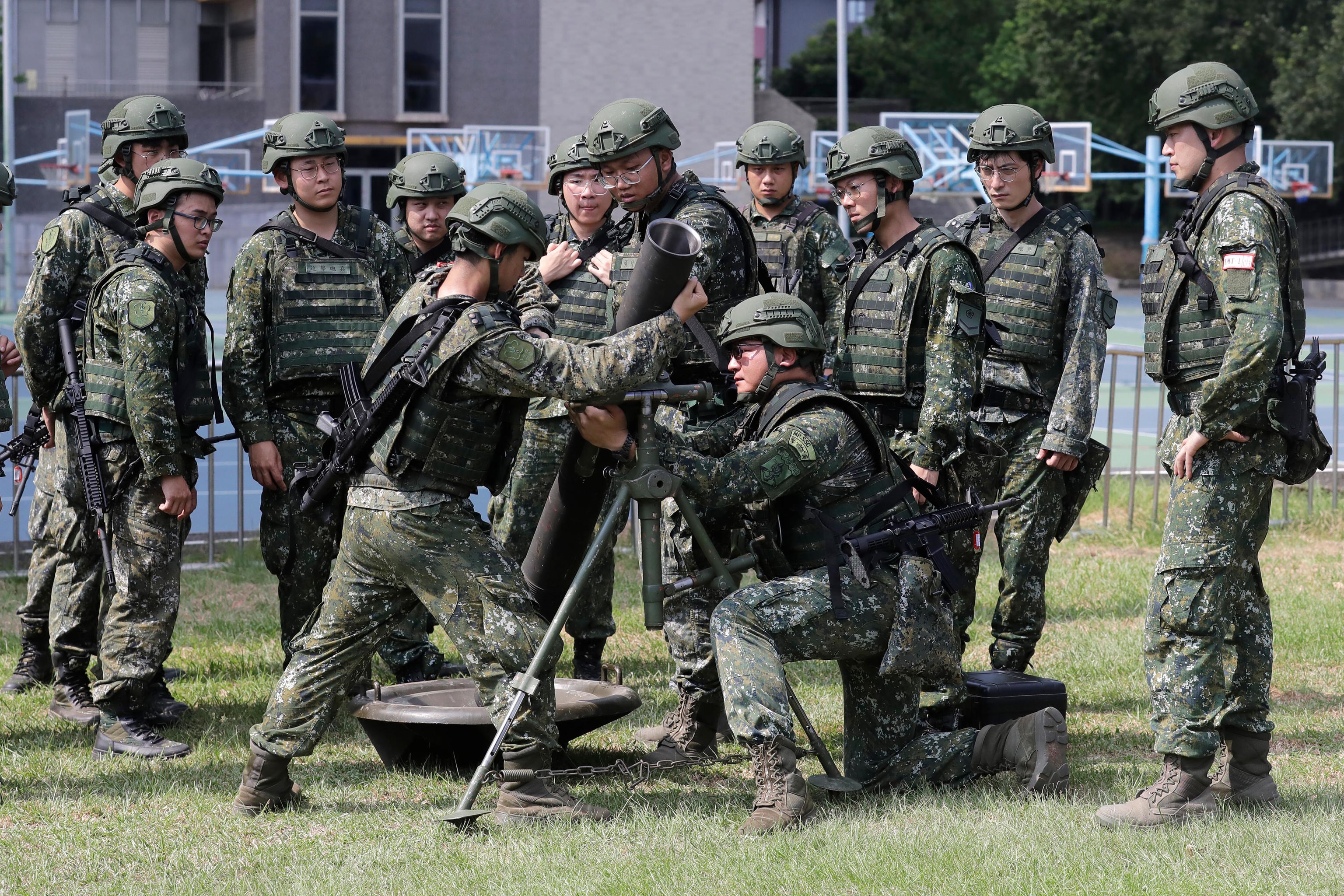
The first lights of dawn barely illuminated the beaches on the western coast of Taiwan as the marines began to deploy among dikes, jetties, and coastal roads. A few kilometers away, amphibious vehicles advanced towards the sand while drone operators searched for positions to monitor the horizon. On paper, the enemy was still 130 kilometers away, on the other side of the strait. But for the Taiwanese soldiers, the battle had already begun.
The debut this week of the new Littoral Operations Command in the Han Kuang maneuvers, the island's largest annual military exercises, represents the implementation of the most important piece of the so-called "porcupine" strategy, the doctrine -popularized in the Ukraine war- with which Taipei aims to convince Beijing that an invasion would be so costly that it may never be worth attempting.
The activation of the new command also coincides with an escalation of Chinese military pressure. Before the start of the maneuvers, the People's Liberation Army (PLA) deployed 21 fighter jets and nine warships around the island. Beijing refers to this movement as the "combat readiness patrol," the twentieth of its kind this year. In recent months, Chinese military have almost made these operations routine, alternating large encirclement exercises with air and naval incursions aimed at psychologically wearing down Taiwan and getting its armed forces accustomed to constant pressure.
In Taipei, they are aware that they cannot compete with China's massive military power. That was accepted long ago. The goal of their military maneuvers is not to defeat the army of the Asian superpower in a conventional confrontation, but to turn any invasion attempt into a logistical nightmare. Like a porcupine facing a much larger predator.
This animal has become the best metaphor for Taiwan's new defensive doctrine. The porcupine never wins by brute force. It survives because attacking it is too painful. That same logic now permeates the entire military planning of the island, further reinforced after studying in detail the lessons learned from the Ukrainian resistance against Russia.
Objective: prevent Chinese troops from landing
At the center of this strategy is the newly created Littoral Operations Command, designed to prevent, in a hypothetical invasion, the first Chinese troops from ever reaching the shore. While the Navy tries to stop the invasion fleet at sea and the Air Force fights to keep the airspace open, the units of the new command are deployed along the main beaches, ports, and coastal infrastructure to turn the coastline into a huge trap.
The plan is that if the initial Chinese assaults manage to land, it will be these marines who must launch rapid counterattacks before they can introduce tanks and heavy artillery. They also maintain a permanent presence on the most exposed islands in the strait (Kinmen, Matsu, and Penghu), forward positions located just a few kilometers from the Chinese mainland coast.
For decades, Taiwanese marines were trained for large conventional battles. Now they train to fight in extremely mobile small groups, capable of constantly changing position, hiding among mountainous areas, and attacking through ambushes.
Their arsenal also reflects this transformation. The old American amphibious vehicles AAV-7 still transport troops, but the weight of defense increasingly relies on anti-ship missiles hidden in shelters, naval mines, portable anti-tank weapons, light mortars, short-range anti-aircraft systems, and above all, swarms of reconnaissance and attack drones.
The goal is not to destroy the entire Chinese fleet. It is enough to turn each potential landing beach into such a dangerous place that the operation becomes unfeasible. And this is the approach that runs through the 10 days of maneuvers this August.
In this edition, about 20,000 reservists will be mobilized. The Ministry of Defense of Taiwan has reported that the exercises also include simulations to break a hypothetical Chinese naval blockade, the transfer of strategic arsenals, the mobilization of civilian industries, the protection of critical infrastructure, and, for the first time, the deliberate slowing down of the mobile network in certain areas to see how both the army and the population would respond if the PLA attacked the submarine cables connecting the island to the outside world.
The experience of Ukraine constantly appears in these maneuvers. Taiwan has incorporated the massive use of cheap drones to make the opponent spend expensive precision missiles. New command procedures inspired by the American model have also been introduced. Faced with the possibility that a Chinese attack could disable communication centers, junior officers receive instructions that they must immediately repeat to their superiors to confirm that the mission has been correctly understood. The philosophy is to decentralize decisions and allow units to continue fighting even if senior commands are isolated.
Defense Minister Wellington Koo clearly summarized the objective of the maneuvers: to ensure that a large-scale invasion "fails." He does not speak of defeating China. He speaks of preventing it from achieving its objectives. This nuance is crucial.
Taiwan's survival has traditionally relied on the possibility of US military intervention. However, recent statements by President Donald Trump, stating that he was not willing to travel "9,500 miles to fight a war," have reinforced an idea within the island that had already been gaining strength: if the worst-case scenario comes, Taiwan will have to be able to resist on its own for as long as possible.